01. Historical Context
Why the current setup can still support more upside
The bull case for Novartis starts from strength, not distress. At CHF 118.04 on May 15, 2026, the stock was below its 52-week high but still much closer to that high than to its 10-year lows.
The reason the bull case survives a weak quarter is product quality. The drag came from US generic erosion, but priority brands still grew strongly: Kisqali +55% cc, Pluvicto +70%, Kesimpta +26%, Scemblix +79%, and Leqvio +69%. Those are not defensive low-single-digit numbers; they are franchise-strength numbers.
What makes this a real rather than easy bull case is valuation. Investors need to believe that generic erosion is temporary enough for the market to reward the growth franchises again.
| Horizon | What matters now | Current datapoint | What would strengthen the thesis |
|---|---|---|---|
| 1-3 months | Execution versus guidance | Q1 2026 net sales were USD 13.1 billion, down 5% at constant currencies, while core EPS was USD 1.99, down 15% at constant currencies. | Management keeps 2026 guidance and brand-level momentum remains intact. |
| 6-18 months | Valuation versus revisions | MarketScreener showed Novartis at about 19.2x trailing 2025 earnings, 20.1x 2026 estimated earnings, and 17.3x 2027 estimated earnings. Consensus EPS on MarketScreener was USD 7.244 for 2026 and USD 8.433 for 2027, implying roughly 16.4% growth into 2027. | Consensus EPS moves higher while the multiple does not need to do all the work. |
| To 2030 | Structural compounding | 10-year price range CHF 39.77 to CHF 126.65; 10-year CAGR 10.0%. | The company sustains growth through launches, pipeline conversion, and disciplined capital allocation. |
02. Key Forces
Five bullish forces that could extend the move
The first bullish driver is priority-brand momentum. Kisqali, Pluvicto, Kesimpta, Scemblix, and Leqvio are still growing fast enough to support a higher earnings base once erosion fades.
The second is the 2025-2030 company algorithm. A stated 5% to 6% sales CAGR gives the market a medium-term reason to stay patient through a softer 2026.
The third is margin quality. FY 2025's 40.1% core operating margin shows the underlying engine is still highly profitable.
The fourth is infrastructure support. The USD 23 billion US manufacturing and R&D program adds tangible capacity behind radioligand therapy, RNA, and other growth platforms.
The fifth is capital return. Novartis is still buying back stock even while investing heavily, which supports long-term per-share growth.
| Factor | Current Assessment | Bias | Why it matters now |
|---|---|---|---|
| Priority brands | All five major growth brands posted double-digit cc growth in Q1 2026 | Bullish | The portfolio still has real internal momentum. |
| Long-term guide | 5%-6% sales CAGR through 2030 | Bullish | This supports the medium-term upside case. |
| Margin base | 40.1% core operating margin in FY 2025 | Bullish | The business has room to absorb temporary noise. |
| Valuation | About 20.1x 2026 EPS | Neutral | The upside case needs earnings follow-through. |
| Erosion cycle | Still hurting Q1 2026 reported growth | Neutral to Bearish | The bull case improves once this fades. |
03. Countercase
What could interrupt the rally
The bullish setup is vulnerable if generic erosion remains the dominant narrative for longer than management expects.
It is also vulnerable if the stock stays expensive enough to cap upside. A quality business can still tread water when the multiple already implies confidence.
Finally, the sector backdrop still matters. FactSet shows healthcare lagging on earnings breadth, which makes investors faster to punish any disappointment.
| Risk | Latest datapoint | Current assessment | Bias |
|---|---|---|---|
| Generic erosion | Q1 2026 sales down 5% cc | Main near-term drag | Bearish |
| Valuation cap | Around 20x 2026 EPS | Upside must be earned | Neutral |
| Sector breadth | Healthcare still weak in FactSet's Q1 2026 lens | External drag | Neutral |
| Execution bar | Consensus only Hold on MarketScreener | Market wants proof | Neutral |
04. Institutional Lens
What professional research implies for the upside case
The bullish institutional case for Novartis is less about cheapness and more about quality. J.P. Morgan's sector work says healthcare is historically discounted relative to the S&P 500, while Novartis itself has a credible 5% to 6% sales CAGR target through 2030.
FactSet's breadth work is the balancing factor. It says investors are still skeptical about healthcare revisions generally, which is why Novartis needs product strength to keep doing the talking.
That leaves a practical conclusion: Novartis can keep rising, but the cleanest upside path is erosion normalization plus sustained brand growth, not multiple enthusiasm alone.
| Source | Latest update | What it says | Why it matters here |
|---|---|---|---|
| MarketScreener, May 7, 2026 | On May 7, 2026, MarketScreener listed 22 analysts on the Novartis ADR with a Hold consensus, average target USD 155.06, low target USD 121.07, and high target USD 178.42. | Analysts see only modest upside on the ADR, which implies the market already gives meaningful credit to quality and capital returns. | That makes execution on priority brands and generic erosion the main swing factors. |
| IMF, April 2026 | Global growth 3.1% in 2026 and 3.2% in 2027. | The IMF said downside risks still dominate because of conflict, fragmentation, and disappointment over AI productivity. | A slower macro tape usually limits multiple expansion for defensive growth names as well as cyclical names. |
| FactSet, May 1, 2026 | Health Care was one of only two S&P 500 sectors reporting a year-over-year earnings decline; the S&P 500 forward P/E was 20.9x. | FactSet's message is that broad equity valuations are not cheap even as healthcare revisions remain mixed. | That raises the bar for stock-specific execution and makes relative valuation important. |
| J.P. Morgan Asset Management, 2026 | Public healthcare multiples sit at 30-year lows relative to the S&P 500 despite USD 318 billion of M&A across 2,500-plus transactions in 2025. | J.P. Morgan's sector view is that policy noise has compressed healthcare valuations relative to the market. | That helps explain why solid pharma execution can still re-rate if policy fears fade. |
05. Scenarios
How to trade or own the bullish case with clear triggers
The right way to act on the bull case is to watch whether the market stops looking through the erosion cycle and starts focusing again on the growth franchises.
The key dates are the next quarterly results, the next full-year guide, and whether consensus 2027 EPS keeps moving above the current USD 8.433 estimate.
| Scenario | Probability | Target range | Trigger | When to review |
|---|---|---|---|---|
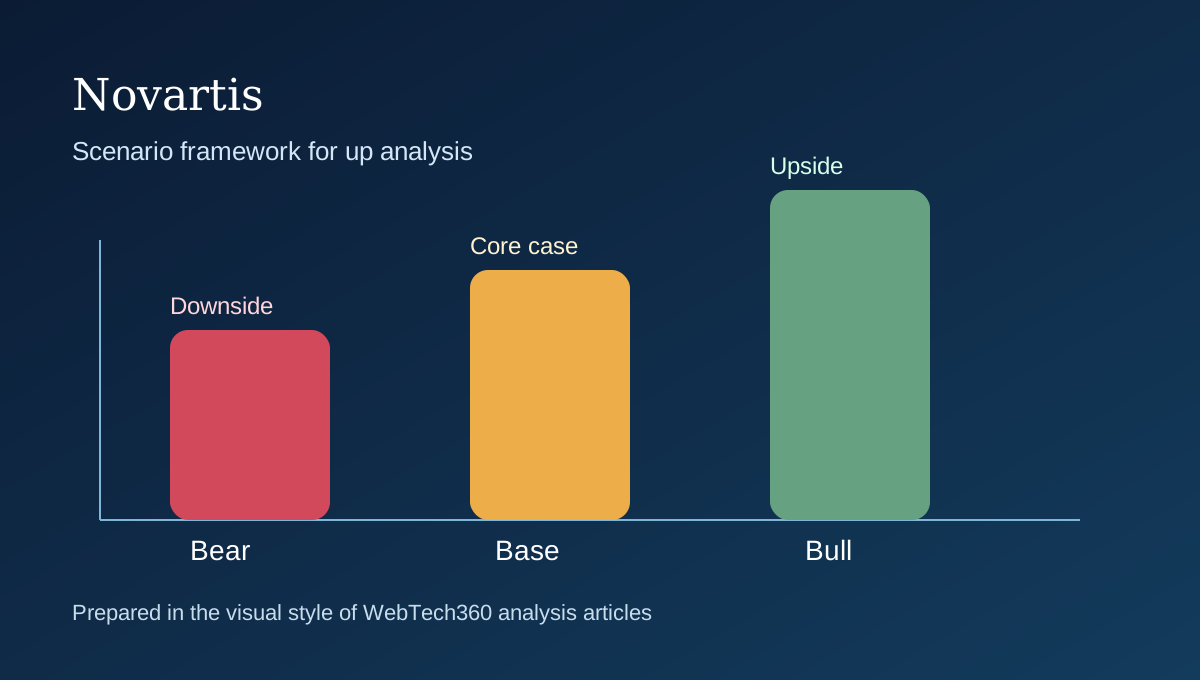
| Fast bull | 25% | CHF 135 to CHF 145 | The market quickly looks through erosion and refocuses on the growth portfolio. | Review after Q2 2026. |
| Measured bull | 45% | CHF 123 to CHF 134 | The stock grinds higher as normalization becomes visible but not fully complete. | Review after FY 2026. |
| Bull case invalidated | 30% | Below CHF 118 | Erosion and margin pressure keep dominating the story. | Review if guidance is cut or brand growth slows materially. |
References
Sources
- Yahoo Finance chart endpoint for Novartis (NOVN.SW), used for current price and 10-year range
- Novartis Q1 2026 results press release, published April 28, 2026
- Novartis annual results 2025 page
- Novartis 2025-2030 sales CAGR and pipeline outlook, published November 20, 2025
- Novartis US manufacturing and R&D expansion plan, published April 30, 2026
- Novartis agreement with the US government on drug pricing, published December 19, 2025
- MarketScreener Novartis financial forecasts and valuation ratios
- MarketScreener Novartis analyst consensus and target prices
- IMF World Economic Outlook, April 2026
- FactSet S&P 500 Earnings Season Update, May 1, 2026
- J.P. Morgan Asset Management: Healthcare growth equity in 2026