01. Historical Context
Why the current setup can still support more upside
The bull case starts with a simple fact: EUR 74.04 on May 15, 2026 is well below the analyst average target and only marginally above the 52-week low of EUR 71.73. That matters because upside stories work best when the starting valuation is not already stretched.
The operating evidence is solid. Q1 2026 net sales were EUR 10.509 billion, up 13.6% at constant exchange rates, while business EPS was EUR 1.88, up 14.0% at CER. Dupixent contributed EUR 4.2 billion in Q1 2026, up 30.8%; launches added EUR 1.2 billion, up 49.6%; vaccines were EUR 1.3 billion, up 2.1%. When a stock delivers that profile and still trades around 11x forward earnings, investors have to take the upside case seriously.
The bullish argument is not that Sanofi is suddenly a hyper-growth company. It is that the market still values the business like a lower-quality, slower-growth pharma than the current launch and immunology data justify.
| Horizon | What matters now | Current datapoint | What would strengthen the thesis |
|---|---|---|---|
| 1-3 months | Execution versus guidance | Q1 2026 net sales were EUR 10.509 billion, up 13.6% at constant exchange rates, while business EPS was EUR 1.88, up 14.0% at CER. | Management keeps 2026 guidance and brand-level momentum remains intact. |
| 6-18 months | Valuation versus revisions | MarketScreener showed Sanofi on about 12.9x trailing 2025 earnings, 10.9x 2026 estimated earnings, and 10.1x 2027 estimated earnings. Consensus EPS on MarketScreener was EUR 6.852 for 2026 and EUR 7.372 for 2027, implying about 7.6% growth into 2027. | Consensus EPS moves higher while the multiple does not need to do all the work. |
| To 2030 | Structural compounding | 10-year price range EUR 44.62 to EUR 94.70; 10-year CAGR 4.1%. | The company sustains growth through launches, pipeline conversion, and disciplined capital allocation. |
02. Key Forces
Five bullish forces that could extend the move
The first bullish driver is continued Dupixent strength. More than 1.4 million patients are already being treated globally, and new approvals in 2026 further widened the franchise.
The second driver is launch velocity. Sanofi's new-product sales growth of 49.6% in Q1 2026 is the clearest proof that the company is building future revenue streams rather than simply harvesting legacy assets.
The third driver is valuation asymmetry. About 10.9x 2026 EPS and 10.1x 2027 EPS is a low bar if management can keep EPS growth at or above the rate of sales growth.
The fourth driver is sector positioning. J.P. Morgan says public healthcare multiples are at 30-year lows relative to the S&P 500. If investors rotate back into healthcare, Sanofi has room to benefit.
The fifth driver is operational leverage. Q1 2026 business EPS rose 14.0% at CER, slightly ahead of the sales growth rate, which shows the model can still convert growth into profit.
| Factor | Current Assessment | Bias | Why it matters now |
|---|---|---|---|
| Dupixent expansion | Q1 sales EUR 4.2 billion; new 2026 approvals | Bullish | The franchise is still expanding rather than maturing. |
| Launch momentum | Launch sales EUR 1.2 billion, up 49.6% | Bullish | This is the best evidence that future growth is broadening. |
| Valuation | 10.9x 2026 EPS and 10.1x 2027 EPS | Bullish | The multiple leaves room for upside. |
| Sector setup | Healthcare cheap relative to the S&P 500 per J.P. Morgan | Bullish | Relative valuation can help if policy fear eases. |
| FX | FX still a headwind for reported numbers | Neutral | Good operating momentum can be obscured by currency. |
03. Countercase
What could interrupt the rally
The bull case fails if investors decide Dupixent is too large a share of the story. Concentration is the single biggest reason Sanofi does not yet trade like a premium-growth name.
It also fails if launch momentum slows materially. A cheap stock is not automatically a bargain if new products do not scale into durable franchises.
Finally, it fails if healthcare remains a revision laggard. FactSet's May 1 note is a reminder that sector-level skepticism is still real even when individual companies execute well.
| Risk | Latest datapoint | Current assessment | Bias |
|---|---|---|---|
| Concentration | Dupixent around 40% of Q1 group sales | High but manageable | Neutral to Bearish |
| Launch fade | Current launch growth very strong | Would hurt the upside case if it slows sharply | Bearish if it happens |
| Sector skepticism | FactSet still flags weak healthcare earnings breadth | Still present | Neutral |
| FX optics | Reported growth can lag CER growth | Known issue | Neutral |
04. Institutional Lens
What professional research implies for the upside case
Named institutional inputs are constructive enough to support a bull case, but only with discipline. MarketScreener consensus still points to a much higher average target than the recent price.
J.P. Morgan's 2026 healthcare note matters because it frames the sector as historically cheap relative to the market. FactSet matters because it shows the sector still lacks broad earnings support, which means upside will go to the stocks actually executing.
That combination is why Sanofi's bull case is plausible: low valuation, strong product momentum, and room for relative sector sentiment to improve.
| Source | Latest update | What it says | Why it matters here |
|---|---|---|---|
| MarketScreener, May 7, 2026 | MarketScreener listed 24 analysts on May 7, 2026 with an Outperform consensus, average target EUR 97.10, low target EUR 82.00, and high target EUR 112.00. | Analysts still see upside because the stock is screening at a low-teens trailing P/E and about 11x forward earnings. | That institutional setup matters because Sanofi does not need an aggressive multiple to outperform if launches keep delivering. |
| IMF, April 2026 | Global growth 3.1% in 2026 and 3.2% in 2027. | The IMF said downside risks still dominate because of conflict, fragmentation, and disappointment over AI productivity. | A slower macro tape usually limits multiple expansion for defensive growth names as well as cyclical names. |
| FactSet, May 1, 2026 | Health Care was one of only two S&P 500 sectors reporting a year-over-year earnings decline; the S&P 500 forward P/E was 20.9x. | FactSet's message is that broad equity valuations are not cheap even as healthcare revisions remain mixed. | That raises the bar for stock-specific execution and makes relative valuation important. |
| J.P. Morgan Asset Management, 2026 | Public healthcare multiples sit at 30-year lows relative to the S&P 500 despite USD 318 billion of M&A across 2,500-plus transactions in 2025. | J.P. Morgan's sector view is that policy noise has compressed healthcare valuations relative to the market. | That helps explain why solid pharma execution can still re-rate if policy fears fade. |
05. Scenarios
How to trade or own the bullish case with clear triggers
A bullish setup is not the same as a blind buy. The right way to act on the upside case is to define what evidence would justify paying closer to the sell-side target range.
For Sanofi, the most useful checkpoints are whether Q2 2026 still shows strong launch growth, whether FY 2026 guidance is maintained, and whether 2027 EPS estimates keep firming from the current EUR 7.372 base.
| Scenario | Probability | Target range | Trigger | When to review |
|---|---|---|---|---|
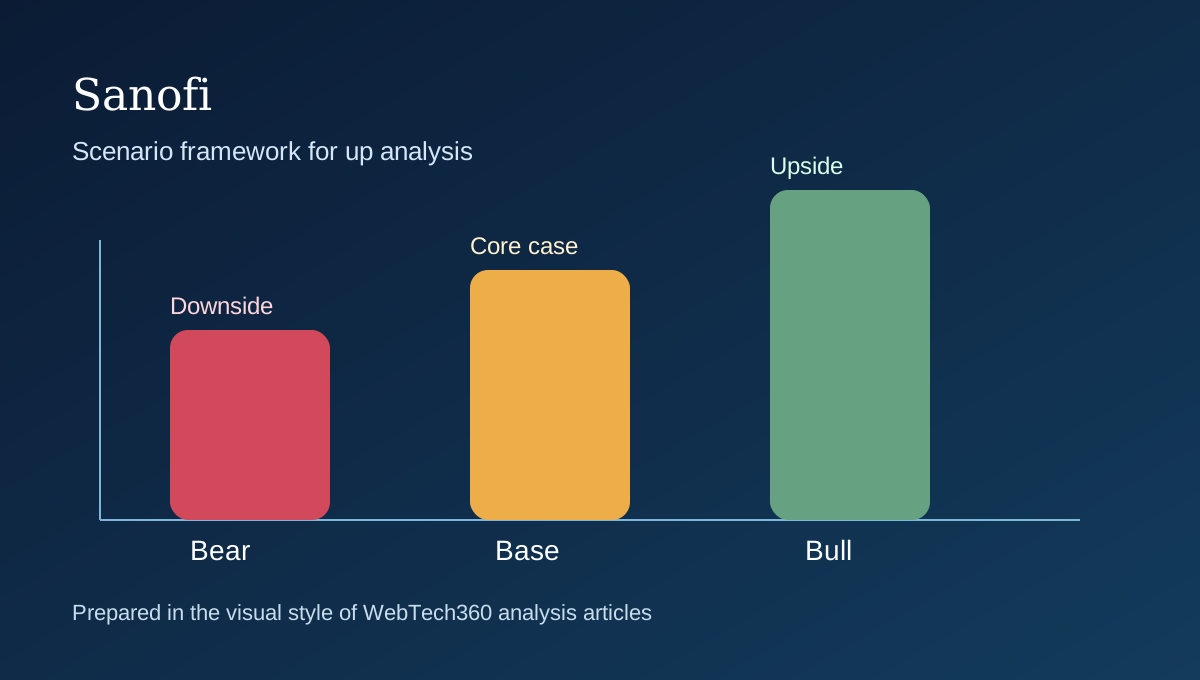
| Fast bull | 30% | EUR 95 to EUR 105 | Stock re-rates toward the consensus target as execution stays clean through FY 2026. | Review after Q2 2026 and FY 2026. |
| Measured bull | 45% | EUR 83 to EUR 94 | Upside comes from earnings delivery more than multiple expansion. | Review after each quarterly result. |
| Bull case invalidated | 25% | Below EUR 74 | Launch growth cools and the market stops paying for a rerating thesis. | Review if the stock revisits the 52-week low. |
References
Sources
- Yahoo Finance chart endpoint for Sanofi (SAN.PA), used for current price and 10-year range
- Sanofi press release: Q1 2026 double-digit sales and business EPS growth, published April 23, 2026
- Sanofi press release: FY 2025 strong sales and EPS growth, published January 29, 2026
- MarketScreener Sanofi financial forecasts and valuation ratios
- MarketScreener Sanofi analyst consensus and target prices
- IMF World Economic Outlook, April 2026
- FactSet S&P 500 Earnings Season Update, May 1, 2026
- J.P. Morgan Asset Management: Healthcare growth equity in 2026