01. Historical Context
Why a high-quality software name can still de-rate
SAP's operating story is strong, but the stock is not immune to disappointment. The company finished 2025 with total cloud backlog up 30% at constant currencies and basic EPS of EUR 6.14, then began 2026 with current cloud backlog of EUR 21.9 billion and 25% constant-currency growth. Yet the stock still trades close to the bottom of its 52-week range.
That gap between business quality and price action is the warning sign. When a stock remains weak despite solid quarterlies, it usually means the market is worried about what happens next, not what just happened.
| Horizon | What matters now | Current assessment | Bias |
|---|---|---|---|
| Next 3 months | Does Q2 confirm or weaken the Q1 backlog signal? | Still unresolved | Neutral to bearish |
| 6-18 months | Can FY2026 cloud revenue and EPS stay near consensus? | Possible, but the market wants repeated proof | Neutral |
| To 2030 | Will AI and data-platform bets create enough value to keep SAP's suite premium intact? | Positive strategically, but still execution-heavy | Neutral |
02. Key Forces
Five bearish forces that could push the stock lower
The first bearish force is the backlog slope. SAP explicitly said on its recent-results page that constant-currency current cloud backlog growth should slightly decelerate in 2026 versus the 25% growth delivered in 2025. If the market sees a slide from "slightly slower" to "meaningfully weaker," the multiple can compress fast.
The second force is that valuation still assumes healthy earnings delivery. At EUR 144.06, the stock is trading at roughly 20.2 times FY2026 consensus EPS of EUR 7.14. That is not excessive for a strong software company, but it is too rich for a story where the backlog or revenue bridge stops feeling reliable.
| Factor | Current data point | Current assessment | Bias |
|---|---|---|---|
| Backlog deceleration risk | Management flagged slight deceleration in 2026 | A real issue because backlog is the stock's central proof point | Bearish |
| Forward valuation | Around 20.2x FY2026 consensus EPS | Reasonable only if execution remains clean | Neutral to bearish |
| Price trend | SAP.DE still near the 52-week low | Shows conviction remains fragile | Bearish |
| Consensus dependence | FY2026 median total revenue EUR 40.114 billion | A public hurdle can become a public disappointment quickly | Neutral |
| AI expectations | Two thirds of Q4 cloud order entry included Business AI | Helpful, but also raises the bar for follow-through | Neutral |
03. Countercase
What could stop the decline
The main counterargument is that the business still prints strong cloud numbers. Q1 2026 cloud revenue was up 27% at constant currencies and current cloud backlog still grew 25% at constant currencies. If that remains true in Q2, the downside case weakens quickly.
The second counterargument is balance-sheet and cash-flow quality. Consensus still points to more than EUR 10 billion of free cash flow in FY2026, and the company is already running a large buyback program. That does not eliminate downside, but it does provide support if execution remains decent.
| Potential offset | Latest data point | Why it matters | Bias |
|---|---|---|---|
| Q1 cloud strength persists | Cloud revenue +27% cc in Q1 2026 | A strong Q2 would keep the growth case intact | Bullish |
| Consensus still healthy | FY2026 EPS median EUR 7.14 | The street has not yet cut the bridge materially | Bullish |
| Cash flow support | FY2026 FCF median EUR 10.067 billion | Supports shareholder returns and downside absorption | Bullish |
| AI monetization already visible | Business AI included in two thirds of Q4 cloud order entry | Suggests AI demand is not purely aspirational | Neutral to bullish |
04. Institutional Lens
How the published institutional framework should be read now
SAP's published consensus is useful because it makes the stock's risk transparent. If investors continue to believe in EUR 25.527 billion of cloud revenue and EUR 7.14 of FY2026 EPS, the stock can stabilize even with some backlog deceleration. If those numbers start falling, the de-rating argument strengthens immediately.
The bear case is therefore not about finding a hidden disaster. It is about monitoring whether the visible, public bridge is slipping.
| Source and date | What it showed | Specific number | Why it matters |
|---|---|---|---|
| SAP recent-results page, crawled May 2026 | 2026 backlog growth should decelerate slightly | Deceleration versus 25% growth in 2025 | This is the central risk variable |
| SAP consensus page, April 22, 2026 | Public FY2026 EPS bridge | EUR 7.14 | If this falls, the multiple likely follows |
| SAP consensus page, April 22, 2026 | Public FY2026 revenue bridge | EUR 40.114 billion total revenue | A clean number for the market to judge |
| SAP Q1 2026 release, April 23, 2026 | Current starting point remains strong | Backlog +25% cc; total revenue +12% cc | Shows why the bear case still needs confirmation |
05. Scenarios
Actionable downside scenarios
The downside case should be reviewed against Q2 and Q3 2026 results, because that is where backlog durability will either be confirmed or challenged. Until then, SAP is better framed as a fragile recovery than as a broken trend.
If the public 2026 numbers remain intact, the stock may simply churn. If they weaken, the downside opens up quickly because the market is already trading off a clear earnings bridge.
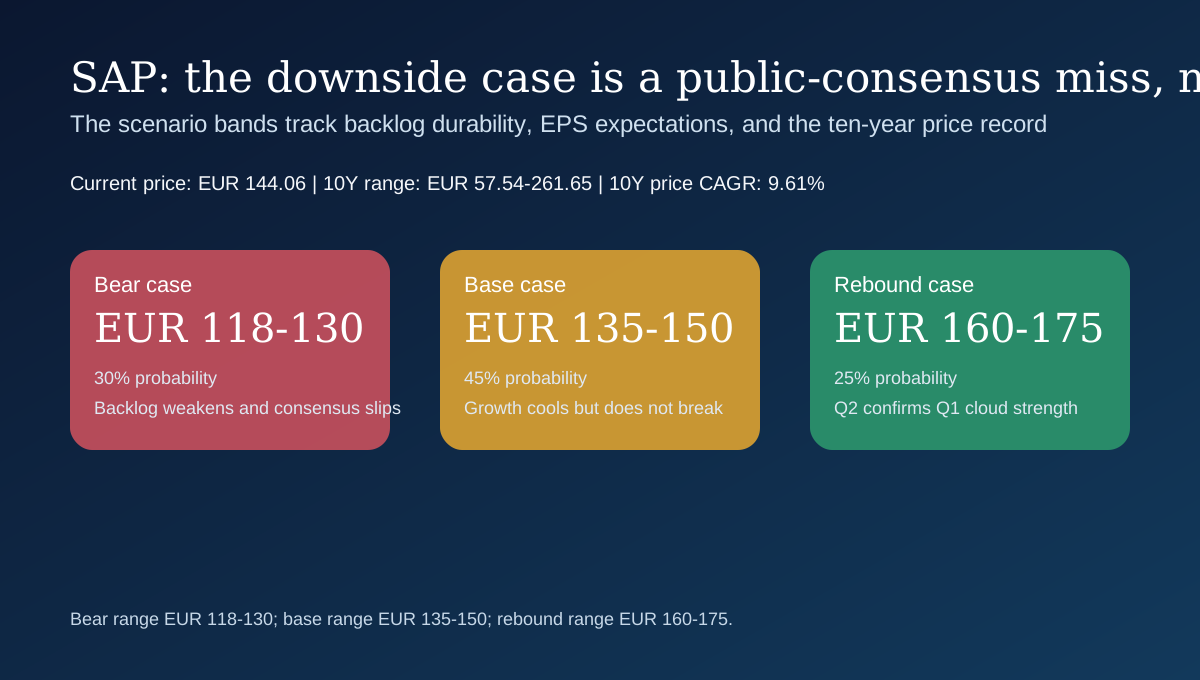
| Scenario | Probability | Trigger | Review date | Target range |
|---|---|---|---|---|
| Bear case | 30% | Current cloud backlog growth slips into the mid-teens and FY2026 EPS consensus starts moving down | Q2/H1 2026 and Q3 2026 results | EUR 118-130 |
| Base case | 45% | Growth moderates but consensus stays broadly intact | Q2/H1 2026 and Q3 2026 results | EUR 135-150 |
| Rebound case | 25% | Backlog stays near 20%+ cc and Q2 confirms Q1 cloud strength | Q2/H1 2026 and Q3 2026 results | EUR 160-175 |
References
Sources
- Yahoo Finance chart API for SAP.DE 10-year price history and latest market data
- SAP Q1 2026 results, published April 23, 2026
- SAP Q4 and FY 2025 results, published January 29, 2026
- SAP Integrated Report 2025 five-year summary, including 2025 basic EPS
- SAP company-published consensus estimates, last update April 22, 2026
- SAP recent results page with 2026 outlook corridor and backlog commentary
- StockAnalysis valuation page for SAP, used for trailing and forward multiple cross-checks