01. Historical Context
The rally case starts from a strong but not cheap market
SMI is trying to extend a move that has already carried it close to the top of its own decade range. Yahoo Finance chart data show ^SSMI closed at 13,220.17 on May 15, 2026, versus a 10-year monthly low of 7,827.74 and a 10-year monthly high of 14,014.30 reached in February 2026. That leaves the index only about 5.7% below its recent peak, which matters because rallies are easier to sustain from depressed levels than from already-demanding ones.
| Horizon | What matters most | Current assessment | What would weaken the thesis |
|---|---|---|---|
| 1-3 months | Macro confirmation and re-risking | Swiss CPI was 0.3% year on year in March 2026, core inflation was 0.4%, and April 2026 unemployment was 3.0%. | Inflation or joblessness worsen while the market keeps trading on a premium multiple. |
| 6-12 months | Earnings resilience and dividend support | UBS published a December 2026 SMI base target of 14,000 and highlighted Swiss dividend yield around 3.2% on March 24, 2026. | Large-cap healthcare and consumer defensives miss guidance or dividend confidence slips. |
| To 2027 | Can Swiss quality keep compounding? | SECO still expects Swiss GDP growth of 1.0% in 2026 and 1.7% in 2027, implying a slow but intact macro backdrop. | External demand softens enough to force a valuation reset instead of a steady grind higher. |
SIX describes the SMI as a 20-stock benchmark that covers about 75% of Swiss equity market capitalization, with individual weights capped at 18% on a quarterly basis. That concentration is important. The next rally does not need a broad tech boom; it mainly needs the index's large defensive and healthcare constituents to keep delivering enough earnings and dividends to justify their premium.
The long-term compounding record supports that idea. On the iShares SMI ETF (CH) benchmark proxy, 10-year annualized benchmark return was 8.54% in CHF as of April 30, 2026, and cumulative 10-year benchmark return was 126.83%. The bull case is therefore less about discovering a new market and more about extending a proven compounding profile without overpaying for it.
02. Key Forces
Five forces that could keep the rally going
The first support is still the inflation backdrop. The Swiss Federal Statistical Office reported March 2026 CPI at 0.3% year on year and core inflation at 0.4%. SECO's March 18, 2026 forecast put average CPI at 0.4% for 2026 and 0.5% for 2027. For a quality market like Switzerland, low inflation matters because it reduces the pressure for a sharp rise in discount rates.
Second, the labor market is not signaling recession. SECO reported April 2026 unemployment at 3.0%, down 0.1 percentage point from March on a monthly basis, although still above the 2.8% level a year earlier. That is not a booming backdrop, but it is good enough to support the base case that SMI keeps compounding rather than breaking down.
Third, the dividend anchor is still real. iShares' SMI ETF proxy showed a 12-month trailing dividend distribution yield of 2.59% as of May 14, 2026. UBS argued on March 24, 2026 that Swiss equities still offered an appealing dividend yield around 3.2%, one reason it upgraded Swiss equities to Attractive while cutting more cyclical parts of Europe to Neutral.
Fourth, institutional targets still allow upside from here. UBS's January 22, 2026 Monthly Extended kept a December 2026 SMI central target of 14,000, an upside scenario of 15,000, and a downside scenario of 10,500. With the index at 13,220.17 on May 15, the base target still implies upside, while the upside scenario remains reachable if macro stability persists and earnings hold.
Fifth, Switzerland's defensive earnings base is still producing real numbers, not just a reputation. Roche's 2025 Annual Report showed group sales of CHF 61.5 billion and core operating profit of CHF 21.8 billion, while Novartis reported 2025 net sales of USD 54.5 billion and core EPS of USD 8.98, up 15% in USD terms. That is a narrower source of upside than a broad cyclical rerating, but it is also a more durable one when inflation is low and policy visibility is mixed elsewhere.
| Factor | Current assessment | Bias | Bullish trigger | Bearish trigger |
|---|---|---|---|---|
| Valuation proxy | iShares SMI ETF (CH) showed 21.06x P/E and 4.03x P/B as of May 14, 2026. | Neutral | Earnings keep validating the premium and the market accepts 20x-plus multiples. | Investors stop paying up for defensives and the multiple compresses first. |
| Inflation regime | March 2026 CPI was 0.3% and core inflation 0.4%. | Bullish | Swiss inflation stays around SECO's 0.4-0.5% forecast corridor. | Imported inflation or energy pressure pushes real yields higher. |
| Labor market | April 2026 unemployment rate was 3.0%. | Neutral | Joblessness stabilizes near 3.0% and domestic demand avoids a hard slowdown. | Unemployment rises materially above 3.0% and consumer weakness broadens. |
| Dividend support | Trailing ETF yield was 2.59%; UBS cited about 3.2% for Swiss equities. | Bullish | Dividend-rich large caps keep attracting defensive capital. | Payout confidence weakens or bond alternatives become more compelling. |
| Positioning versus targets | SMI is below both the February high of 14,014.3 and UBS's 15,000 upside scenario. | Neutral | The index reclaims 14,014.3 and broadens participation. | The rally stalls below the old high and turns into repeated failed breakouts. |
The key point is that the bull case does not require heroic GDP growth. It requires low inflation, stable labor conditions, and enough earnings durability for investors to keep treating Swiss blue chips as a place to hide and compound at the same time.
03. Countercase
What could interrupt the rally
The main risk is simple: valuation is already doing a lot of the work. A public proxy at 21.06x earnings and 4.03x book means SMI is not entering the next phase from a bargain level. If earnings revisions flatten or global risk appetite rotates toward cheaper cyclical markets, the benchmark can stall even with stable Swiss macro data.
The second risk is weak demand outside Switzerland. SECO's March 2026 forecast still showed exports of goods rising only 1.0% in 2026 before recovering to 3.9% in 2027. That is consistent with a sluggish external backdrop. Since Switzerland is an open economy, the index does not need domestic recession to feel pressure.
Third, sentiment is not clean enough to dismiss downside. SECO said consumer sentiment stood at -40 in April 2026. That was better than a year earlier, but still negative in absolute terms. A market trading near its decade high with soft consumer mood is vulnerable if investors decide to demand more proof.
| Risk | Latest data point | Why it matters | Current bias |
|---|---|---|---|
| Premium multiple risk | 21.06x P/E and 4.03x P/B as of May 14, 2026 | Leaves limited room for disappointment if earnings momentum fades. | Bearish |
| Soft household tone | Consumer sentiment was -40 in April 2026 | Signals that domestic confidence is still weak even with low inflation. | Neutral |
| External-demand drag | SECO sees 2026 GDP growth at 1.0% and goods export growth at 1.0% | Implies the economy is stable, not booming, so rerating headroom is finite. | Neutral |
| Concentration | SIX says SMI has 20 stocks covering about 75% of Swiss market cap | A small number of heavyweights can decide whether the rally broadens or fails. | Bearish |
A rally from here is investable only if the index keeps earning the premium. If price rises but the data stop improving, the setup becomes less a quality-compounding story and more a valuation-risk story.
04. Institutional Lens
What named institutional research is actually saying
UBS provides the clearest public scenario map for SMI. In its Monthly Extended published on January 22, 2026, UBS kept a December 2026 central target of 14,000, with an upside scenario at 15,000 and a downside scenario at 10,500. That matters because it frames the current setup as constructive but bounded, not as an open-ended melt-up.
UBS then became more selective inside Europe. In a March 24, 2026 Q&A, it upgraded Swiss equities and European healthcare to Attractive, arguing that both markets were down more than 10% since the start of the conflict and that Switzerland's approximately 3.2% dividend yield could help stabilize returns. SECO's March 18, 2026 forecast reinforced the idea that Switzerland offers below-average growth but still a usable macro corridor for defensives, with GDP at 1.0% in 2026 and 1.7% in 2027.
| Institution / source | Updated | What it says | Why it matters here |
|---|---|---|---|
| UBS House View Monthly Extended | January 22, 2026 | SMI December 2026 central target 14,000, upside 15,000, downside 10,500 | Provides a public scenario map that still implies upside from 13,220.17. |
| UBS Q&A on Europe and Switzerland | March 24, 2026 | Swiss equities upgraded to Attractive; Swiss dividend yield around 3.2% highlighted | Shows why institutional money can still prefer Switzerland in a fragile European backdrop. |
| SECO economic forecast | March 18, 2026 | Swiss GDP growth 1.0% in 2026 and 1.7% in 2027; CPI 0.4% in 2026; unemployment 3.0% in 2026 | Defines the macro corridor that must hold for the rally thesis to remain credible. |
| iShares SMI ETF (CH) | May 14-15, 2026 | P/E 21.06, P/B 4.03, trailing yield 2.59% | Shows that the market still has upside, but not from a cheap starting point. |
The common message is that a higher SMI is plausible, but the route is narrow: stable inflation, resilient dividends, and no material earnings disappointment from the index heavyweights.
05. Scenarios
Actionable scenarios for the next 6-12 months
For existing holders, the base case still favors staying constructive, but it also argues against treating every uptick as fresh cheap upside. A move toward 14,000 is consistent with today's macro and valuation data. A move materially beyond that requires stronger evidence than the market has already seen.
For new capital, the cleanest setups are either a confirmed breakout through the February high with earnings support, or a valuation-led pullback into the low-13,000s that resets expectations. The middle ground is tradable, but it is not the highest-margin entry.
| Scenario | Probability | Working range | Measured trigger | Review window |
|---|---|---|---|---|
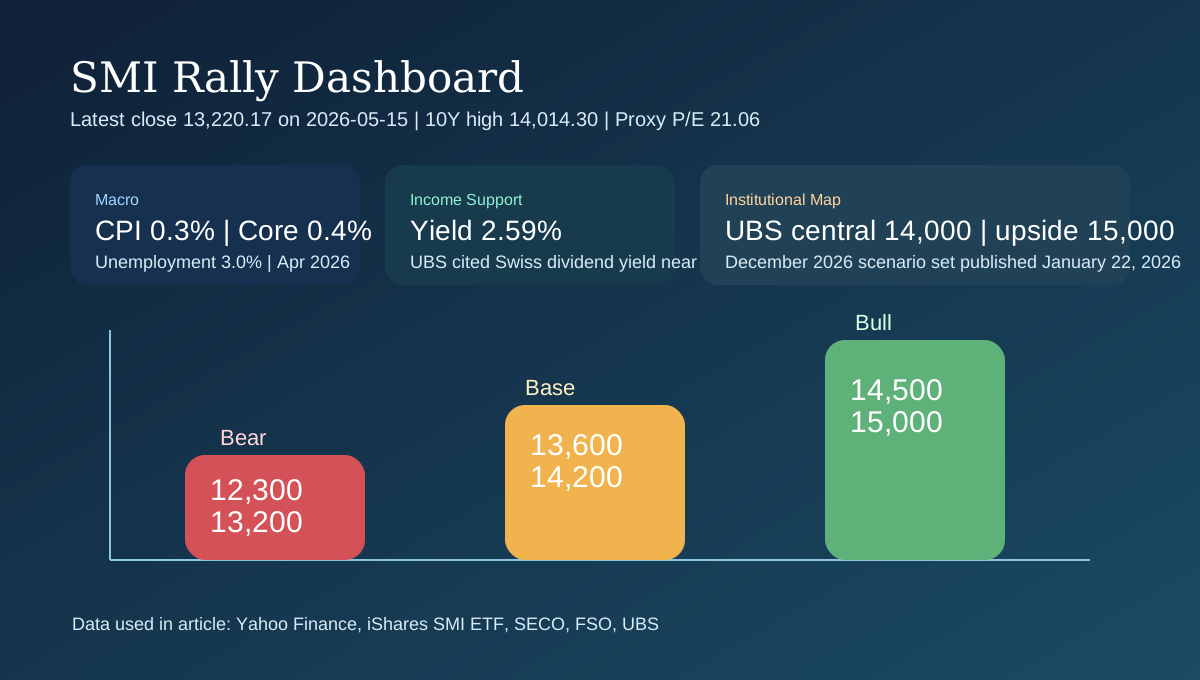
| Bull | 35% | 14,500 to 15,000 | SMI reclaims and holds above 14,014.3, Swiss CPI stays near 0.3-0.5%, and large-cap defensives deliver stable earnings through 2026. | Review after H1 and Q3 2026 reporting seasons and each SECO forecast update. |
| Base | 45% | 13,600 to 14,200 | The index tracks close to UBS's 14,000 central target while GDP stays near SECO's 1.0% 2026 forecast and unemployment remains around 3.0%. | Review monthly after CPI and labor releases, and quarterly after earnings. |
| Bear | 20% | 12,300 to 13,200 | Consumer sentiment remains near -40, earnings revisions soften, or investors stop accepting a 20x-plus earnings multiple. | Review on any weekly close below 12,900 and after major large-cap earnings updates. |
The highest-conviction bull call is not that SMI must surge immediately. It is that the benchmark still has a credible path higher if low inflation and Swiss dividend quality keep offsetting only moderate economic growth.
If those supports weaken, the right response is not loyalty to the story. It is a lower probability on the upside range and a faster pivot back to capital protection.
References
Sources
- Yahoo Finance quote page for SMI Index (^SSMI)
- Yahoo Finance 10-year chart data API for SMI Index (^SSMI)
- SIX overview page for the Swiss Market Index
- SIX Exchanges Figures: February 2026
- iShares SMI ETF (CH) product page
- Swiss Federal Statistical Office CPI press release for March 2026
- SECO economic forecast for Switzerland, March 18, 2026
- SECO labour market report for April 2026
- SECO consumer sentiment page
- UBS House View Monthly Extended, published January 22, 2026
- UBS Q&A on Europe and Switzerland, March 24, 2026
- Roche Annual Report 2025
- Novartis annual results 2025