01. Historical Context
The bear case starts from a market still priced for quality
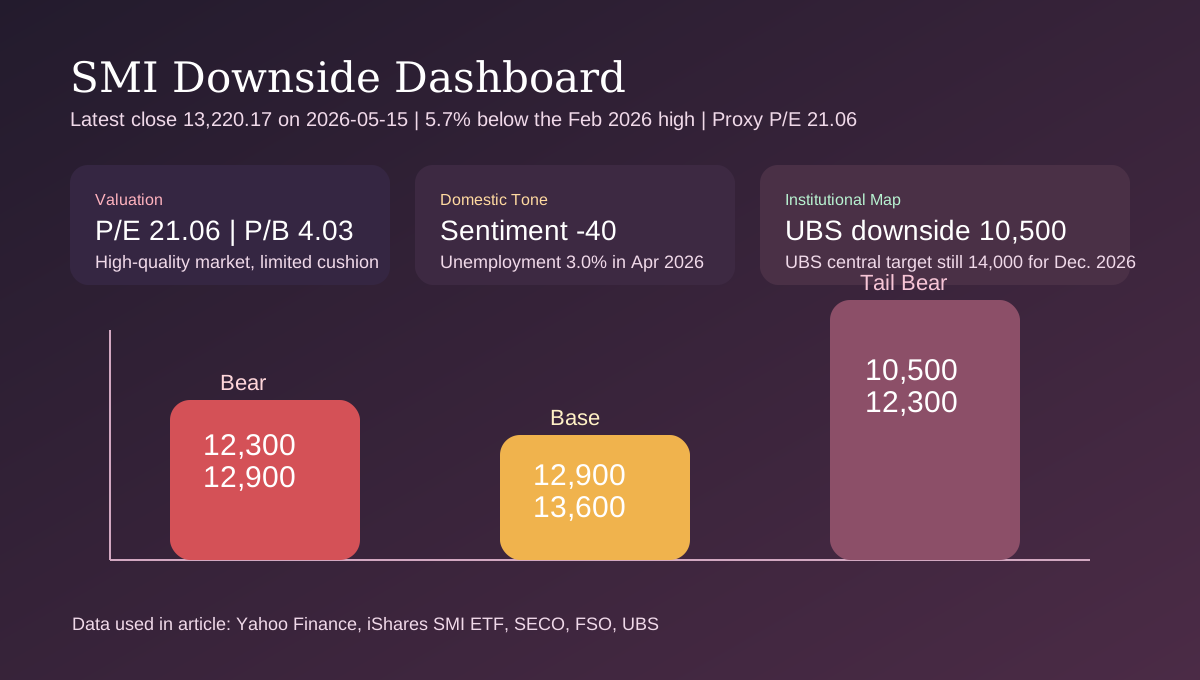
SMI does not look washed out. Yahoo Finance chart data show ^SSMI at 13,220.17 on May 15, 2026, against a 10-year monthly range of 7,827.74 to 14,014.30. In other words, the index is still near the upper end of its own decade history even after backing off the February 2026 high. That leaves room for a deeper drawdown if investors decide the premium for safety has become too expensive.
| Horizon | What matters most | Current assessment | What would strengthen the downside thesis |
|---|---|---|---|
| 1-3 months | Valuation and risk appetite | iShares SMI ETF (CH) showed 21.06x P/E, 4.03x P/B, and 2.59% trailing yield as of May 14, 2026. | Investors stop paying premium multiples for low-beta exposure. |
| 6-12 months | External demand and earnings revisions | SECO still sees GDP growth at 1.0% in 2026, with goods export growth only 1.0% this year. | Global growth weakens enough to pressure Swiss exporters and defensives together. |
| To 2027 | Can the quality premium survive slower growth? | UBS kept a December 2026 downside SMI scenario of 10,500 but still a central target of 14,000. | The market shifts from respecting the central target to discounting the downside map. |
SIX says the SMI contains 20 stocks and covers about 75% of Swiss market capitalization. That concentration cuts both ways. It helps in calm periods because defensives can dominate index performance, but it also means a narrow group of stocks can drag the entire benchmark lower if their premium multiples crack.
The long-run record is good, which is precisely why downside can emerge without a dramatic macro collapse. The iShares SMI ETF benchmark proxy showed 8.54% annualized benchmark return over the past 10 years as of April 30, 2026. When a market with that kind of track record trades near the top of its range, disappointment often comes through valuation compression first, not through an obvious fundamental disaster.
02. Key Forces
Five bearish forces that could drag the index lower
The first bearish force is the starting multiple. A public proxy at 21.06x earnings and 4.03x book is manageable only as long as investors remain willing to pay up for Switzerland's stability. If global bond yields or equity risk appetite move against that preference, SMI can fall even if the companies inside it remain profitable.
Second, the macro base is stable but hardly strong. SECO's March 18, 2026 forecast showed Swiss GDP growth of 1.0% in 2026 and 1.7% in 2027. That does not signal recession, but it also does not create much room for heroic multiple expansion. A slow-growth market trading at a premium is exposed if sentiment worsens.
Third, labor and sentiment data are mixed rather than strong. SECO reported April 2026 unemployment at 3.0%, versus 2.8% a year earlier, while consumer sentiment was still -40 in April 2026. Those numbers do not scream crisis, but they do show that the domestic backdrop is not strong enough to absorb unlimited valuation stretch.
Fourth, the benchmark remains tied to the global cycle through trade and earnings. SECO's forecast table showed goods export growth slowing to 1.0% in 2026 before recovering in 2027. If external demand weakens further, SMI constituents may lose the earnings resilience that justifies their premium.
Fifth, the technical and strategic cushion is thinner than headlines suggest. SMI was already above 14,000 in February 2026, and UBS's downside scenario for December 2026 is still 10,500. That does not mean 10,500 is the base case. It does mean that serious institutional downside still exists in public strategy work.
| Factor | Current assessment | Bias | Downside trigger | Stabilizer |
|---|---|---|---|---|
| Valuation proxy | 21.06x P/E and 4.03x P/B as of May 14, 2026 | Bearish | Premium multiples compress even without a recession. | Defensive earnings continue to validate the premium. |
| Inflation regime | March 2026 CPI was 0.3% and core inflation 0.4% | Neutral | Imported inflation or energy shocks push yields and discount rates higher. | Low inflation keeps Swiss financial conditions relatively benign. |
| Labor market | April 2026 unemployment was 3.0%, up from 2.8% a year earlier | Bearish | Unemployment moves decisively above 3.0%. | The rate stabilizes and avoids signaling a broader slowdown. |
| Consumer demand | Consumer sentiment stood at -40 in April 2026 | Bearish | Sentiment weakens further and household spending softens. | Sentiment keeps recovering from current depressed levels. |
| Institutional scenario map | UBS central target 14,000, downside 10,500 for Dec. 2026 | Neutral | The market starts trading toward the downside corridor. | Price stabilizes around the central target instead. |
The bearish setup becomes much stronger if weak sentiment and slow growth start to matter more than the dividend and quality narrative. That is how a controlled pullback turns into a lower-quality phase.
03. Countercase
Why the decline may still stop short of a larger break
The strongest counterargument is that the macro data do not yet justify a full bearish regime call. Inflation is still extremely low by international standards, and SECO's own 2026 forecast keeps average CPI at 0.4%. That lowers the probability of a sharp rates shock inside Switzerland.
There is also a case that the dividend floor remains useful. iShares showed a 2.59% trailing yield as of May 14, 2026, and UBS said on March 24 that Switzerland's roughly 3.2% dividend yield was part of the reason Swiss equities still looked Attractive. Roche also reported CHF 61.5 billion of 2025 sales and CHF 21.8 billion of core operating profit, while Novartis reported USD 54.5 billion of 2025 net sales and core EPS of USD 8.98. If global investors keep preferring defensive income and healthcare cash generation, SMI can absorb more bad news than a growth-heavy index.
Finally, UBS's public base target was still 14,000 for December 2026. That matters because the market does not need bullish euphoria to avoid another leg lower. It only needs the quality premium to remain credible.
| Support | Latest data point | Why it matters | Current bias |
|---|---|---|---|
| Low inflation | March 2026 CPI 0.3%, core 0.4% | Reduces the immediate need for a major discount-rate reset. | Bullish |
| Dividend support | Trailing ETF yield 2.59%; UBS cited around 3.2% for Swiss equities | Helps keep defensive capital interested even in softer growth periods. | Bullish |
| Institutional base case | UBS central SMI target is 14,000 for December 2026 | Shows public strategy work is not yet centered on a deep decline. | Neutral |
| Long-run compounding record | 10-year annualized benchmark return proxy was 8.54% as of April 30, 2026 | Historically, SMI has often recovered when the macro backdrop stays merely slow, not broken. | Neutral |
The bear case therefore needs confirmation. Without worsening labor data, weaker earnings, or a clear loss of valuation support, the more likely outcome is a choppy lower range, not an immediate collapse.
04. Institutional Lens
What the institutional downside map really implies
The cleanest public downside marker comes from UBS. In its Monthly Extended published on January 22, 2026, UBS kept a December 2026 downside scenario for the SMI at 10,500, while the central target remained 14,000 and the upside scenario 15,000. That tells investors the downside case is real, but also that it requires a more serious deterioration than the current data alone show.
SECO's March 18, 2026 forecasts explain why. Swiss GDP growth of 1.0% in 2026, average CPI of 0.4%, and unemployment of 3.0% is a slow-growth mix, not a crisis mix. The bearish thesis strengthens only if that corridor starts to slip or if the market decides that even this stable backdrop no longer deserves a 20x-plus earnings multiple.
| Institution / source | Updated | What it says | Why it matters here |
|---|---|---|---|
| UBS House View Monthly Extended | January 22, 2026 | SMI December 2026 central target 14,000, upside 15,000, downside 10,500 | Defines a credible downside corridor without pretending collapse is the base case. |
| UBS Q&A on Europe and Switzerland | March 24, 2026 | Swiss equities upgraded to Attractive; dividend yield near 3.2% cited as support | Shows why the bearish thesis still needs a stronger catalyst than weak sentiment alone. |
| SECO economic forecast | March 18, 2026 | GDP growth 1.0% in 2026, 1.7% in 2027; CPI 0.4% in 2026; unemployment 3.0% in 2026 | Frames the downside debate around slow growth and valuation, not around a confirmed recession. |
| SECO labor and sentiment data | May 7, 2026 and May 8, 2026 | April unemployment 3.0%; April consumer sentiment -40 | Confirms that domestic data are soft enough to watch closely, but not yet broken. |
The institutional message is disciplined rather than dramatic: downside remains plausible because SMI is expensive relative to its growth rate, not because Switzerland has already entered a clear macro downturn.
05. Scenarios
Actionable downside scenarios for the next 6-12 months
For profitable holders, the key question is whether this is still a normal reset inside a quality market or the beginning of a broader premium unwind. The difference becomes visible when valuation and macro data worsen together. If that happens, protecting capital matters more than arguing with the label of the market.
For new money, waiting for either a cleaner valuation reset or a confirmed recovery remains the higher-quality process. Buying into a slow drift lower when the market still trades near 21x earnings is not the same thing as buying a true capitulation.
| Scenario | Probability | Working range | Measured trigger | Review window |
|---|---|---|---|---|
| Bear | 35% | 12,300 to 12,900 | The index fails to reclaim 13,500, unemployment remains at or above 3.0%, and investors keep cutting the premium multiple from current levels. | Review after each CPI and labor release and after major large-cap results. |
| Base | 45% | 12,900 to 13,600 | Growth stays slow but positive, low inflation prevents panic, and SMI digests its premium rather than collapsing. | Review monthly and after each SECO forecast revision. |
| Tail bear | 20% | 10,500 to 12,300 | Global growth slows materially, Swiss defensives miss earnings expectations, and price begins trading toward UBS's published downside scenario. | Review immediately on any decisive break below 12,300 or large downgrade cycle. |
The bearish conclusion is not that SMI must crash. It is that the index still has enough valuation and concentration risk to slide lower if investors decide the quality premium is no longer worth its price.
If inflation stays low and dividends remain trusted, that slide can stop earlier than bears expect. If those supports fail, the path toward the low-12,000s and even UBS's 10,500 downside map becomes much more relevant.
References
Sources
- Yahoo Finance quote page for SMI Index (^SSMI)
- Yahoo Finance 10-year chart data API for SMI Index (^SSMI)
- SIX overview page for the Swiss Market Index
- iShares SMI ETF (CH) product page
- Swiss Federal Statistical Office CPI press release for March 2026
- SECO economic forecast for Switzerland, March 18, 2026
- SECO labour market report for April 2026
- SECO consumer sentiment page
- UBS House View Monthly Extended, published January 22, 2026
- UBS Q&A on Europe and Switzerland, March 24, 2026
- Roche Annual Report 2025
- Novartis annual results 2025