01. Historical Context
Solana in context: usage is real, but the asset still trades like a high-beta growth network
Base case: Solana still has one of the strongest utility cases in crypto, but the token remains highly sensitive to the macro cycle and to expectations around user growth, trading activity, and fee capture. At about $86.02 on May 16, 2026, SOL sits roughly 71% below its January 2025 all-time high of $293.31, which means the market has already removed a large portion of peak optimism.
| Horizon | What matters most | What would strengthen the thesis | What would weaken the thesis |
|---|---|---|---|
| 1-3 months | Macro tone, ETF flows, and market-share retention in trading activity | SOL stabilizes while fees and on-chain activity stop falling | Risk-off macro combines with weaker fee capture |
| 6-18 months | Whether usage converts into durable economic value | Monthly activity stays high and regulated access deepens | High activity does not translate into enough value capture |
| To 2027+ | If Solana keeps winning in payments, trading, and tokenization | Network share stays high without repeated operational setbacks | Competing chains erode economic relevance |
The full public history is shorter than 10 years, but the compounding has still been extreme. Yahoo chart data show SOL around $0.57 at the first monthly close in May 2020 and about $86.35 by May 16, 2026, with a monthly high near $237.74 in November 2024. That still implies roughly 129.62% annualized growth from the first full month of price history, so any long-range forecast should assume major deceleration from the launch-era slope.
Like other native cryptoassets, Solana does not have issuer earnings. P/E, forward P/E, EPS, and EPS growth are therefore not applicable. The more useful lenses are network usage, fee economics, validator and staking security, regulated market access, and whether actual activity stays high enough to justify SOL's role as settlement collateral.
02. Key Forces
Five forces that matter most from current levels
Macro remains the first filter. April 2026 CPI printed at 3.8% year over year and March 2026 core PCE at 3.2%, so a full-duration re-rating still needs cleaner disinflation or at least a friendlier real-rate backdrop.
The operating metrics are still impressive. Solana's homepage showed 50 million monthly active addresses, 3.5 billion monthly transactions, $3.3 trillion in trading volume, and $3.4 billion in app revenue when checked on May 16, 2026. Those are unusually strong headline numbers for a chain trading 70% below its prior peak.
Network reliability has improved meaningfully in the latest visible window. Solana Status showed 100.0% uptime over the prior 90 days for mainnet beta and its regional RPC categories, which matters because reliability used to be one of the network's biggest knocks.
Regulated market infrastructure is stronger than it was a year ago. CME Group launched Solana futures on March 17, 2025, and 21Shares' TSOL product page showed $3.11 million in AUM, 360,000 shares outstanding, and a $8.64 NAV as of May 6, 2026.
The open question is value capture. CoinGecko's latest financial snapshot showed $464,651 in 24-hour fees and $62,157.58 in 24-hour project revenue. Those are real economics, but still small relative to a nearly $50 billion market cap unless activity accelerates or monetizes better.
| Factor | Why it matters | Current assessment | Bias | Current posture |
|---|---|---|---|---|
| Macro and rates | SOL still behaves like a duration-sensitive high-beta asset. | April 2026 CPI 3.8% y/y; March 2026 core PCE 3.2% y/y. | Neutral | Needs easier macro |
| Usage scale | The chain's core claim is mass activity at low cost. | 50M monthly active addresses; 3.5B monthly transactions. | Bullish | Usage lead intact |
| Operational reliability | Reliability is essential for institutions and high-frequency use cases. | Status page showed 100.0% uptime over the last 90 days. | Bullish | Operationally improved |
| Regulated access | Futures and ETFs expand the buyer base. | CME futures live since Mar. 17, 2025; TSOL AUM $3.11M on May 6, 2026. | Moderately bullish | Access exists, still early |
| Fee capture | SOL ultimately needs usage to convert into durable economics. | 24h fees $464,651; 24h revenue $62,157.58. | Neutral | Economics still small versus cap |
The right question is not whether Solana has a narrative. It is whether the latest macro data and the latest operating data still justify paying the current multiple for that narrative.
03. Countercase
What would break or delay the thesis
The first risk is still macro. If the inflation path remains closer to the latest 3.8% CPI and 3.2% core PCE readings than to the Fed's long-run target, SOL can keep trading like a high-beta risk asset rather than like durable financial infrastructure.
The second risk is monetization. Solana's usage statistics are large, but current fee and revenue figures remain modest relative to the token's market cap. If activity stays high while economic capture stays thin, investors may conclude the network is useful without deserving a much higher token premium.
The third risk is that regulated access is still small in scale. TSOL's $3.11 million AUM proves the wrapper exists, and CME futures prove the derivatives market exists, but neither figure yet guarantees a broad institutional absorption bid.
A fourth risk is supply optics. CoinGecko lists no fixed maximum supply for SOL, so the thesis depends on demand, staking security, and fee burn mechanics carrying enough weight to offset issuance over time.
| Risk | Latest data | Why it matters now | Current assessment |
|---|---|---|---|
| Sticky inflation | April 2026 CPI 3.8% y/y; March 2026 core PCE 3.2% y/y | Keeps pressure on long-duration crypto assets | Bearish if disinflation stalls |
| Weak economic capture | 24h fees $464,651; 24h revenue $62,157.58 | Usage is strong, but token monetization remains debated | Neutral to bearish |
| Small regulated AUM | TSOL AUM $3.11M as of May 6, 2026 | Institutional wrappers exist but are still small | Neutral |
| No fixed supply cap | CoinGecko lists max supply as infinite | Makes SOL more dependent on continued demand than capped-supply assets | Neutral |
A valid long-run thesis can still produce a poor near-term setup. The purpose of the countercase is to show exactly which data points would move the article from constructive to cautious or from cautious to outright defensive.
04. Institutional Lens
What institutional and official sources actually show
The institutional evidence for Solana is stronger than it was a year ago and more concrete than for many altcoins. CME Group announced on February 28, 2025 that Solana futures would launch on March 17, 2025, giving the asset a regulated U.S. derivatives venue.
On the cash-product side, SEC records show the 21Shares Solana ETF registration became effective on November 18, 2025, and 21Shares' product page showed $3,109,738.53 in AUM, 360,000 shares outstanding, and a $8.64 NAV as of May 6, 2026. That is still small, but it is live, measurable, and more meaningful than a mere filing.
The operating backdrop also matters for institutions. Solana's official homepage showed 50 million monthly active addresses and 3.5 billion monthly transactions, while the status page showed 100.0% uptime over the prior 90 days. For a network asset, that combination of usage and recent reliability is the strongest pro-thesis evidence currently visible in primary sources.
| Source | Latest update | What it says | Why it matters here |
|---|---|---|---|
| CME Group | February 28, 2025 / March 17, 2025 | Announced and launched Solana futures with micro and standard contracts. | Creates a regulated derivatives reference market. |
| SEC / 21Shares | November 18, 2025 | 21Shares Solana ETF registration became effective. | Confirms a live U.S. ETF wrapper exists. |
| 21Shares TSOL | May 6, 2026 | AUM $3.11M, NAV $8.64, shares outstanding 360,000. | Shows early but measurable regulated demand. |
| Solana official sites | May 16, 2026 snapshot | 50M monthly active addresses, 3.5B monthly transactions, 100% uptime over 90 days. | Strengthens the real-usage and reliability case. |
That distinction matters. A filing, an effective registration, a futures launch, and a live AUM number are not interchangeable. The article only treats them as evidence to the extent the underlying source supports that claim directly.
05. Scenarios
Probability-weighted scenarios with measurable triggers
A useful downside framework names hard triggers. Here that means hotter inflation, weaker chain metrics, softer fee capture, or failure to hold important support zones.
The reason tactical downside still matters is that both assets remain far above their first-trading levels even after the latest drawdowns, so the market still has room to compress the multiple.
That does not invalidate the long-run story. It simply means the path can stay volatile enough that timing discipline still matters.
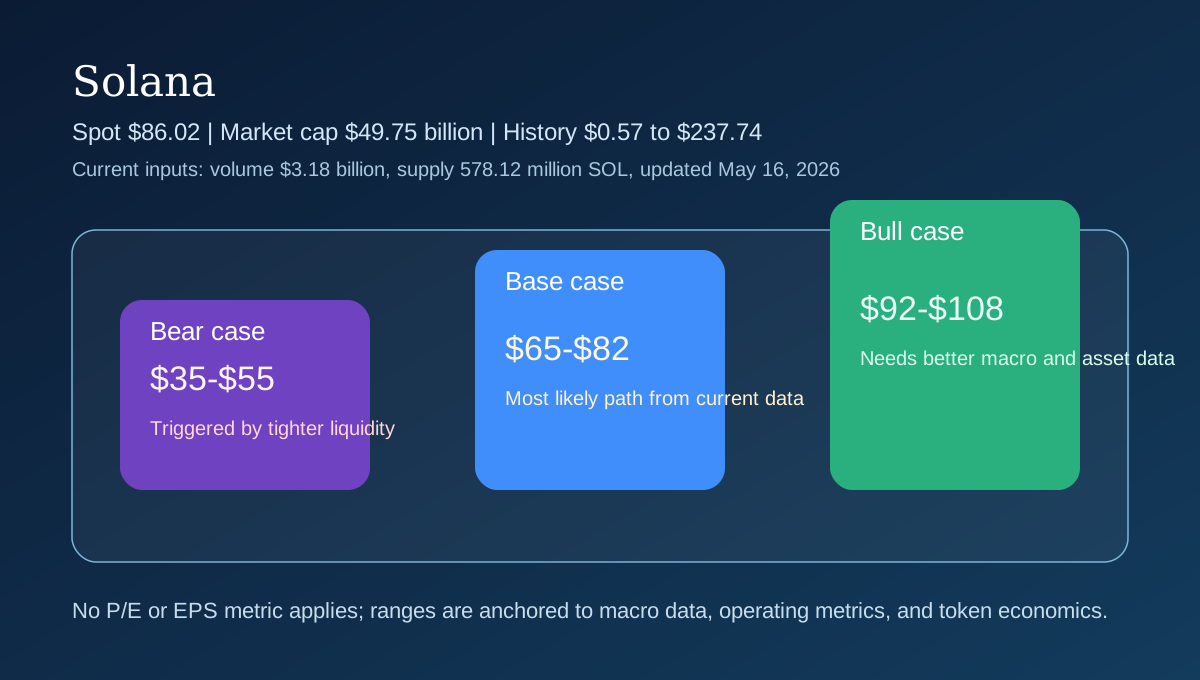
| Scenario | Probability | Target range | Trigger conditions | When to review |
|---|---|---|---|---|
| Bull case | 20% | $92-$108 | Macro improves and Solana's activity stays resilient | Review after each monthly macro and status update |
| Base case | 45% | $65-$82 | Risk-off conditions persist and SOL stays a high-beta laggard | Reassess over the next two quarters |
| Bear case | 35% | $35-$55 | High activity fails to save the token from multiple compression | Review on continuing fee weakness and failed support |
Those ranges are intentionally wider than an equity-style target because these assets do not have issuer earnings. The disciplined approach is to keep updating the probability weights as macro data, market structure, and asset-specific operating evidence change.
References
Sources
- CoinGecko Solana page
- Yahoo Finance chart endpoint for SOL-USD
- Solana homepage
- Solana status page
- Solana fee structure docs
- CME Group Solana futures announcement
- 21Shares TSOL product page
- SEC notice of effectiveness for 21Shares Solana ETF
- SEC filing for Franklin Solana ETF
- BLS CPI release for April 2026
- BEA Personal Income and Outlays, March 2026
- BEA GDP (Advance Estimate), 1st Quarter 2026
- IMF World Economic Outlook, April 2026