01. Historical Context
Why the bearish case is anchored in current numbers
| Metric | Latest figure | Why it matters |
|---|---|---|
| Share price | $443 | Sets the starting point for every scenario in this article |
| Valuation | 433.32x trailing P/E and 207.01x forward P/E | Shows Tesla still trades on future optionality, not current earnings power |
| Street operating view | FY2026 EPS estimate $2.01, up 86.2%; FY2026 operating margin estimate 4.4% | The forward case still assumes a sharp profit recovery from a low base |
| Latest quarter | Q1 2026 revenue $22.387 billion, up 15.8%; gross profit $4.72 billion | Demand did not collapse, but the valuation still needs better monetization than that alone |
| Demand and balance sheet | Q1 deliveries 358,023 versus 368,903 Visible Alpha consensus; cash and short-term investments $44.74 billion | Tesla still has liquidity, but consensus demand assumptions are under pressure |
Base case: Tesla is still financeable, but the stock price already discounts a much stronger earnings and autonomy outcome than the current income statement justifies. StockAnalysis showed the shares at $443.30 on May 14, 2026, against a 12-month average target of $405.47, a low target of $24.86, and a high target of $600. The asymmetry is obvious: upside still exists, but the average target is below spot.
Primary data from Tesla's April 22, 2026 Form 10-Q show why the debate is still open. Q1 revenue rose 15.8% to $22.387 billion and automotive revenue reached $19.979 billion, but finished-goods inventory climbed to $6.842 billion from $4.849 billion at year-end 2025. Operating cash flow was $3.94 billion, cash and short-term investments reached $44.74 billion, and AI infrastructure assets rose to $7.69 billion from $6.816 billion at December 31. Tesla has balance-sheet capacity, but it is using it.
Macro still matters because Tesla trades more like a long-duration asset than a traditional auto stock. April 2026 CPI was 3.8% year over year, core CPI was 2.8%, and March core PCE was 3.2%. The IMF's April 1, 2026 U.S. Article IV update projected 2.4% GDP growth for 2026 and a return to 2% core PCE only in the first half of 2027. That backdrop does not kill the thesis, but it argues against assuming that a triple-digit forward multiple can keep expanding on macro alone.
02. Key Forces
Five bearish forces that could push the stock lower
Tesla's stock still trades on three layers at once: EV demand, margin recovery, and a large autonomy or robotics option value. That is why the forward P/E around 207x matters more than the trailing P/E around 433x. Investors are not paying for what Tesla earned over the last year. They are paying for a projected rebound that still has to be delivered.
The company-compiled consensus published on April 17, 2026 captures that gap. Analysts were looking for FY2026 revenue of $103.36 billion, EPS of $2.01, operating margin of 4.4%, and 1.658 million deliveries. Reuters then reported on April 2 that Q1 deliveries of 358,023 missed the 368,903 Visible Alpha consensus. The result is a stock that can still work if execution improves, but one that remains unusually vulnerable to small disappointment.
| Factor | Why it matters | Current Assessment | Bias | Current evidence |
|---|---|---|---|---|
| Valuation | Sets the hurdle rate for all future narratives | Very demanding | Bearish | 433.32x trailing P/E and 207.01x forward P/E are still extreme relative to current profit levels |
| Earnings recovery | Forward multiples can work only if margins recover | Improving but incomplete | Neutral | FY2026 EPS estimate is $2.01 and consensus operating margin is only 4.4% |
| Demand durability | Unit growth still matters because software monetization is not yet dominant | Mixed | Neutral/Bearish | Q1 deliveries were 358,023 versus 368,903 expected by Visible Alpha |
| Balance sheet and AI spend | Liquidity buys time, but it does not erase capital intensity | Financed but expensive | Neutral | Cash and short-term investments were $44.74 billion while AI infrastructure reached $7.69 billion |
| Macro and rates | Higher real rates still hurt long-duration equities first | Unhelpful | Bearish | Core CPI at 2.8% and core PCE at 3.2% keep discount-rate risk alive |
03. Countercase
What would stop a deeper drawdown
The main countercase to the bull narrative is simple: Tesla does not need an operational collapse for the stock to fall. It only needs a smaller gap between current execution and the valuation investors are still willing to pay. With the average analyst target already below spot, the margin for disappointment is narrower than the branding around the company sometimes suggests.
Inventory and capital intensity are the two numbers that deserve the closest watch. Tesla's March 31, 2026 balance sheet showed finished-goods inventory at $6.842 billion versus $4.849 billion at year-end 2025, while Reuters reported on April 22 that the company still planned to spend more than $25 billion this year. If deliveries stay soft and capex stays elevated, multiple compression can happen faster than the headline revenue growth rate implies.
| Risk | Latest data point | Why it matters now | What would confirm it |
|---|---|---|---|
| Multiple compression | Average target $405.47 is already below the $443.30 share price | Valuation support is thin if the earnings recovery slips | Forward P/E stays above 150x while FY2027 EPS falls below $2.40 |
| Demand softening | Q1 deliveries 358,023 versus 368,903 Visible Alpha consensus | Consensus unit assumptions still need improvement from here | Another delivery miss or deeper discounting in subsequent quarters |
| Inventory build | Finished-goods inventory $6.842 billion at March 31, 2026 | Inventory growth can signal demand frictions before margins fully show it | Inventory rises again while deliveries or ASPs weaken |
| Capital intensity | AI infrastructure $7.69 billion and a plan to spend more than $25 billion in 2026 | Large optionality projects become a valuation problem if cash conversion lags | Capex stays high while operating cash flow fails to keep improving |
04. Institutional Lens
What the current institutional data says about downside risk
The best institutional anchor for Tesla right now is not a headline target from one bank. It is the combination of Tesla's own analyst consensus file, Reuters' delivery and spending reporting, and the 10-Q. Tesla's April 17, 2026 consensus put FY2026 revenue at $103.36 billion, EPS at $2.01, operating margin at 4.4%, and deliveries at 1.658 million. Those numbers show how much of the current valuation depends on an earnings recovery that is still more forecast than fact.
Reuters sharpened the risk side of that setup twice in April. On April 2, Reuters reported that first-quarter deliveries missed the 368,903 Visible Alpha consensus. On April 22, Reuters reported that Tesla still intended to spend more than $25 billion this year even as analysts were cutting annual delivery estimates. The institutional insight is therefore not that Tesla lacks upside. It is that upside now has to compete with a very demanding risk budget.
| Source type | Concrete datapoint | Why it matters for the stock |
|---|---|---|
| Tesla consensus, updated April 17, 2026 | FY2026 EPS estimate $2.01, operating margin 4.4%, deliveries 1.658 million | Shows the recovery assumptions that still sit underneath the stock price |
| Reuters, April 2, 2026 | Q1 deliveries were 358,023 versus 368,903 expected by Visible Alpha | Confirms demand expectations are still vulnerable to downside revisions |
| Tesla 10-Q, filed April 22, 2026 | Cash and short-term investments $44.74 billion; AI infrastructure $7.69 billion; finished-goods inventory $6.842 billion | Shows Tesla can fund ambition, but it is doing so with rising capital intensity |
| IMF, April 1, 2026 | 2026 U.S. GDP growth projected at 2.4% and core PCE normalization delayed into 2027 | Explains why rate-sensitive names still need better-than-average execution |
05. Scenarios
Bearish scenarios with explicit invalidation points
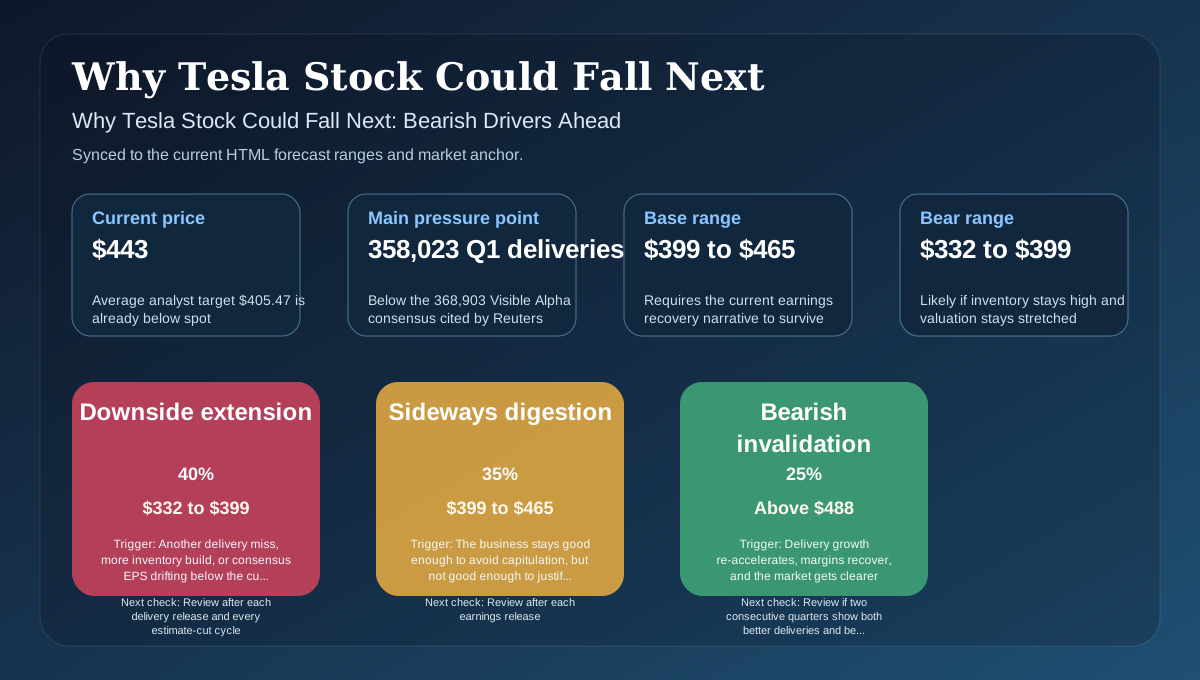
The bearish path becomes most credible when soft deliveries, rising inventory, and a still-extreme multiple start reinforcing one another. Tesla does not need disaster for that to happen. It just needs the earnings recovery to arrive more slowly than investors are paying for.
| Scenario | Probability | Range / implication | Trigger | When to review |
|---|---|---|---|---|
| Downside extension | 40% | $332 to $399 | Another delivery miss, more inventory build, or consensus EPS drifting below the current FY2027 level | Review after each delivery release and every estimate-cut cycle |
| Sideways digestion | 35% | $399 to $465 | The business stays good enough to avoid capitulation, but not good enough to justify re-rating | Review after each earnings release |
| Bearish invalidation | 25% | Above $488 | Delivery growth re-accelerates, margins recover, and the market gets clearer proof that autonomy can monetize | Review if two consecutive quarters show both better deliveries and better cash conversion |
References
Sources
- StockAnalysis Tesla overview, price, valuation, and analyst target data accessed May 14, 2026
- StockAnalysis Tesla revenue and EPS forecast data accessed May 14, 2026
- Tesla analyst consensus compiled by the company, April 17, 2026
- Tesla first-quarter 2026 production, deliveries, and deployments, April 2, 2026
- Tesla Form 10-Q for quarter ended March 31, 2026, filed April 22, 2026
- Reuters on Tesla Q1 2026 deliveries missing Visible Alpha consensus, April 2, 2026
- Reuters on Tesla Q1 2026 spending plan and analyst concerns, April 22, 2026
- U.S. CPI for April 2026, Bureau of Labor Statistics
- U.S. Personal Income and Outlays for March 2026, Bureau of Economic Analysis
- IMF 2026 Article IV consultation for the United States, April 1, 2026