01. Historical Context
The rally case begins with a still-firm U.S. macro backdrop
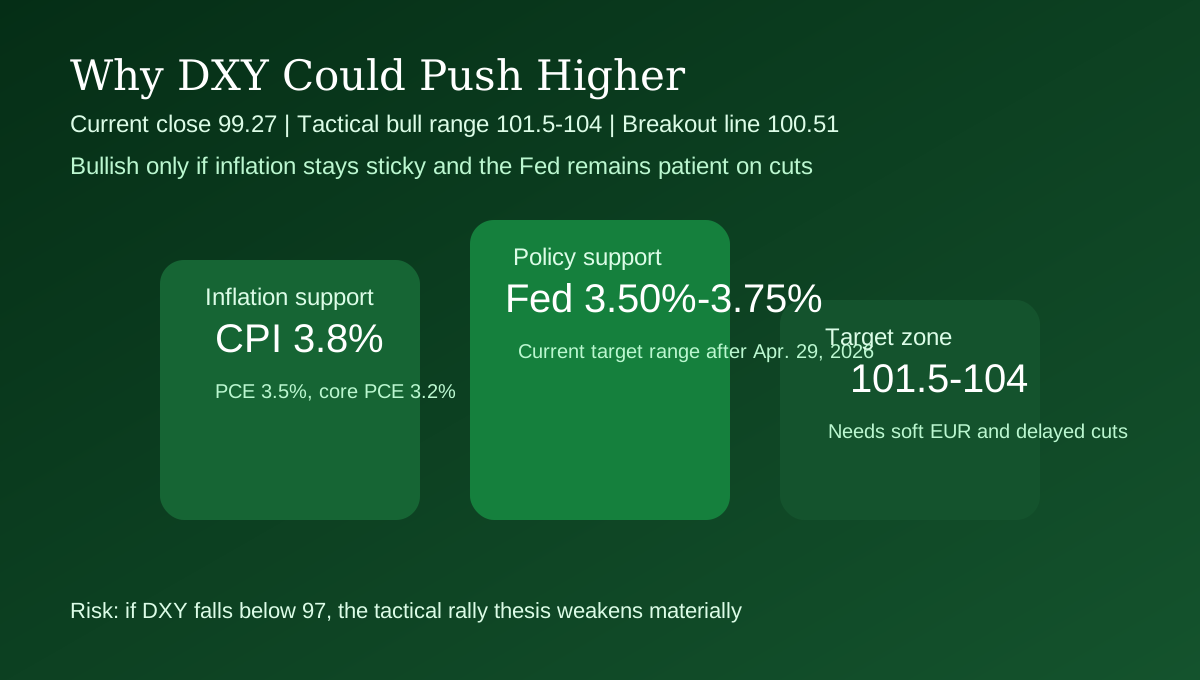
DXY rebounded from 97.84 on May 8 to 99.27 on May 15, 2026. That rebound came after the Fed kept the policy rate at 3.50%-3.75% on April 29 and after April CPI re-accelerated to 3.8% year over year. The tactical message is that the market still has to respect U.S. inflation and rate support.
| Horizon | Current setup | What would strengthen the thesis | What would weaken the thesis |
|---|---|---|---|
| 1-4 weeks | DXY bounced into mid-May after a May 8 low close of 97.84 | Hot CPI/PCE or hawkish Fed communication | Soft inflation and weaker payrolls |
| 1-2 quarters | Fed still on hold and inflation still above target | Delayed cuts and weaker euro-area data | Clear disinflation and lower yields |
| Into late 2026 | Index still below the March 30, 2026 high close of 100.51 | Break and hold above 100.5 | Loss of 98, then 97 |
DXY remains a currency basket, not a company, so there is no legitimate P/E, EPS, or earnings-growth framework to force onto this call. The rally thesis lives or dies on relative inflation, rates, and growth.
02. Key Forces
Five bullish forces that could extend the move
First, inflation is still sticky enough to keep the Fed cautious. April 2026 CPI was 3.8% year over year and core CPI was 2.8%; March 2026 PCE was 3.5% and core PCE was 3.2%. Those numbers are not compatible with an easy dollar-bear story.
Second, the Fed is still restrictive. The target range remains 3.50%-3.75%, and Chair Powell said on April 29 that inflation had moved up and remained elevated. That leaves room for the market to keep pricing delayed cuts.
Third, U.S. growth is still solid enough to support a rate differential. Q1 2026 real GDP grew 2.0% annualized and private domestic final sales grew 2.5%, according to BEA. That is not booming, but it is strong enough to make a sharp policy pivot harder.
Fourth, DXY can rally even if the U.S. story is only moderately firm, because the euro makes up 57.6% of the basket. A softer euro-area growth pulse, another energy shock, or a slower ECB response can be enough to lift DXY materially.
Fifth, the consensus is not structurally bullish the dollar anymore. Goldman says the dollar should weaken in 2026. When the consensus leans that way, upside surprises in U.S. inflation or rates can squeeze DXY higher faster than the longer-term narrative would suggest.
| Factor | Current Assessment | Bias | Trigger for stronger upside |
|---|---|---|---|
| Inflation | CPI 3.8%; PCE 3.5% | Bull | Another upside CPI or PCE surprise |
| Fed stance | Target range 3.50%-3.75% | Bull | Fed signals patience on cuts |
| Growth | Q1 GDP 2.0%; private demand 2.5% | Neutral to bull | More evidence that domestic demand is holding |
| Basket dynamics | Euro still dominates DXY at 57.6% | Bull | Euro-area data disappoint |
| Consensus positioning | Institutional bias leans weaker USD over time | Bull for squeeze risk | Market forced to reprice delayed cuts |
The strongest version of the rally thesis is not "the dollar is structurally unstoppable." It is "the market may still be underpricing how long the Fed can stay relatively firm."
03. Countercase
What could interrupt the rally
The main risk is that inflation cools faster than expected. The Fed's March 2026 median already sees both headline and core PCE at 2.7% by year-end 2026. If the data start converging quickly toward that path, DXY's short-term rate support fades.
A second risk is that the rally is only a rebound inside a broader sideways range. DXY remains below the March 30 high close of 100.51 and far below the 2022 monthly high of 112.12. Until those levels are challenged, the move is tactical, not structural.
Third, global growth could prove better than feared. IMF's base case still expects world growth of 3.1% in 2026 and 3.2% in 2027. If non-U.S. data stabilize while U.S. inflation cools, the setup shifts back toward the medium-term dollar-bear view.
| Risk | Latest data | Why it matters | Current bias |
|---|---|---|---|
| Disinflation resumes | Fed median sees 2.7% PCE by Q4 2026 | Would justify more cuts | Neutral |
| Failed breakout | Current close still below 100.51 | No technical confirmation yet | Neutral |
| Global catch-up | IMF still sees moderate global expansion | Reduces the U.S. premium | Neutral to bear |
The tactical bull case should be treated as conditional. It improves sharply if DXY can reclaim 100.5 and hold it through a softer-growth, still-sticky-inflation environment.
04. Institutional Lens
Why a rally is possible even though institutions lean softer on the dollar
Goldman Sachs expects the dollar to continue weakening in 2026, and J.P. Morgan Asset Management's LTCMA assumes 0.6% annualized dollar weakness versus the euro. That is the structural backdrop.
The tactical rally case exists because those views can be wrong on timing. If the April CPI rebound is not noise, and if the Fed's April 29 hold becomes a longer pause than markets expect, DXY can rally against a medium-term dollar-bear consensus.
The market does not need institutions to turn bullish for DXY to push higher. It only needs the incoming data to be less dovish than the market had assumed.
| Institution | Updated | What it says | Why bulls still care |
|---|---|---|---|
| Federal Reserve | April 29, 2026 | Policy rate unchanged at 3.50%-3.75% | High policy floor supports tactical dollar strength |
| Goldman Sachs | 2026 outlook page | Dollar should weaken in 2026 | Leaves room for upside surprises against consensus |
| J.P. Morgan Asset Management | 2026 LTCMA | Dollar weakens 0.6% annualized versus euro over time | Reinforces that the rally case is tactical, not secular |
| IMF | April 2026 WEO | Geopolitical and commodity risks still matter | Risk-off episodes can support the dollar |
The high-quality bullish view is therefore narrow and disciplined: stronger-for-longer rates plus no meaningful improvement abroad.
05. Scenarios
Actionable rally scenarios
The tactical setup is easiest to use when it is attached to explicit levels and dates.
| Scenario | Probability | Range | Trigger | Review point |
|---|---|---|---|---|
| Rally extends | 35% | 101.5-104 | Inflation stays hot, Fed stays patient, euro remains soft | After May 28 PCE and June 16-17 FOMC |
| Range trade | 40% | 98-101 | Inflation cools slowly and markets avoid a strong conviction on cuts | Weekly while DXY stays below 100.5 |
| Rally fails | 25% | 95-97 | Soft inflation and lower yields pull the dollar down | Immediately if DXY loses 97 on closing basis |
The most important line is still 100.51, the March 30, 2026 high close. Above that, the tactical rally becomes easier to defend. Below 97, the setup increasingly belongs to the broader dollar-down camp.
Readers should treat this as a macro trade thesis, not a stock-style valuation thesis. DXY has no earnings multiple to defend it when policy and inflation shift.
References
Sources
- Yahoo Finance chart data for U.S. Dollar Index (daily series)
- ICE U.S. Dollar Index overview
- ICE FX Indexes methodology
- BLS Consumer Price Index, April 2026
- BEA Personal Income and Outlays, March 2026
- BEA GDP Advance Estimate, 1st Quarter 2026
- Federal Reserve FOMC statement, April 29, 2026
- Federal Reserve Summary of Economic Projections, March 18, 2026
- IMF World Economic Outlook, April 2026
- Goldman Sachs 2026 outlooks page
- J.P. Morgan Asset Management 2026 Long-Term Capital Market Assumptions