01. Historical Context
The bearish case starts with a lower U.S. premium, not with a U.S. collapse
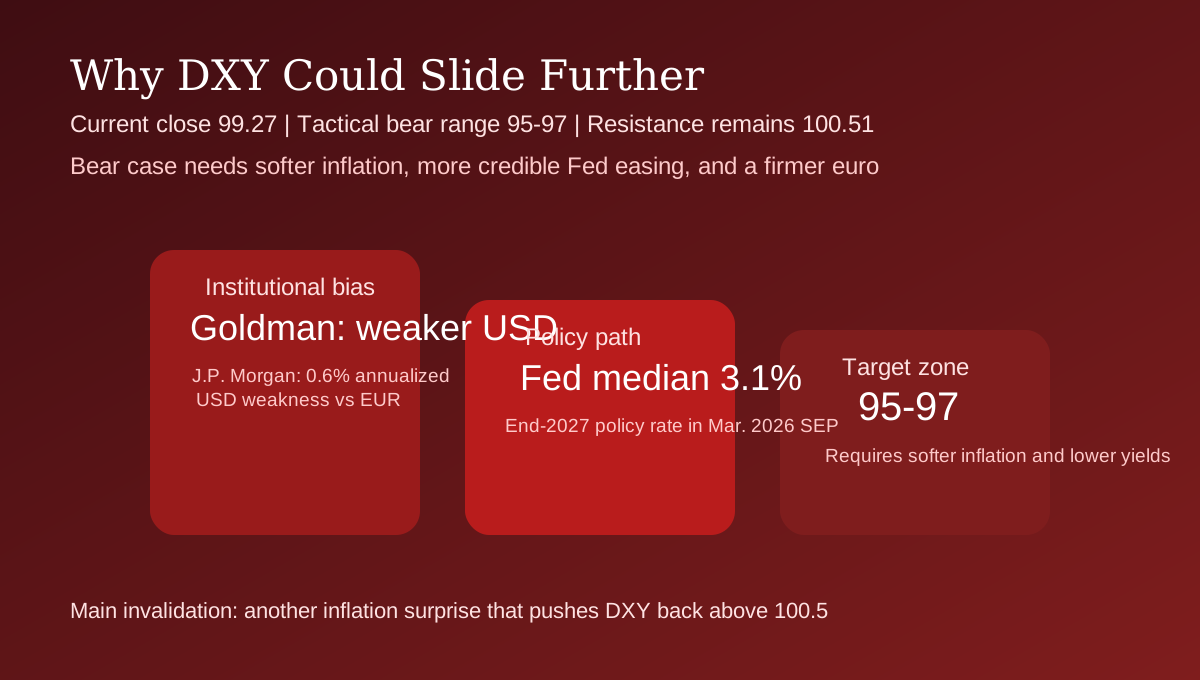
DXY does not need a recession to fall. It only needs the market to decide that the U.S. policy and growth advantage is narrowing. Goldman already expects the dollar to keep weakening in 2026, and J.P. Morgan Asset Management's long-term assumptions already build in annualized dollar weakness versus the euro.
| Horizon | Current setup | What would strengthen the thesis | What would weaken the thesis |
|---|---|---|---|
| 1-4 weeks | DXY remains below the March 30 high close of 100.51 | Soft PCE and lower yields | Another upside inflation surprise |
| 1-2 quarters | Fed medians point to lower rates over time | Confidence that cuts are back on track | Renewed inflation persistence |
| Into late 2026 | Institutional bias is already mildly dollar-negative | Better non-U.S. data and stronger euro | U.S. growth re-accelerates |
DXY is a currency basket, so stock-style valuation language does not apply. The relevant question is whether the U.S. macro premium is shrinking fast enough to justify a lower range.
02. Key Forces
Five bearish forces that could push the trend lower
First, the Fed's own path points lower. The March 2026 Summary of Economic Projections shows median fed funds at 3.4% for end-2026 and 3.1% for end-2027, down from the current 3.50%-3.75% target range. Lower carry is the most direct mechanical reason for dollar softness.
Second, institutional research is already tilted that way. Goldman says the dollar should continue weakening in 2026 as demand for U.S. assets diminishes. J.P. Morgan Asset Management projects 0.6% annualized dollar weakening versus the euro over its forecast horizon.
Third, the basket structure favors downside if Europe stabilizes. With the euro at 57.6% of DXY, even modest euro strength can pull the index lower without any dramatic domestic U.S. weakness.
Fourth, the current level is not a panic high. DXY at 99.27 is well below the September 2022 monthly closing peak of 112.12. That means there is no crisis premium that needs to be defended.
Fifth, the macro corridor is good enough outside the U.S. to allow mean reversion. IMF sees world growth at 3.1% in 2026 and 3.2% in 2027, which is hardly a disaster backdrop for non-dollar currencies if U.S. inflation cools.
| Factor | Current Assessment | Bias | Trigger for stronger downside |
|---|---|---|---|
| Fed path | Median 3.4% end-2026, 3.1% end-2027 | Bear | Market prices cuts with more confidence |
| Institutional view | Goldman and J.P. Morgan both lean weaker USD over time | Bear | More public evidence of softer capital demand |
| Basket concentration | Euro is 57.6% of DXY | Bear | Euro-area data improve |
| Current price level | Far below the 2022 high close of 112.12 | Bear | Market loses remaining safe-haven premium |
| Global backdrop | IMF still expects moderate world growth | Neutral to bear | Non-U.S. growth broadens |
The bearish case is strongest if the market can pair softer inflation with a still-okay global backdrop. That combination narrows the U.S. advantage without requiring outright stress.
03. Countercase
What could stop the decline
The biggest counterargument is that inflation has not actually been tamed yet. April CPI came in at 3.8% year over year and March PCE at 3.5%, both above target and both supportive of a patient Fed. That is the main reason the dollar-down story cannot be treated as automatic.
A second risk to bears is that U.S. growth is still decent. Q1 2026 GDP grew 2.0% annualized and private domestic final sales grew 2.5%. If those numbers hold while Europe disappoints, DXY can drift back toward 101-103 instead of breaking lower.
Third, geopolitics still matter. IMF explicitly warns that downside global risks dominate because of conflict and fragmentation. In those periods, tactical dollar demand can return quickly.
| Risk to bears | Latest data | Why it matters | Current bias |
|---|---|---|---|
| Sticky inflation | CPI 3.8%; PCE 3.5% | Delays cuts and supports DXY | Bullish counterweight |
| Solid U.S. growth | Q1 GDP 2.0%; private demand 2.5% | Keeps the U.S. premium alive | Bullish counterweight |
| Risk-off shocks | IMF still flags downside geopolitical risks | Can trigger temporary safe-haven dollar buying | Neutral |
In practice, the bears need softer inflation and no new global shock. Without both, DXY downside can remain frustratingly slow.
04. Institutional Lens
Why the published institutional bias still leans lower
Goldman Sachs' 2026 outlook is explicit that the dollar should continue weakening in 2026 as demand for U.S. assets diminishes. That matters because it is a direct strategic call on the dollar rather than a side comment on growth.
J.P. Morgan Asset Management's 2026 LTCMA is equally useful because it quantifies the view: 0.6% annualized dollar weakening versus the euro over its forecast horizon. Since the euro dominates DXY, that is directly relevant rather than cosmetic name-dropping.
The bearish case is therefore grounded in published institutional work. It is not a claim that every near-term inflation print must be dollar-negative; it is a claim that the medium-term base case is for a smaller U.S. premium.
| Institution | Updated | What it says | Implication for DXY |
|---|---|---|---|
| Goldman Sachs | 2026 outlook page | Dollar should weaken in 2026 as U.S. asset demand diminishes | Supports a lower medium-term range |
| J.P. Morgan Asset Management | 2026 LTCMA | Dollar weakens 0.6% annualized versus euro over horizon | Direct drag on DXY through its euro weight |
| Federal Reserve | March 18 and April 29, 2026 | Policy still tight now, but medians point lower over time | Creates a delayed rather than immediate bear path |
| IMF | April 2026 WEO | Global growth remains positive, though risky | Keeps room open for non-U.S. currency recovery |
The clean version of the bearish thesis is therefore measured: lower DXY because relative advantages compress, not because the dollar suddenly breaks.
05. Scenarios
Actionable downside scenarios
The bearish setup is usable only if the trigger conditions are explicit.
| Scenario | Probability | Range | Trigger | Review point |
|---|---|---|---|---|
| Slide extends | 45% | 95-97 | Inflation cools, Fed easing path gains credibility, euro firms | After May 28 PCE and June 16-17 FOMC |
| Range trade | 35% | 97-101 | Inflation and growth remain mixed | Weekly while DXY is trapped below 100.5 and above 97 |
| Bear case fails | 20% | 101-103 | Sticky inflation delays cuts and global stress boosts the dollar | Immediately if DXY closes back above 100.5 |
The most useful downside trigger is a sustained break below 97. The most useful invalidation signal is a move back above 100.51, which would suggest the tactical bears are early rather than right.
As with any DXY analysis, the process should stay anchored to rates, inflation, and basket composition. Earnings-style narratives do not belong here.
References
Sources
- Yahoo Finance chart data for U.S. Dollar Index (daily series)
- ICE U.S. Dollar Index overview
- ICE FX Indexes methodology
- BLS Consumer Price Index, April 2026
- BEA Personal Income and Outlays, March 2026
- BEA GDP Advance Estimate, 1st Quarter 2026
- Federal Reserve FOMC statement, April 29, 2026
- Federal Reserve Summary of Economic Projections, March 18, 2026
- IMF World Economic Outlook, April 2026
- Goldman Sachs 2026 outlooks page
- J.P. Morgan Asset Management 2026 Long-Term Capital Market Assumptions