01. Historical Context
WTI is expensive relative to its official 2027 path
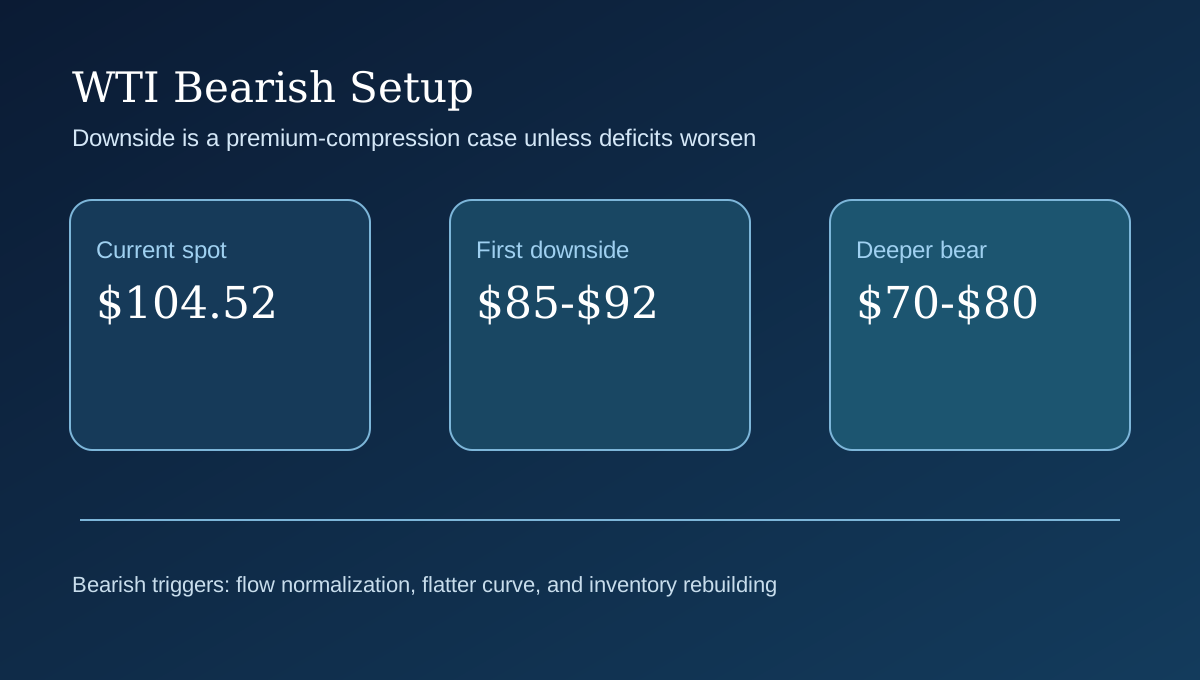
The cleanest bearish starting point is simple: current spot is materially above EIA's own quarterly path once the present disruption is assumed to fade. EIA's May 2026 STEO has WTI averaging $96.42 in 2Q26, $90.06 in 3Q26, and $83.00 in 4Q26, then $74.39 for full-year 2027.
That does not guarantee an immediate decline, but it does mean the market is carrying a meaningful disruption premium. If that premium fades, price can fall even without a recession.
| Stage | What changes | Measured signal | Current assessment |
|---|---|---|---|
| Stage 1 | Risk premium compresses | WTI loses $95 and weekly draws fade | Not confirmed |
| Stage 2 | Curve relaxes | Prompt spreads narrow materially below April levels | Not confirmed |
| Stage 3 | Fundamental easing | Inventories build and demand forecasts soften further | Partly possible |
The current price is therefore vulnerable if the market starts treating the shortage as temporary rather than persistent.
02. Key Forces
Five bearish forces now visible in the data
First, demand is already weakening. IEA now expects global oil demand to contract by 420,000 barrels per day in 2026 and says the loss versus its pre-war forecast is 1.3 million barrels per day. That is not a healthy demand backdrop for sustained triple-digit oil.
Second, inflation is rising into the shock. April 2026 CPI rose 0.6% month over month and 3.8% year over year, with the energy index up 17.9% year over year. March 2026 headline PCE was 3.5% and core PCE was 3.2%. Oil may be pricing its own macro headwind.
Third, EIA still expects supply response outside the Gulf. U.S. crude production is forecast at 13.65 million barrels per day in 2026 and 14.10 million barrels per day in 2027. That means the current shortage is not being met with zero response.
Fourth, U.S. commercial crude stocks are falling week to week but are still 11.046 million barrels above the same week a year earlier. The inventory picture is tight enough for a rally today but not so depleted that a reversal is impossible.
Fifth, current price is high versus the official average path. EIA's full-year 2027 WTI estimate of $74.39 is far below today's spot market. If the market gains confidence in that normalization path, downside opens without requiring a dramatic macro collapse.
| Factor | Latest data | Current assessment | Bias |
|---|---|---|---|
| Demand | IEA 2026 demand -420 kb/d | Weakening | Bearish |
| Inflation | CPI 3.8% y/y; energy CPI 17.9% y/y | High enough to hurt future demand | Bearish |
| Supply response | EIA U.S. crude 14.10 mb/d in 2027 | Meaningful | Bearish |
| Inventories | Commercial crude 452.876 mb | Still drawing, so not yet outright bearish | Neutral |
| Spot versus forecast | Spot $104.52 versus 2027 avg $74.39 | Large premium | Bearish |
The bearish case strengthens materially if inventories and the curve start confirming what demand and official forecast averages already suggest.
03. Countercase
What could invalidate the bearish call
The first risk is obvious: the physical shortage could worsen. EIA still describes 10.5 million barrels per day of Gulf production shut in, and IEA still sees the market in deficit until 4Q26. A bear thesis that ignores that is simply early.
The second risk is that inventory draws remain too severe to let price normalize. IEA's combined 246 million barrel draw over March and April is large enough to keep traders paying up for immediate barrels even with weaker demand.
The third risk is geopolitical tail risk. World Bank says Brent could average $115 in 2026 in a worse disruption scenario. That would imply a WTI market whose downside is repeatedly interrupted by event risk.
| Risk to bear case | Latest evidence | Current assessment | Bias impact |
|---|---|---|---|
| Persistent deficit | IEA sees deficit until 4Q26 | Real | Bullish risk |
| Large stock draws | Global inventories -246 mb in Mar-Apr | Real | Bullish risk |
| Worse disruption | World Bank stress case Brent $115 | Real | Bullish tail |
| Flow restoration | Not yet visible | Would validate bear case | Bearish if confirmed |
The bear case is therefore a conditional normalization thesis, not a denial that the current shock is real.
04. Institutional Lens
How official forecasts line up with the bearish path
EIA is the most useful bearish source because its May 2026 table already embeds price normalization once the current disruption eases. The path from $96.42 in 2Q26 to $74.39 in 2027 is not a crash forecast, but it is a clear argument against extrapolating $100-plus WTI indefinitely.
IEA adds a nuance: spot can stay high for some time even while the medium-term demand story deteriorates. That is why bearish timing should rely on inventories and curve shape, not on demand data alone.
BLS and BEA matter because they show oil is already passing through to inflation. If that becomes a growth drag, it increases the odds that price eventually overshoots downward after the shortage premium fades.
| Source | Update | Specific datapoint | Bearish use |
|---|---|---|---|
| EIA STEO | May 12, 2026 | WTI $83.00 in 4Q26 and $74.39 in 2027 | Normalization path |
| IEA OMR | May 13, 2026 | Demand down 420 kb/d in 2026 | Demand headwind |
| BLS CPI | May 12, 2026 | Energy CPI +17.9% y/y in April | Inflation feedback risk |
| BEA GDP | April 30, 2026 | Q1 2026 real GDP +2.0% annualized | Growth not weak yet, but not booming |
The bearish argument gains the most credibility once the physical market starts converging toward the softer medium-term forecasts already published by EIA.
05. Scenarios
Bearish scenarios with concrete triggers
Base bearish scenario, 50% probability: WTI falls into an $85-$92 range over the next one to three months. Trigger: the market begins to price a repair in export flows and the prompt curve narrows. Review after each weekly EIA inventory release and each monthly IEA update.
Deeper bearish scenario, 25% probability: WTI drops into a $70-$80 range by late 2026 or 2027. Trigger: inventory rebuilding, another round of demand downgrades, and visible non-Gulf supply growth. Review after 3Q26 and 4Q26 STEO revisions.
Failed bearish scenario, 25% probability: WTI stays above $100 or spikes higher. Trigger: disruption persists and inventories keep draining at crisis pace. Review immediately on any worsening in export infrastructure or shipping access.
| Scenario | Probability | Price zone | Trigger / review point |
|---|---|---|---|
| Normalize | 50% | $85-$92 | Flows improve and prompt tightness eases |
| Deeper unwind | 25% | $70-$80 | Stocks rebuild and demand weakens further |
| Bear fails | 25% | Above $100 | Supply disruption persists and deficits deepen |
A bearish WTI call should be updated quickly once the curve and inventories turn. Those are the indicators that convert a theoretical downside case into a real one.
References
Sources
- Yahoo Finance chart API for CL=F 10-year monthly history
- EIA Daily Prices page, including WTI spot and Brent spot updates
- EIA Weekly Petroleum Status Report, latest week ending May 8, 2026
- EIA Short-Term Energy Outlook tables, May 2026
- EIA press release on the May 12, 2026 STEO update
- IEA Oil Market Report, May 2026
- IMF World Economic Outlook, April 2026
- World Bank Commodity Markets Outlook press release, April 28, 2026
- BLS CPI release for April 2026
- BEA headline PCE price index page
- BEA core PCE price index page
- BEA GDP advance estimate for Q1 2026