00. The Setup
From $5,405 to $4,564 in weeks: what exactly happened?
Gold opened 2026 with momentum from an extraordinary 2025. The 2025 annual average of $3,431 represented a 44% gain — the strongest since 1979. Entering January 2026, speculative positioning was extended, ETF inflows were at records, and geopolitical risk premiums were embedded in the price.
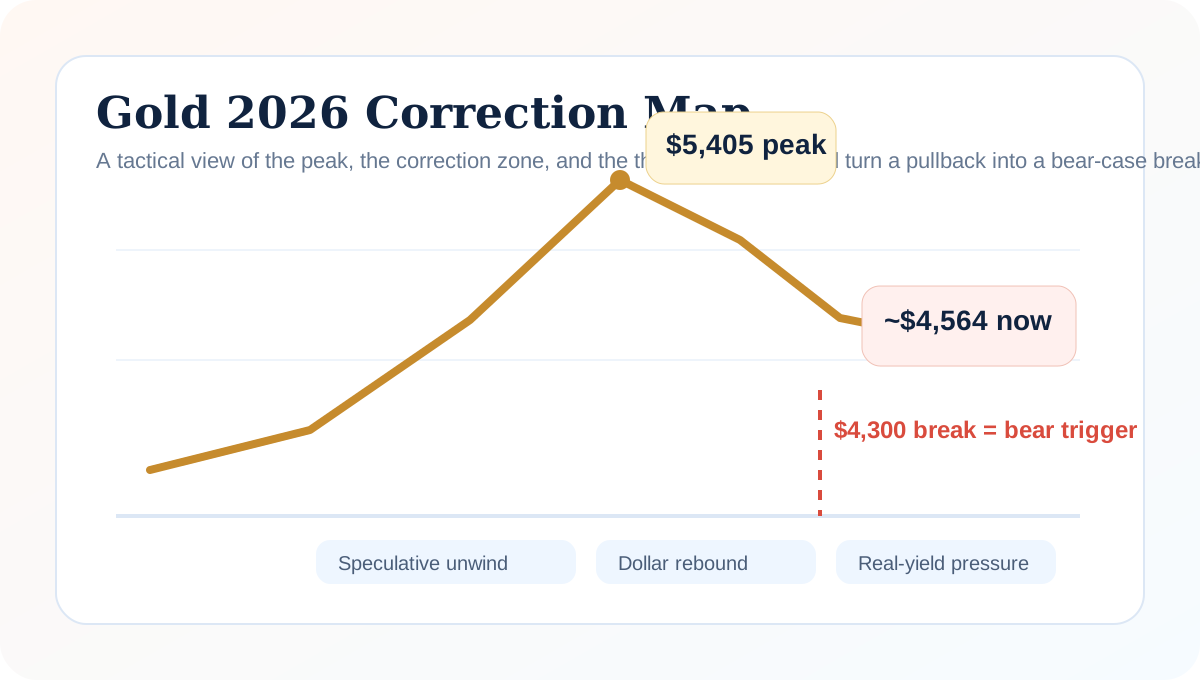
The World Gold Council recorded an intraperiod high of $5,405/oz in Q1 2026. Then came the break. The immediate trigger was a combination of events: the Iran conflict drove oil sharply higher, which paradoxically triggered gold selling (as energy-driven inflation fear caused leveraged long unwinding), while a temporary dollar rebound squeezed non-dollar buyers. Late March Reuters data showed gold in the $4,600s; by early February a brief drop to $4,098 had already previewed downside vulnerability.
As of early May 2026, gold was trading near $4,564/oz — down approximately 16% from the Q1 high and sitting just above the critical $4,300–$4,400 structural support zone that most technical analysts identify as the last clear line of defense before a deeper bear scenario becomes viable.
Is this a correction or a reversal? That is the question this article attempts to answer honestly — without the bullish cheerleading common in gold media, but also without the dismissiveness common in anti-gold commentary.
01. The Bearish Case
Five reasons gold could fall further in 2026 — with data
Bearish reason 1: Real yields are elevated, and the Fed is in no hurry to cut
The most well-documented inverse relationship in gold markets is with real (inflation-adjusted) interest rates. When real yields rise, the opportunity cost of holding gold — which pays no coupon or dividend — rises, and money migrates to bonds. The 10-year TIPS yield is currently above 1%, near its highest level since 2015. The Fed's December 2025 Summary of Economic Projections signaled only one 25-basis-point rate cut for the full year of 2026 — far below what the market had priced in earlier.
If the Fed pauses or even hikes in response to persistently sticky inflation driven by tariff-related price increases, the opportunity cost argument intensifies. This was precisely the environment of 2022, when gold consolidated between $1,620 and $1,950 despite massive inflation headlines — because real yields rose sharply. A repeat of that dynamic in 2026 is not the base case, but it is materially possible.
The key data to watch: the spread between 10Y nominal Treasury yields and 10Y TIPS yields (breakeven inflation). If nominal yields rise faster than inflation expectations, real yields climb and gold faces headwind. Current TIPS real yield: approximately +1.2% (as of May 2026).
Bearish reason 2: Dollar resilience limits gold's purchasing-power appeal internationally
Gold is priced in dollars globally, which means dollar strength directly reduces gold's affordability in non-dollar currencies. The DXY, after a multi-year decline, has been stabilizing in 2026 in the 100–107 range. A sustained DXY move above 108–110 — which could happen if U.S. growth data outperforms or if tariff-driven trade surpluses boost dollar demand — would create a significant headwind for gold purchases from the world's two largest retail gold consumers: China and India.
This matters more than it might appear. China and India together account for roughly 50% of global jewellery demand and approximately 40% of bar-and-coin demand. When gold is expensive in renminbi or rupees, consumers buy less. That demand destruction from the demand side — even if Western institutional demand holds up — can suppress price progress for extended periods.
Bloomberg's Mike McGlone has specifically noted that gold's behavior in recent months resembles a "speculative risk asset" more than a pure safe-haven, suggesting that positioning-driven selling can be more violent and sustained than traditional gold corrections.
Bearish reason 3: After a 100%+ rally in 14 months, profit-taking pressure is structural
Gold rose from approximately $2,600 at the start of 2025 to $5,405 in Q1 2026 — a gain of approximately 108% in 14 months. Historical precedent suggests that such compressed, rapid gains in gold are almost always followed by extended consolidation or correction, because:
- Investors who bought at lower prices have large unrealized gains, and at some point locking in profits becomes rational.
- Leveraged long positions (futures, CFDs) built up during the acceleration phase face forced liquidation if prices dip below their cost basis or margin thresholds.
- Even in the most powerful historical gold bull markets, corrections of 15–25% from peak to trough were normal and expected.
The 2011 gold cycle is instructive: gold peaked at $1,920 in September 2011 after a multi-year rally, then fell to $1,527 by early 2012 — a 20% drop that was entirely consistent with the structural bull market continuing (which it eventually did, in a sense, by running to $2,075 in 2020). A 20% correction from $5,405 would bring gold to approximately $4,324 — very close to the structural support being watched.
Bearish reason 4: Geopolitical de-escalation risk can remove the "war premium" quickly
An estimated $200–$400/oz of gold's current price represents what analysts call the "geopolitical risk premium" — the extra price investors pay for insurance against conflict-driven market disruptions. This premium is driven by Ukraine, Middle East tensions, and China-Taiwan uncertainties. The problem with geopolitical premiums is that they can compress very rapidly: a ceasefire announcement, a peace framework, or even credible diplomatic progress can trigger sharp gold selling within hours.
The March 2026 correction itself was partly triggered by the Iran conflict dynamic — ironically, escalating oil prices caused risk-off dollar buying that temporarily worked against gold. If geopolitical tensions de-escalate materially, the war premium could be removed faster than most holders of gold anticipate.
Bearish reason 5: Speculative repositioning can be self-reinforcing
CFTC Commitment of Traders data for gold futures has historically shown that at price peaks, net speculative long positions reach extreme levels. When the market turns, those same speculative longs become sellers — creating a cascade that can significantly overshoot the "fundamental value" indicated by structural demand. We do not have confirmation that speculative positioning was at a record when gold peaked at $5,405, but the speed and depth of the correction suggests that leveraged selling played a material role.
State Street's SPDR Gold Trust team and several commodity research desks have noted that 2026's gold price dynamics have increasingly reflected positioning dynamics rather than purely fundamental supply-demand flows — which increases the risk of disorderly corrections when sentiment turns.
02. What the Bears Get Wrong
Three structural facts the bearish case consistently underweights
Fact 1: The structural demand floor did not disappear during the correction
The World Gold Council's Q1 2026 data confirmed that official sector buying and bar-and-coin demand remained firm even as spot prices corrected. Central banks are not day traders — they buy on a quarterly schedule driven by reserve policy objectives, not price momentum. When a central bank's mandate is to diversify reserves away from dollar assets, a 16% gold price correction is not a reason to stop buying; it may actually be a reason to buy more.
The World Gold Council's 2025 survey found that 43% of central bank respondents planned to increase their institutions' gold reserves in the next 12 months. If even half of those intended buyers remain active, that is approximately 400 tonnes of structural demand that exists regardless of tactical price direction. That is a floor that would not have existed in the 2011 or 2013 corrections.
Fact 2: The major institutional forecasters are still bullish — by a significant margin
The bear case tends to cite declining prices as evidence of a broader structural problem. But the institutions with the most resources dedicated to macro commodity research have not downgraded their 2026 targets after the correction:
- J.P. Morgan Global Research maintains a year-end 2026 target of $6,300 — 38% above current prices.
- Goldman Sachs maintains $5,400 — 18% above current prices.
- Wells Fargo Investment Institute maintains $6,100–$6,300.
- UBS targets $6,200 as a 2026 average.
The fact that none of these institutions has revised down to current prices — and that the most bearish major bank (HSBC) targets $4,800, still above current levels — is a significant data point. Institutional research teams are not infallible, but they are also not subject to the same behavioral biases that drive retail sentiment. Their collective maintenance of bullish targets through a 16% correction signals that the structural case remains intact from their perspective.
Fact 3: De-dollarization is a structural, not cyclical, process
The most common bear argument is that "de-dollarization is overblown." This is partly true in the short term — the dollar is not about to be replaced as the world's reserve currency. But the relevant question is not replacement; it is share reduction. The IMF COFER data showing USD share declining from 71% in 1999 to 56.32% in Q2 2025 is not a narrative; it is a measurement. Each percentage point of declining USD share represents approximately $130–$150 billion in reserve assets being reallocated — and gold has been one of the primary beneficiaries.
This process does not stop during a 16% gold price correction. It is driven by geopolitical risk aversion at the sovereign level, which operates on a 10–20 year strategic horizon. Bears who claim de-dollarization is "already priced in" need to explain what specific event would cause the 73% of central bank respondents who expect USD reserves to decline to reverse their stated intentions.
03. Correction or Reversal?
The $4,300 level is the line between a correction story and a regime-break story
The analytical distinction between a "correction" and a "reversal" is not arbitrary. It can be defined with precision using price levels, technical structures, and fundamental triggers. Here is how to think about it for gold in 2026:
The correction scenario (base case): Gold is experiencing a normal post-ATH digestion phase following an extraordinary 100%+ move. The primary structural demand — central bank buying, de-dollarization, long-term inflation hedging — remains intact but is temporarily overwhelmed by speculative liquidation and reduced fear premiums. In this scenario, gold should find support in the $4,300–$4,500 range (corresponding to the 2025 Q4 base and approximate 200-week moving average), consolidate for several months, and resume trending higher when a macro catalyst (Fed cut, dollar weakening, ETF inflow resumption) provides the next directional signal.
The reversal scenario (tail risk): Gold has completed a speculative bubble cycle and is entering a multi-year bear market, similar to the 2011–2015 post-ATH decline. In this scenario, the current decline from $5,405 continues materially below $4,300, structural demand weakens, and gold tests $3,500–$4,000 before stabilizing. This requires the five bearish conditions described earlier to compound simultaneously — particularly a Fed rate hike restart and a sustained dollar move above 110.
| Episode | Pre-correction peak | Trough / max drawdown | Time to new ATH | Nature |
|---|---|---|---|---|
| 2008 GFC sell-off | $1,030 | $681 (−34%) | ~18 months | Correction; resumed to $1,920 in 2011 |
| 2011 September peak | $1,920 | $1,050 (−45%) | 9+ years (ATH not broken until 2020) | Reversal; post-GFC structural bear market |
| 2020 COVID sell-off | $1,680 | $1,472 (−12%) | 5 months | Correction; resumed to $2,075 ATH |
| Current (Q1–Q2 2026) | $5,405 | ~$4,564 (−16% so far) | Unknown | Pending — watching $4,300 level |
The critical difference between the 2011 reversal and the 2020 correction was structural demand. In 2011, central banks were still net sellers of gold. In 2020, they were already net buyers — and in 2026, they are buying at their highest pace in modern history. That structural difference strongly biases the current episode toward correction rather than reversal, absent a fundamental change in central bank behavior.
04. Definitive Trigger Table
The three conditions that would confirm a genuine downtrend
Rather than guessing whether gold will go down, the more disciplined approach is to identify the specific conditions that would confirm or deny the bear thesis. If these conditions do not materialize, the correction remains a correction.
| # | Bear trigger | Specific threshold | Current status (May 2026) | Bear confirmed? |
|---|---|---|---|---|
| 1 | Sustained break below structural support | Gold closes below $4,300 for 3+ consecutive weeks | ~$4,564; approaching but not at level | Not yet |
| 2 | Fed signals return to rate hike cycle | FOMC statement explicitly signals rate increase, or 2026 dot plot shows 2+ hikes | Fed signaling only 1 cut in 2026; no hike signal yet | Not yet |
| 3 | Central bank net selling appears in data | IMF COFER shows gold's share of reserves declining for 2+ consecutive quarters, or WGC data shows CB net selling | No current evidence; 43% plan to increase holdings | Not yet |
As of early May 2026, none of the three confirming triggers has been activated. Gold is near the critical $4,300 support zone, but has not broken through it. The Fed has not signaled rate hikes, and central bank buying data remains intact. This keeps the current episode in the "correction within a bull market" category rather than the "regime reversal" category.
This framework is designed to be updated. If trigger #1 fires (sustained close below $4,300), the bear case probability increases sharply. If all three fire simultaneously, the long-run bull thesis must be seriously reconsidered.
Additional sentiment indicators to watch
Beyond the three primary triggers, the following secondary indicators are worth monitoring weekly:
- World Gold Council ETF monthly flow data: Any sustained net outflow months would indicate institutional selling, not just speculative liquidation.
- CFTC gold net speculative position: If net longs collapse to near zero (as they did in 2018–2019), that typically marks a sentiment floor, not a further decline risk.
- Gold in non-dollar terms: Gold priced in euros, yuan, and Indian rupees often diverges from the USD price. If gold remains at highs in non-dollar terms even while the USD price corrects, it suggests the move is dollar-driven, not structural.
- Shanghai Gold Exchange premium: A sustained premium (Chinese buyers paying more than London spot) indicates strong physical demand that will ultimately support prices even during paper-market corrections.
05. Verdict
Yes, gold can go lower. No, the structural case is not broken. Here is the conditional answer.
Gold can absolutely fall further in 2026. The five bearish pressures identified in this article — elevated real yields, dollar resilience, profit-taking after a 100%+ rally, geopolitical premium risk, and speculative repositioning — are all real. They are not invented by gold bears. A decline to $4,100–$4,300 over the next two to three months is a meaningful probability, not a tail risk.
What the bear case gets wrong is the conflation of tactical downside with structural reversal. The structural demand architecture — central bank buying at historically elevated pace, de-dollarization as a 10-year process, a widening buyer base including new institutional categories — has not collapsed. It is simply not being amplified by the speculative and ETF layers that drove the 2025 rally. When those layers reduce, gold corrects. When they return, gold resumes.
| Factor | Current assessment | Net impact on gold |
|---|---|---|
| 10Y TIPS real yield (~1.2%) | Elevated; headwind | Bearish short-term |
| DXY (stable ~103) | Neutral; not strongly bullish or bearish | Neutral |
| Central bank buying pace | Firm; 43% plan to increase | Structurally bullish |
| ETF flows (monthly) | Neutral to slightly positive post-correction | Neutral |
| Speculative positioning (CFTC) | Reduced from peak; less crowded | Short-term neutral; less downside pressure |
| Geopolitical risk premium | Partially reduced; Iran conflict ongoing | Neutral; could go either way |
| Institutional forecasts (JP Morgan, GS, WF) | $5,400–$6,300 year-end targets maintained | Bullish medium-term |
| $4,300 structural support | Not yet broken; ~6% below current price | Critical watch level |
The conditional verdict: if none of the three primary bear triggers fires, the most likely outcome is a base-case consolidation in the $4,400–$5,000 range for H1 2026, followed by a gradual recovery toward institutional targets of $5,400–$6,300 in H2 2026 as ETF flows resume and macro conditions stabilize. If trigger #1 fires (sustained break below $4,300), the tactical picture deteriorates significantly. If all three fire, the structural bull thesis must be reconsidered.
For investors currently holding gold: the data does not support panic selling below $4,500 unless your time horizon is very short. For investors considering new positions: the $4,300–$4,500 zone represents the strongest structural entry point in the current cycle, based on institutional target spreads and historical correction precedent. Neither of these statements constitutes investment advice — they are analytical observations from the available data.
References
Sources
- World Gold Council, Gold Demand Trends Q1 2026 — Q1 peak data, structural demand analysis post-correction
- World Gold Council, Gold Outlook 2026 — institutional demand projections, 585t/qtr CB buying forecast
- World Gold Council, Central Bank Gold Reserves Survey 2025 — 43% of CBs plan to increase holdings
- J.P. Morgan Global Research — $6,300 year-end 2026 target; maintained post-correction
- GoldSilver.com — 2026 institutional forecast compilation: Goldman $5,400, Wells Fargo $6,100–$6,300, UBS $6,200
- State Street SPDR, Gold 2026 Outlook — structural bull cycle analysis, positioning discussion
- Reuters, March 9, 2026 — Iran war oil shock and gold correction dynamics
- Reuters, March 31, 2026 — March market wrap; gold at $4,669
- Fortune, May 4 2026 — current gold spot price reference ($4,564)
- IMF COFER Q2 2025 — USD reserve share data; structural de-dollarization trend