01. Historical Context
WTI Oil in context: a crisis price is not the same as a structural price
The last decade shows why long-horizon oil forecasts need regime thinking. WTI spent long periods between roughly $45 and $75, briefly collapsed during the April 2020 demand shock, then moved above $100 during the 2022 supply shock and again during the current 2026 Middle East disruption.
That matters because 2030 should be anchored to what the oil system looks like after spare capacity, shale response, and demand adaptation have had time to operate. A six-month shortage can dominate the tape, but it rarely dictates the whole decade.
| Horizon | Primary variable | What improves the thesis | What weakens the thesis |
|---|---|---|---|
| 2026 | Emergency supply outage | Inventory draws stay extreme | Hormuz flows normalize |
| 2027-2028 | Restoration and demand elasticity | Supply remains constrained after the shock | Demand softens while non-OPEC output rises |
| To 2030 | Capital discipline versus transition drag | Chronic underinvestment keeps spare capacity thin | Demand growth decelerates faster than supply |
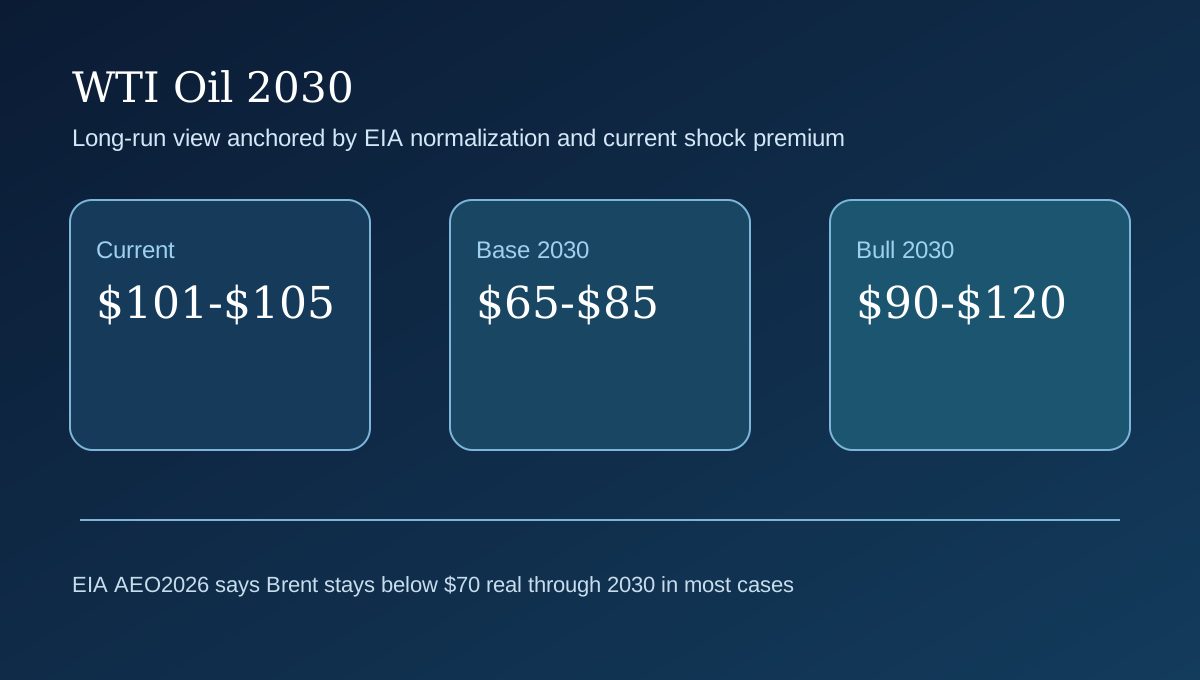
EIA's AEO2026 narrative says Brent crude prices remain below $70 per barrel in real 2025 dollars through 2030 in nearly all of its main cases. That is not a WTI spot target, but it is a strong official signal that the long-run reference case is materially below current nominal crisis pricing.
A sensible 2030 WTI framework therefore starts from normalization, then layers on upside for chronic supply stress and downside for demand disappointment.
02. Key Forces
Five forces that will decide whether 2030 oil is tight or normalized
First, spare capacity and outage repair still dominate the front half of the path. IEA said in May 2026 that more than 14 million barrels per day of Gulf output were shut in relative to pre-war levels. A 2030 bull case must assume that the market keeps discovering new constraints even after the present conflict fades.
Second, U.S. shale remains the most credible medium-term balancing force. EIA expects U.S. crude production at 14.10 million barrels per day in 2027, above the 13.65 million barrels per day expected for 2026. If that responsiveness persists, it lowers the odds that 2030 needs triple-digit WTI as a base case.
Third, global demand growth is becoming less linear. IMF's April 2026 WEO pegs global growth at 3.1% in 2026 and 3.2% in 2027, while IEA now expects 2026 oil demand to contract by 420,000 barrels per day. Even if demand recovers later, the market has already shown that high prices can trigger demand saving.
Fourth, inflation matters because oil cannot outrun macro policy forever. U.S. CPI rose 3.8% year over year in April 2026 and the energy CPI was up 17.9%. If repeated oil shocks keep headline inflation sticky, real demand and valuations elsewhere in the economy eventually absorb the hit.
Fifth, transition pressure is real but not immediate. Oil demand is not disappearing by 2030, yet the burden of proof for permanently higher prices rises if efficiency gains, EV penetration, and slower petrochemical growth reduce the slope of long-run demand.
| Factor | Current assessment | Bias | Reason |
|---|---|---|---|
| Current supply tightness | Acute | Bullish near term | IEA still sees a deficit into 4Q26 |
| Long-run supply response | Credible | Bearish for 2030 | U.S. output and Atlantic Basin supply can expand |
| Demand durability | Positive but weaker | Neutral | IMF growth remains positive, but IEA cut oil demand |
| Inflation feedback loop | Elevated | Mixed | Higher oil supports price but can cap demand |
| Transition drag | Gradual | Bearish long term | Oil remains needed, but demand growth should slow |
The net result is that the 2030 base case should not assume either collapse or scarcity permanence. It should assume a higher-volatility version of a mid-cycle market.
03. Countercase
What would break the 2030 thesis
A bullish 2030 thesis breaks if supply proves more elastic than expected. EIA's long-run narrative already suggests that prices below $70 Brent in real terms can coexist with substantial U.S. output through 2030. If shale productivity and Atlantic Basin exports keep absorbing shocks, WTI can normalize faster than the supercycle view allows.
It also breaks if demand is weaker on volume, not just on sentiment. IEA has already shifted 2026 demand to a year-over-year decline, and BEA reported only 2.0% annualized U.S. GDP growth in Q1 2026. A world with slower industrial activity and stronger efficiency adoption does not need triple-digit WTI as a base case.
The bear case, however, is not automatic. World Bank still says Brent could average $86 in 2026 under baseline conditions and as high as $115 in a harsher disruption scenario. That means the downside case must be earned through improving supply and softer demand, not assumed by ideology.
| Risk | Latest evidence | Current assessment | Bias |
|---|---|---|---|
| Persistent geopolitical fragmentation | World Bank stress case Brent $115 in 2026 | Still a live upside tail | Bullish risk |
| Demand slowdown | IEA 2026 demand -420 kb/d | Already visible | Bearish |
| Inflation-led policy drag | CPI 3.8% y/y; core PCE 3.2% y/y | Meaningful | Bearish |
| Faster supply response | EIA U.S. output 14.10 mb/d in 2027 | Likely over multi-year horizon | Bearish |
That is why the 2030 argument should be probability-weighted. The upside tail is real, but the official base path still leans toward normalization rather than permanent scarcity.
04. Institutional Lens
How the latest institutional work should be used for a 2030 call
EIA provides the short bridge and the long anchor. The short bridge is May 2026 STEO: WTI averages $85.68 in 2026 and $74.39 in 2027. The long anchor is AEO2026: Brent remains below $70 per barrel in real 2025 dollars through 2030 in nearly all major cases.
IEA provides the physical-market texture. Its May 2026 OMR says inventories drew by 246 million barrels over March and April combined and that the market remains in deficit until the final quarter of 2026. That supports today's price, but it does not by itself prove 2030 must price oil near today's level.
IMF and World Bank provide the macro corridor. IMF says global growth slows to 3.1% in 2026. World Bank says oil-price volatility roughly doubles in periods of rising geopolitical stress and that a geopolitically driven 1% oil production decline tends to lift prices about 11.5%. Those are range-setting inputs, not reasons to skip scenario discipline.
| Institution | Update | Specific datapoint | Implication |
|---|---|---|---|
| EIA STEO | May 12, 2026 | WTI $85.68 in 2026 and $74.39 in 2027 | Near-term normalization path |
| EIA AEO2026 | April 8, 2026 | Brent below $70 real through 2030 in most cases | Long-run base case not structurally triple-digit |
| IEA OMR | May 13, 2026 | Inventories -246 mb over Mar-Apr; deficit until 4Q26 | Supports current tightness |
| World Bank | April 28, 2026 | Oil volatility roughly doubles in geopolitical stress | Keeps upside tail wide |
A disciplined 2030 article therefore uses official sources to define the corridor, then assigns probabilities. It does not pretend that EIA or IEA has handed investors a single exact WTI number for 2030.
05. Scenarios
Scenario ranges, triggers, and review points to 2030
Base case, 50% probability: WTI trades in a $65-$85 range by 2030. Trigger: 2026-2027 disruption fades, U.S. output remains responsive, and global demand keeps growing but at a slower pace than the pre-2020 trend. Review the thesis after each annual EIA AEO and each major IEA medium-term update.
Bull case, 30% probability: WTI trades in a $90-$120 range by 2030. Trigger: chronic underinvestment, repeated geopolitical outages, and no durable spare-capacity rebuild. Review the thesis if inventories stay structurally low even after the present conflict normalizes.
Bear case, 20% probability: WTI trades in a $45-$60 range by 2030. Trigger: weaker global growth, stronger efficiency gains, and a supply response that outruns demand. Review the thesis if EIA's long-run price cases and IEA demand data both trend down for multiple years.
| Scenario | Probability | WTI range | Measurable trigger |
|---|---|---|---|
| Base | 50% | $65-$85 | Post-shock normalization plus slower, still-positive demand growth |
| Bull | 30% | $90-$120 | Inventory tightness persists after 2027 and spare capacity stays thin |
| Bear | 20% | $45-$60 | Demand growth weakens and supply recovers faster than expected |
The most important review date for a 2030 thesis is not a single weekly inventory report. It is whether the 2026 crisis premium has materially faded by 2027 without creating a new structural undersupply regime.
References
Sources
- Yahoo Finance chart API for CL=F 10-year monthly history
- EIA Daily Prices page, including WTI spot and Brent spot updates
- EIA Weekly Petroleum Status Report, latest week ending May 8, 2026
- EIA Short-Term Energy Outlook tables, May 2026
- EIA press release on the May 12, 2026 STEO update
- IEA Oil Market Report, May 2026
- IMF World Economic Outlook, April 2026
- World Bank Commodity Markets Outlook press release, April 28, 2026
- BLS CPI release for April 2026
- BEA headline PCE price index page
- BEA core PCE price index page
- BEA GDP advance estimate for Q1 2026