01. Historical Context
WTI Oil in context: 2035 depends on replacement cost and demand slope, not today's headline
A 2035 oil forecast has to survive both the demand-transition debate and the depletion-investment debate. The first says electrification and efficiency cap demand growth. The second says that underinvestment, geopolitics, and mature-field decline can keep the marginal barrel expensive even if demand flattens.
Current market data matters because it shows how sensitive oil still is to physical disruption. WTI spot was $104.52 on May 13, 2026 and front-month futures were about $101.02 on May 14. That confirms oil's strategic relevance has not disappeared, but it does not prove those prices are sustainable for a decade.
| Regime | Supports higher prices | Supports lower prices | Current balance |
|---|---|---|---|
| Supply regime | Underinvestment, outages, spare-capacity erosion | Fast U.S. and Atlantic Basin response | Still tight near term |
| Demand regime | Emerging-market growth and aviation/petrochemical demand | Efficiency, electrification, slower global growth | Mixed |
| Macro regime | Commodity hedging and geopolitical risk premium | High real rates and weaker demand | Mixed |
EIA's AEO2026 narrative says Brent moves above $75 per barrel in real 2025 dollars only in the late 2030s. That suggests the official long-run base case is not calling for persistent real-price inflation in oil before that point.
For WTI, that supports a 2035 base case below current nominal spot levels but above the low-growth troughs that appeared during 2016, 2020, and parts of 2023-2025.
02. Key Forces
Five forces that shape a 2035 oil market
First, depletion is slow but relentless. Mature supply basins need capital just to stand still. If investment repeatedly undershoots decline rates, the market can reprice higher even with slower demand growth.
Second, demand does not need to boom for oil to stay expensive; it only needs to fall more slowly than supply flexibility improves. IMF still sees the global economy growing above 3% in 2026 and 2027, and the world remains deeply dependent on liquid fuels for freight, aviation, petrochemicals, and strategic inventories.
Third, volatility itself can sustain a higher risk premium. World Bank's April 2026 analysis says oil-price volatility in periods of rising geopolitical risk is roughly twice as high as in calmer periods. A structurally more fragmented geopolitical landscape can therefore keep the average clearing price above what a smooth-transition model implies.
Fourth, the energy transition changes the shape of oil demand more than it instantly erases it. That lowers the probability of a straight-line supercycle, but it also discourages long-cycle investment if producers doubt future payback periods.
Fifth, inflation and policy cycles still matter. A commodity that repeatedly feeds CPI and PCE becomes vulnerable to demand suppression if central banks and fiscal authorities lean against the shock.
| Factor | Current assessment | Bias | Why it matters for 2035 |
|---|---|---|---|
| Supply discipline | Tight | Bullish | Thin spare capacity can keep long-run floors elevated |
| Demand trend | Slowing, not collapsing | Neutral | Keeps oil relevant but caps runaway upside |
| Transition pressure | Rising | Bearish | Reduces long-run demand elasticity in oil's favor |
| Geopolitical risk premium | High | Bullish | Lifts average volatility and upper tail |
| Policy and inflation feedback | Elevated | Bearish | Oil shocks can trigger macro pushback |
That mix is why 2035 deserves a wider range than 2027 or 2030. Too many structural variables are still open, but the official data does not support either an immediate oil-irrelevance story or an unconditional supercycle call.
03. Countercase
What would invalidate the long-term bull story
The clearest long-term bear argument is not ideology; it is arithmetic. If demand growth weakens while non-OPEC supply stays responsive and spare capacity rebuilds, the clearing price needed to balance the market falls. EIA's long-run narrative already leans that way through 2030.
A second bear risk is policy-driven efficiency. High and volatile oil prices speed substitution in transport, industrial process redesign, and energy efficiency. That does not end oil demand, but it can flatten the slope enough to make $100-plus WTI a less frequent state by 2035.
A third risk is that inflation and growth no longer coexist well with high oil. April 2026 CPI came in at 3.8% year over year and headline PCE in March was 3.5%. If commodity shocks keep lifting inflation while GDP growth runs near 2%, policymakers and end users will keep trying to reduce oil intensity.
| Bear risk | Latest evidence | Current assessment | Bias |
|---|---|---|---|
| Demand slowdown | IEA 2026 demand forecast now negative y-o-y | Visible | Bearish |
| Policy-driven substitution | Higher CPI and PCE after the oil spike | Building | Bearish |
| Elastic non-OPEC supply | EIA U.S. crude 14.10 mb/d forecast for 2027 | Credible | Bearish |
| Persistent conflict premium | Volatility roughly doubles in stress periods | Still important | Bullish tail |
The long bull case therefore needs more than 'oil is still important.' It needs evidence that future supply replacement stays difficult even after demand growth slows.
04. Institutional Lens
How to read institutional work for a 2035 horizon
No official source in this review publishes a single point forecast for 2035 WTI. The right way to use institutional work is to anchor the near-term path with EIA STEO, anchor the medium-to-long trend with EIA AEO2026, then use IMF, IEA, and World Bank to bound demand and geopolitical volatility.
EIA AEO2026 is the key long-run input here. It says Brent stays below $70 per barrel in real 2025 dollars through 2030 and only rises above $75 later in the 2030s. That suggests a gradual firming path, not a permanent crisis regime.
IEA and World Bank matter because they remind readers that the tail risks are still large. IEA is documenting record inventory draws in 2026, and World Bank says the current conflict produced the largest oil supply shock on record with an initial loss of about 10 million barrels per day.
| Source | What it provides | Current datapoint | Use in 2035 forecast |
|---|---|---|---|
| EIA STEO | Near-term path | WTI $85.68 in 2026 and $74.39 in 2027 | Starting point |
| EIA AEO2026 | Long-run trend | Brent under $70 real through 2030; above $75 later in 2030s | Base-case anchor |
| IEA OMR | Physical-market stress | Deficit until 4Q26; inventories drawing sharply | Upper-tail support |
| World Bank | Shock transmission | 1% geopolitically driven production loss raises prices about 11.5% | Volatility and tail-risk input |
Because those sources do not hand over a ready-made 2035 WTI target, any long-run range should be presented as an internally consistent scenario set, not as a false precision number.
05. Scenarios
Bull, base, and bear paths to 2035
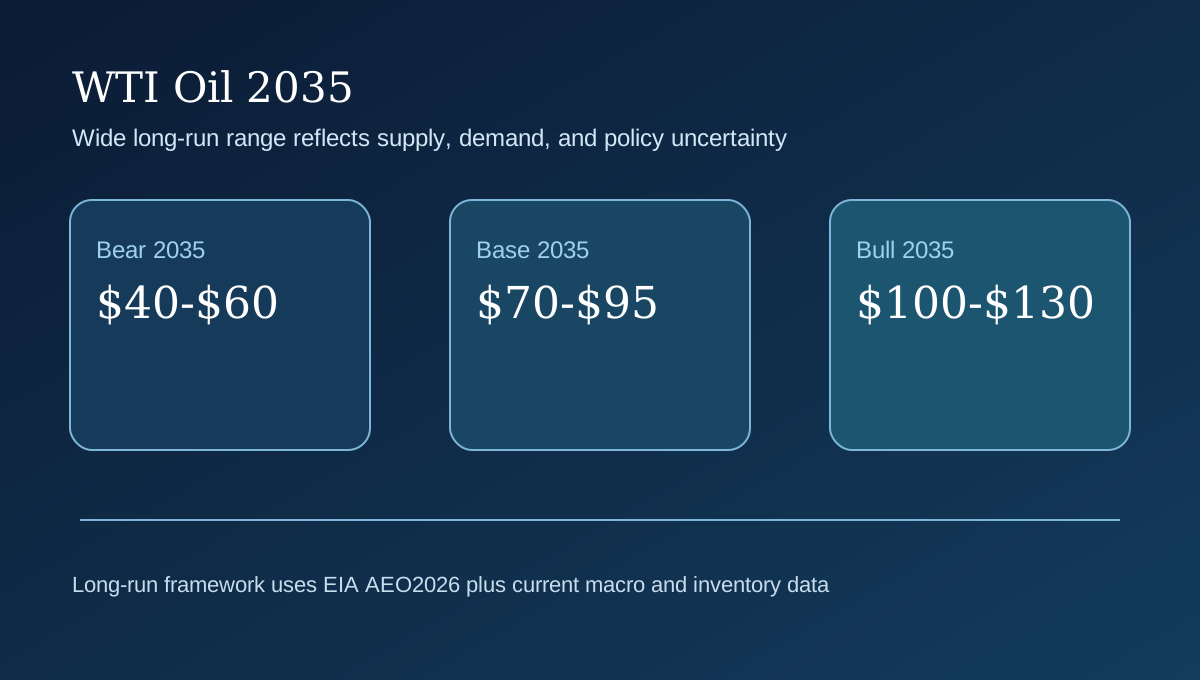
Base case, 45% probability: WTI trades in a $70-$95 range by 2035. Trigger: demand growth slows but stays positive in key end uses, and the supply side remains disciplined enough to prevent a prolonged glut. Review this thesis annually against AEO updates and each major IEA medium-term oil outlook.
Bull case, 30% probability: WTI trades in a $100-$130 range by 2035. Trigger: years of underinvestment, repeated outages, and a failure of spare capacity to rebuild. Review the thesis if Brent's real long-run path starts exceeding the AEO2026 narrative materially before 2030.
Bear case, 25% probability: WTI trades in a $40-$60 range by 2035. Trigger: supply remains flexible while efficiency, electrification, and weaker macro demand keep flattening consumption. Review the thesis if oil demand growth undershoots for several consecutive years and real prices fail to recover after shocks fade.
| Scenario | Probability | Target range | What must happen |
|---|---|---|---|
| Base | 45% | $70-$95 | Mid-cycle demand with disciplined but responsive supply |
| Bull | 30% | $100-$130 | Chronic underinvestment and repeated geopolitical outages |
| Bear | 25% | $40-$60 | Weak demand growth plus flexible supply and substitution |
The practical implication is that 2035 is not a call on one quarterly report. It is a call on whether the oil market keeps needing a risk premium to secure future supply.
References
Sources
- Yahoo Finance chart API for CL=F 10-year monthly history
- EIA Daily Prices page, including WTI spot and Brent spot updates
- EIA Weekly Petroleum Status Report, latest week ending May 8, 2026
- EIA Short-Term Energy Outlook tables, May 2026
- EIA press release on the May 12, 2026 STEO update
- IEA Oil Market Report, May 2026
- IMF World Economic Outlook, April 2026
- World Bank Commodity Markets Outlook press release, April 28, 2026
- BLS CPI release for April 2026
- BEA headline PCE price index page
- BEA core PCE price index page
- BEA GDP advance estimate for Q1 2026