Home
» Wiki
»
Best Halloween Team Building Games to Play at the Workplace
Best Halloween Team Building Games to Play at the Workplace
Halloween team building games that fit a real workday
The best Halloween team building games at work are short, easy to explain, and optional enough that people can take part without feeling put on the spot. A good office activity gives coworkers a shared task; it does not guarantee stronger collaboration by itself. Choose the game to match your group’s size, schedule, accessibility needs, and in-person or hybrid setup.
Illustrative example: Maya is a fictional team coordinator planning a 30-minute Halloween activity for a 14-person hybrid department. This scenario is only an example, not a real workplace, testimonial, or tested result. She wants people in the office and on video to have comparable ways to join, and she has a small supply budget. We’ll use her planning choices to show where each game fits.
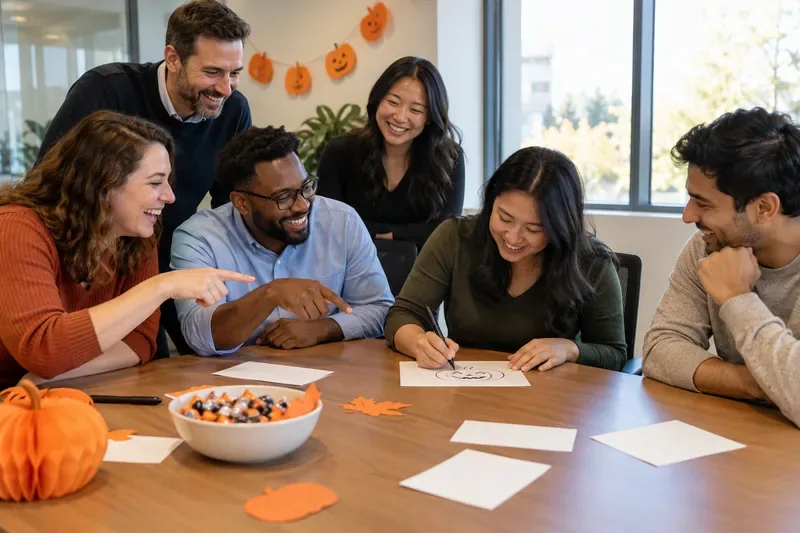
Coworkers share a low-key Halloween drawing game around a conference table.
First, clear up three common assumptions
“A team building game automatically improves teamwork.”
That result is not guaranteed by choosing a Halloween theme. A game creates a shared activity; whether it helps a particular team communicate or connect depends on the people and the setting. Action: Pick one simple goal—such as learning names across departments or practicing quick collaboration—and ask participants afterward what felt useful. Treat feedback as local information, not proof that the activity changed team performance.
“Everyone has to join because it’s a work event.”
That is not a safe assumption. In the United States, the EEOC says employers generally must reasonably accommodate sincerely held religious beliefs that conflict with work requirements, and its guidance specifically discusses excusing an employee from compulsory participation in an initiative or celebration when there is a religious conflict, absent undue hardship. That does not mean every Halloween game automatically creates a legal conflict; the facts matter. Read the EEOC workplace religious-accommodations fact sheet. Action: Keep social participation separate from performance evaluation, offer a non-Halloween alternative, and direct accommodation requests to the appropriate HR contact.
“One game format works for every team.”
That depends on the group. A loud charades round may suit one team and exclude someone who prefers written or seated participation; a remote employee may have a different experience from a person in the room. The EEOC describes reasonable accommodation as changes that can help an employee enjoy workplace benefits and privileges. The exact adjustment depends on the employee and workplace. Action: Offer more than one way to contribute—speaking, writing, drawing, or keeping score—and ask privately what adjustment would help. See the EEOC’s ADA overview for employees for the general workplace context.
Seven Halloween games to try at the office
1. Halloween trivia in small teams
Best for: A mixed group that likes quick, low-pressure questions. Time: 10–15 minutes. Materials: A short question list and answer sheet or shared document.
Make 10–12 questions about autumn, classic movie monsters, Halloween history, or seasonal pop culture. Keep questions general rather than testing obscure fandom knowledge. Teams can submit answers on paper or in chat; let people work in pairs before revealing each answer. Maya can create three mixed office-and-remote teams and have one remote participant submit each team’s final answers.
2. Paper-pumpkin design challenge
Best for: A creative break without messy carving. Time: 12–20 minutes. Materials: Paper circles or pumpkin outlines, markers, tape, and optional craft supplies.
Give each group the same paper pumpkin shape and a prompt, such as “design a pumpkin that represents our team’s superpower.” Allow drawing, collage, or a verbal design description that another teammate sketches. Share the designs and invite each group to explain one choice. Maya can mail a printable page to remote employees or use a digital whiteboard, then let everyone vote with a reaction or chat message. No one needs to buy or carve a real pumpkin.
3. Spooky story, one sentence at a time
Best for: Teams that enjoy improvisation but do not want a performance contest. Time: 8–12 minutes. Materials: A shared document, chat, or a facilitator keeping notes.
Start with a neutral opening line, such as “At 4:59 p.m., the office printer made one last request.” Each person adds one sentence in order. Participants can pass, type instead of speaking, or contribute an idea for someone else to read aloud. Stop after one round and read the story together. Maya can alternate between people in the room and online so the remote group is part of the same story rather than an audience.
4. Halloween Pictionary or charades—with a choice
Best for: Groups that want a lively, visual game. Time: 10–15 minutes. Materials: Prompt cards, paper or a digital whiteboard, and a timer if useful.
Use familiar prompts such as “haunted house,” “black cat,” or “candy corn.” Let the person drawing choose to sketch, describe a clue, or pass the prompt to a teammate; for charades, offer a seated gesture or written clue as an alternative. Keep the timer relaxed and skip elimination rules. Maya’s team can play through video by sharing a whiteboard, while an in-room teammate reads prompts to the camera.
5. Desk-side Halloween scavenger hunt
Best for: Hybrid groups and teams short on supplies. Time: 5–10 minutes. Materials: A list of harmless items or visual clues.
Ask participants to find something orange, something that makes them think of fall, or an object they would bring to a fictional haunted office. Nobody needs to leave their desk or show a private part of their home. People can describe an item instead of holding it up. Maya can use the same prompt list for everyone and accept answers by chat, voice, or a photo that avoids personal information.
6. The mystery envelope puzzle
Best for: Small groups that enjoy problem-solving. Time: 15–25 minutes. Materials: Three short paper or digital clues and one final answer.
Prepare a mini “solve the missing treat” story. Each clue reveals a letter, number, or detail needed for the final answer. Keep the puzzle self-contained, with no locked rooms, darkness, or surprise physical tasks. Give every team the same clues and a hint after a few minutes. Maya can email the clues to each mixed team and keep a facilitator available to read them aloud or paste them in the meeting chat.
7. Costume or desk-theme show-and-tell
Best for: A group that wants a casual social moment rather than a winner-takes-all game. Time: 10–15 minutes. Materials: None required.
Invite people to share a costume detail, a decorated workspace, or a favorite seasonal object. Make dressing up entirely optional and offer categories that do not rate appearance, such as “most inventive use of office supplies” or “best tiny detail.” Maya can invite remote staff to share a virtual background, a drawing, or simply listen. Avoid asking employees to explain personal or religious choices about whether they celebrate.
How Maya can choose a game for her team
With 30 minutes and hybrid attendance, Maya could open with a two-minute explanation, run one 12-minute trivia or story round, and use the remaining time for the paper-pumpkin challenge and a short share-out. This is one possible schedule, not a proven formula. If the team is quiet or has little time, the scavenger hunt is easier to end early. If coworkers already know one another well, the mystery puzzle gives them a shared task without requiring personal disclosures.
Use this quick filter before sending an invitation:
Time: Can the rules be explained in under two minutes?
Participation: Is there a comfortable way to pass, observe, or contribute another way?
Hybrid access: Can a remote participant do the same core activity?
Cost: Can the game work with paper, chat, or supplies already on hand?
Workplace fit: Does it avoid embarrassing prompts, forced disclosure, or unsafe movement?
Keep the event safe and easy to join
Use clear walkways, avoid open flames, and do not make running, blindfolds, or sudden scares part of an office game. The U.S. Consumer Product Safety Commission’s Halloween safety guidance recommends avoiding loose or overly long costumes that can cause trips and using battery-operated lights instead of open flames. Although that guidance covers general Halloween safety rather than workplace game design, the same precautions are sensible around desks, cords, and office decorations. Action: Choose paper-based activities, keep decorations away from exits and walkways, and check your office’s event and safety policies.
The strongest Halloween team building activity is the one that fits your colleagues instead of asking them to fit the game. Start with a short, low-cost option, make participation welcoming, and adjust after hearing what your own team prefers.