Home
» Chinese Astrology
»
Chinese Zodiac 2027: Fire Goat Element, Meaning, and Personality Traits
Chinese Zodiac 2027: Fire Goat Element, Meaning, and Personality Traits
The 2027 Chinese zodiac year is commonly called the Year of the Fire Goat, also rendered as the Fire Sheep or Fire Ram. In the Hong Kong Observatory’s Gregorian–lunar table, 2027 is the Ding-wei year of the Goat, and the first day of the lunar year falls on February 6. The name combines an animal from the repeating 12-year cycle with a stem-and-branch designation from a longer calendar cycle. It is a cultural calendar label; it should not be treated as a tested personality profile or a reliable forecast of an individual’s future.
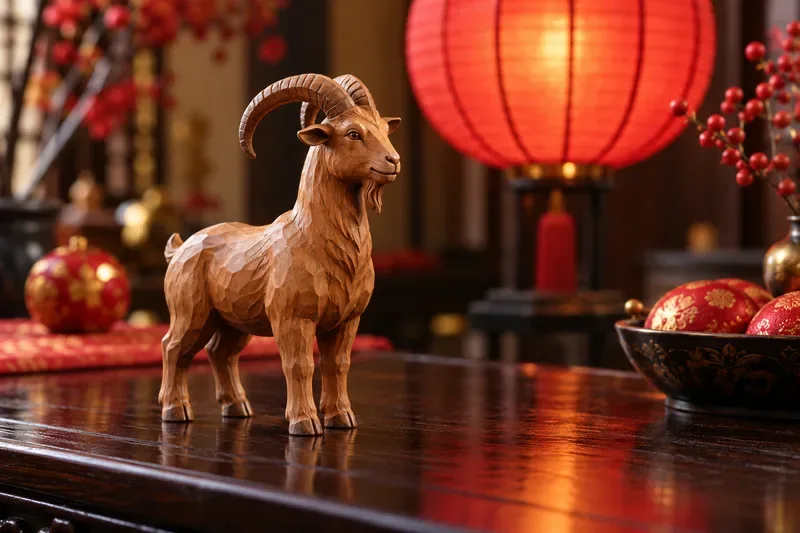
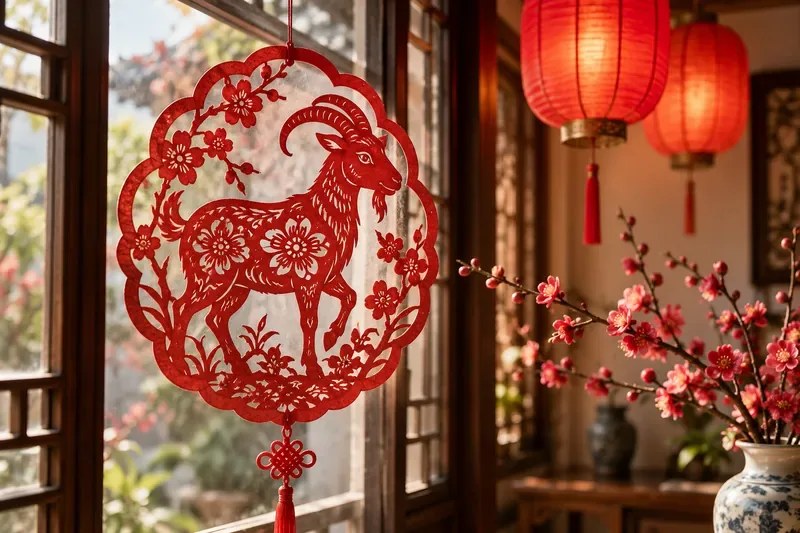
A carved wooden goat stands beside a glowing red lantern and red-and-gold decorations.
That distinction helps answer two different questions: “What does Fire Goat mean in the traditional calendar?” and “What does it prove about a person?” The calendar can verify the year name and its boundary. Personality language is symbolic and varies by interpreter. Knowing which kind of answer you need will help you choose a useful reading without giving it more weight than it can support.
What “Fire Goat” means in the 2027 calendar
The Chinese calendar uses a 12-year animal cycle. The Hong Kong Observatory lists the twelve branches and their animal symbols, including Wei, represented by the Goat. The Observatory also explains that each year can be recorded using a heavenly stem paired with an earthly branch; the pairings cycle through 60 combinations. The 2027 calendar calls the year Ding-wei. Smithsonian describes the same zodiac year as Fire Goat and explains that the animal cycle also rotates through five elements: Wood, Fire, Earth, Metal, and Water.
In that naming system, “Goat” identifies the animal branch and “Fire” identifies the element associated with the year’s stem. Fire is one part of the five-element cycle, not a statement that a person born in 2027 has a literal “fire” temperament. English translations also vary: Goat, Sheep, and Ram appear in different renderings. The Smithsonian uses “Goat (or Ram),” while HKO uses “Goat.” When comparing calendars, make sure the Chinese branch or year designation matches instead of assuming the English animal word always tells the whole story.
The HKO and Smithsonian sources are useful for confirming calendar names and cultural context. They do not establish that a birth-year label measures an individual’s character. For that reason, treat traits below as traditional associations and prompts for reflection, not fixed facts about every Goat-born person.
Personality traits traditionally associated with the Fire Goat
Smithsonian’s short cultural description associates the Goat with kindness, peace, and inner strength. Popular horoscope interpretations often layer Fire onto that image with qualities such as warmth, enthusiasm, initiative, or visibility. The balance is the interesting part: the Goat is often presented as considerate and steady, while Fire can symbolize a more expressive or forceful style. These are interpretive themes, not a consensus personality scale.
Traditional theme
Constructive expression
Possible trade-off
Kindness and empathy
Noticing what others need and building trust.
Taking on too much or avoiding a necessary disagreement.
Peace and cooperation
Finding workable compromises and keeping a group connected.
Agreeing too quickly to preserve harmony.
Inner strength
Staying with a demanding task even when progress is gradual.
Keeping frustration private instead of asking for support.
Fire as warmth or visibility in popular readings
Sharing ideas, starting a creative project, or making a clear appeal.
Moving too fast, seeking approval, or confusing attention with progress.
The trade-offs are not predictions. They show how the same quality can help or hinder depending on the situation. For example, someone who values harmony may be a strong mediator on a project team; that strength becomes less useful if they avoid telling a colleague that a deadline is at risk. A “Fire Goat” reading can offer a question—“Where would a little more directness help?”—but it cannot establish that the person is naturally conflict-averse.
Choose the calendar convention that fits your question
For most everyday zodiac references, the lunar New Year is the clearest boundary. But people consulting a Four Pillars or BaZi chart may encounter another convention. BaZi is a traditional system that combines year, month, day, and hour stem-branch pairs; the HKO calls those four pairs the Eight Characters. HKO notes that its official calendar marks the Gan-Zhi year change on the first day of the first Chinese calendar month, while fortune-tellers or enthusiasts often use “Spring Commences,” the solar term known as Li Chun.
Approach
Boundary or information used
Best fit
Trade-off
Common zodiac-year label
Lunar New Year; in 2027, February 6.
Reading a general zodiac calendar or discussing the year’s animal.
Someone born in early February may fall in the prior animal year under this rule.
Li Chun year boundary
“Spring Commences”; the HKO 2027 calendar lists it on February 4.
Following a specific fortune-telling or BaZi method that explicitly uses this boundary.
It differs from the standard lunar-year boundary and can produce a different year label for dates between the two.
Full BaZi chart
Year, month, day, and hour pillars, with the chosen calendar rules.
Readers who want to explore the broader traditional chart framework.
It needs accurate birth details and a clearly stated method; it is more involved and still remains a traditional interpretive system.
For a birth on February 4 or 5, 2027, the choice matters: the lunar calendar has not reached New Year yet, while Spring Commences has arrived. HKO’s calendar and explanation make the two dates and the two conventions clear. If you are using a chart service or consulting a practitioner, ask which boundary it uses and whether it converts the birth time to a particular time zone. Do not combine one method’s year label with another method’s chart rules without saying so.
Which reading should you use?
For a holiday, classroom, or cultural overview: use the February 6 lunar New Year boundary and call 2027 the Year of the Fire Goat. Mention Sheep or Ram as translation variants when useful.
For a birth date close to early February: verify the exact date against the HKO lunar calendar and state whether you are following Lunar New Year or Li Chun. If the precise birth moment matters to a chart, use the source’s time-zone instructions.
For personality reflection: treat Goat and Fire descriptions as prompts. Compare them with observed habits, feedback, and the person’s own account rather than using a zodiac label to judge character or compatibility.
For a practical decision about work, money, health, or a relationship: give more weight to relevant evidence—costs, goals, medical advice, communication, and circumstances—than to a year sign.
The most useful way to read “Chinese Zodiac 2027: Fire Goat” is to separate the verifiable calendar from the symbolic interpretation. The year label is supported by the calendar’s stem-branch cycle and the lunar date. Associations such as kindness, peace, inner strength, and a warmer Fire quality belong to a cultural horoscope tradition, whose descriptions vary and do not account for a person’s full life. Choose the convention that matches your purpose, name its limits, and let the symbolism invite reflection rather than make the decision for you.