Home
» Discover
»
Cozy Autumn Wardrobe Essentials for 2026: A Practical Capsule for Cooler Days
Cozy Autumn Wardrobe Essentials for 2026: A Practical Capsule for Cooler Days
A verified shift for Autumn/Winter 2026 is easier to see in color than in any single “must-have” garment. On February 11, 2026, the Pantone Color Institute released its New York Fashion Week Autumn/Winter 2026–2027 report, pairing grounded shades such as Muted Clay, Arabian Spice, Red Mahogany, and Burnt Olive with brighter options and a group of seasonless neutrals. That does not mean your closet needs a trend-driven reset. It means 2026 gives you a useful palette to refresh familiar fall layers without replacing what already works. See the official Pantone Autumn/Winter 2026–2027 color report.
To make this practical, consider an illustrative example: Maya has a hybrid office schedule, walks part of her commute, and lives somewhere with cool mornings, milder afternoons, and occasional rain. She wants a cozy autumn wardrobe that feels current in 2026 but does not require buying a completely new closet. Maya is fictional; the example is simply a way to show how the pieces can work together.
A compact autumn wardrobe built around warm neutrals, textured knits, practical boots, and a few earthy accent colors can create many outfits without relying on one-season trends.
Start with the outcome: a wardrobe that handles temperature swings
The best autumn wardrobe is not the one with the most sweaters. It is the one that lets you adjust quickly when the day starts cold, warms up at noon, and cools again after sunset. For Maya, that means building outfits in layers rather than depending on one heavy piece.
A simple test is whether an outfit can lose one layer and still look intentional. If removing your coat leaves you in a base layer that feels too thin for the office, or taking off a sweater exposes something you would not want to wear on its own, the system is not flexible enough.
Merino wool can be useful here because Woolmark describes it as breathable, temperature-regulating, moisture-managing, and suitable for base, mid, and outer layers. A lightweight merino top, for example, can sit under a cardigan or jacket without adding much bulk. Those fiber properties do not guarantee that every merino garment will feel the same, however; knit density, garment construction, blends, and individual skin sensitivity still matter. See Woolmark's official pages on wool fiber properties and merino base layers.
The eight cozy autumn wardrobe essentials that do the most work
Essential
What it should do
Keep-or-buy test
Lightweight base layer
Add warmth without bulk and work under knits or jackets
You can wear it alone indoors and comfortably layer over it
Fine-gauge sweater
Bridge casual and polished outfits
It fits under your main jacket without bunching
Chunky sweater or cardigan
Provide visible texture and warmth on colder days
It works with at least two bottoms you already own
Structured mid-layer
Add shape through a blazer, chore jacket, or overshirt
It looks good open and closed
Weather-appropriate outer layer
Handle wind, drizzle, or real cold depending on climate
It fits over your thickest planned sweater
Reliable everyday bottoms
Anchor repeated outfits
You can sit, walk, commute, and layer comfortably
Closed-toe everyday shoes
Handle cooler streets and longer wear
They work with both pants and your preferred dress/skirt silhouette
One functional accessory layer
Add warmth and color with a scarf, beanie, or wrap
You will actually carry and wear it when temperatures change
1. A lightweight base layer
For Maya, the first piece is not a statement item. It is a long-sleeve top that disappears under other clothes. Cotton jersey works for mild weather; a fine merino layer can be useful when she needs more warmth in less space. The important point is fit: close enough to layer cleanly, but not so tight that it feels like athletic compression unless that is what you want.
If your climate stays warm well into fall, a short-sleeve tee, tank, or lightweight button-down may be a better base. “Autumn essential” should describe a job in your wardrobe, not a fixed fabric weight.
2. A fine-gauge sweater you can dress up or down
A crewneck, mock neck, or slim cardigan in a relatively smooth knit gives Maya a piece she can wear with jeans on Friday and trousers on Monday. Fine-gauge knitwear is especially useful under a blazer or coat because it adds warmth without turning the sleeves into a tight squeeze.
For 2026, this is an easy place to use Pantone's seasonless shades as inspiration. Creamy off-white, warm tan, gray, or deep blue can act as the quiet layer that makes stronger fall colors easier to wear.
3. One visibly cozy knit
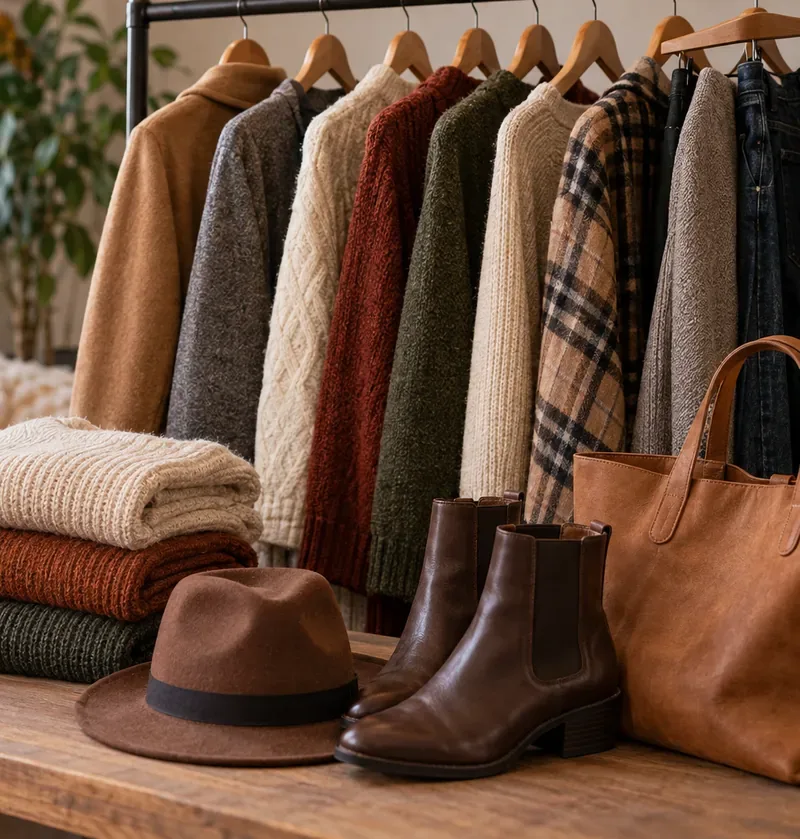
The second knit should do something different. Think a cable sweater, relaxed cardigan, textured half-zip, or brushed pullover. Maya chooses one in an earthy rust tone because it works with her existing denim, charcoal trousers, and camel coat.
The key is to avoid buying several sweaters that create the same outfit. If three chunky knits all require the same bottom, same coat, and same weather, they are competing for the same role. One strong version is usually more useful than a row of near-duplicates.
4. A structured mid-layer
Autumn wardrobes benefit from contrast: soft knit underneath, sharper layer on top. A chore jacket, wool-blend blazer, denim jacket, or overshirt can give shape to cozy pieces and make them feel less like loungewear.
In Maya's example, a relaxed blazer is the office-friendly choice. Someone with a more casual routine might get more use from a denim or canvas overshirt. The better option is the one that survives your actual week, not the one that looks best in a seasonal mood board.
5. An outer layer matched to your real weather
A camel coat photographs beautifully in fall, but it is not automatically the smartest outer layer. Maya needs light insulation and occasional rain protection, so she checks the forecast patterns in her own region and chooses accordingly. In a wet climate, a water-resistant shell or trench may earn more wears. In a colder, drier climate, a wool coat may make more sense. In a mild climate, a lined jacket may be enough.
Whatever you choose, try it over the bulkiest sweater you plan to wear. If the shoulders pull, sleeves bind, or front will not close comfortably, the coat is not functioning as a layering piece.
6. Two dependable bottoms, not five “fall” bottoms
Maya keeps one pair of straight-leg dark jeans and one pair of relaxed trousers in rotation. That is enough to cover much of her workweek because the visual change comes from the upper layers, shoes, and accessories.
If skirts or dresses are more natural for you, the same principle applies: choose silhouettes that work with the tights, socks, boots, and coats you actually wear. The goal is outfit compatibility, not a prescribed capsule formula.
7. Closed-toe shoes that tolerate repeat wear
Brown or black ankle boots are a classic autumn choice because they can bridge jeans and tailored trousers, but loafers, sneakers, clogs, or weatherproof walking shoes may be more useful depending on your commute. Maya chooses simple leather Chelsea boots because she can walk in them and they work with both of her main bottoms.
A useful fitting test is to try fall shoes with the socks you intend to wear. A boot that fits only with thin summer socks may become uncomfortable once temperatures drop.
8. A scarf or other removable warmth layer
A scarf is often a better early-autumn purchase than another sweater because it is easy to remove, easy to carry, and can introduce a seasonal color without changing the rest of the wardrobe. Maya uses a plaid scarf to connect cream, rust, camel, and olive pieces she already owns.
How to use the 2026 color story without becoming trend-dependent
Pantone's New York report for Autumn/Winter 2026–2027 describes a mix of grounded earth tones, carefully considered neutrals, and vivid accents. For a wearable wardrobe, you do not need all of them. Maya uses a simple three-part approach:
Foundation: cream, camel, charcoal, denim, and brown.
Seasonal accents: rust inspired by Muted Clay or Arabian Spice, plus olive inspired by Burnt Olive.
Optional bright note: one scarf, bag, sock, or knit in a stronger blue, pink, or yellow if she wants more energy.
This keeps the 2026 update visible without making the entire closet dependent on one forecast. If a trend color does not flatter you, coordinate with your existing clothes, or feel natural to wear, skip it. A forecast is inspiration, not a requirement.
A one-week outfit test for the fictional capsule
Before Maya buys anything else, she tests the wardrobe for a week. Monday is trousers, base layer, fine sweater, and blazer. Tuesday is jeans, chunky sweater, and boots. Wednesday is trousers, lightweight top, scarf, and coat. Thursday repeats the jeans but swaps in the fine sweater and structured layer. Friday uses the chunky cardigan over the base layer with whichever bottom suits the day.
The point is not the exact schedule. It is the diagnostic result. By the end of the week, Maya should know whether she has enough temperature flexibility, whether one pair of shoes is doing too much work, whether a coat fits over the intended layers, and whether the color palette mixes easily.
If she keeps avoiding one item because it itches, wrinkles badly, requires inconvenient cleaning, or only works with a single outfit, that item is not an essential for her—even if it is fashionable.
Care requirements belong in the buying decision
Cozy fabrics often come with different care needs, so check the label before committing. In the United States, the Federal Trade Commission's Care Labeling Rule requires manufacturers and importers of covered textile apparel to provide regular care instructions. The FTC also notes that care labels should tell consumers the care procedure needed for ordinary use and warn when common procedures could harm the item. See the official FTC Care Labeling Rule.
That makes care a practical wardrobe filter. If Maya knows she will not hand-wash delicate knits or pay for frequent dry cleaning, she should not treat those garments as everyday essentials. An easy-care piece that gets worn weekly is more valuable to her than a beautiful piece that stays folded.
When to change the formula
This capsule approach has limits. If autumn where you live is mostly warm and humid, replace heavy knits with breathable shirts, light cardigans, and a thin rain layer. If your fall is cold, windy, and short, prioritize thermal base layers, heavier outerwear, gloves, and weather-ready footwear sooner. If you work in a formal office, shift the structured layer toward tailoring. If you spend most days outdoors, prioritize insulation, moisture management, visibility, and traction over fashion-first silhouettes.
You should also change direction if the wardrobe takes too much maintenance. A capsule is supposed to reduce friction. If your “versatile” pieces all need special cleaning, cannot be worn in your actual weather, or require constant outfit planning, the solution is not working.
What success looks like by late autumn
For Maya, the wardrobe is successful if she can get dressed quickly, stay comfortable through temperature changes, and create noticeably different outfits without needing a large number of pieces. She should also be able to identify which garments are doing the most work and which ones are not earning closet space.
That is the most useful way to think about cozy autumn wardrobe essentials for 2026. Start with layers that solve real comfort problems. Use this year's color direction to refresh combinations you already own. Add texture through one or two knits rather than buying duplicates. Match outerwear and shoes to your actual climate. And treat care, fit, and repeat wear as part of style—not as afterthoughts.
Trend references and source pages were checked in September 2026. Fashion forecasts describe directional color and design signals, not guarantees about what every retailer, region, or individual will wear. Fabric performance also depends on garment construction, blend, fit, and care.