Home
» Discover
»
Culinary Tourism: 7 Best Cities for Food Lovers and How to Choose
Culinary Tourism: 7 Best Cities for Food Lovers and How to Choose
Choosing a destination for a food-focused vacation sounds easy until you start comparing cities. Tokyo offers everything from counter sushi to ramen alleys; Singapore can turn one hawker-center visit into a tour of several culinary traditions; Naples makes a single craft, pizza, feel inseparable from the city itself. The problem is that “best food city” lists often mix very different experiences and then rank them as if every traveler wants the same thing.
A better approach is to start with the kind of eating you actually enjoy, then compare how much planning, movement, and spending each city demands. This guide focuses on durable culinary culture rather than temporary restaurant rankings or award counts, which can change quickly. Official tourism and heritage sources were checked on September 14, 2026; individual restaurants, market hours, and reservation policies should still be verified before travel.
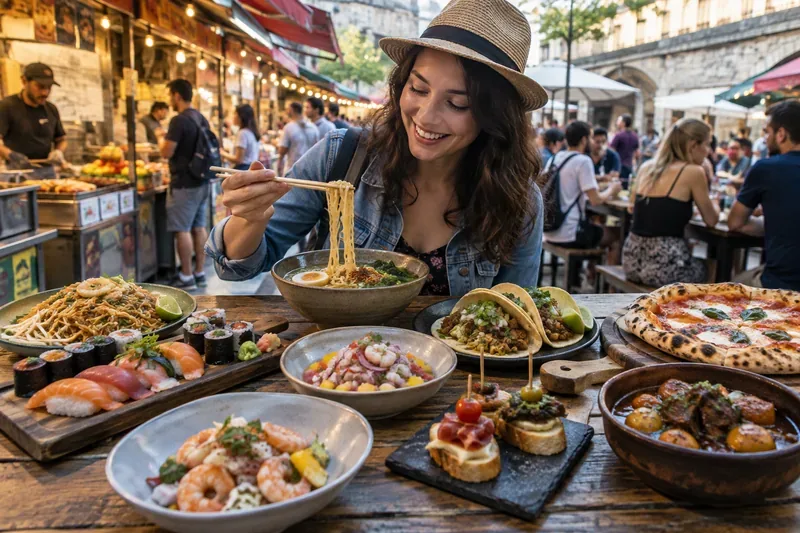
A traveler samples several dishes at a busy open-air food market, illustrating how culinary tourism can combine market stalls, casual dishes, and local dining culture in one trip.
Start with the easiest decision: what kind of food trip do you want?
The most useful first filter is not prestige. It is dining format. Some travelers want markets and small dishes that make it possible to taste ten things in a day. Others want one defining regional tradition, such as Neapolitan pizza or Lyonnais bouchons. Still others care about the contrast between casual food and ambitious chef-driven restaurants.
Great food is widely dispersed, so route planning matters
Lima
Seafood and layered culinary influences
Ceviche, tiradito, chifa, huariques
The most ambitious dining may require reservations and higher spend
Naples
A deeply rooted single-city specialty
Neapolitan pizza and everyday street food
The experience is narrower if you want many unrelated cuisines
San Sebastián
Pintxo hopping and refined Basque cooking
Bar-to-bar pintxos in the old town
Popular dining rooms can be reservation-intensive
Lyon
Traditional French regional cooking
Bouchons, charcuterie, quenelles, praline sweets
Rich traditional dishes may be less appealing to light eaters
1. Tokyo, Japan: best for travelers who want almost unlimited variety
Tokyo is the safest choice when your group cannot agree on one definition of a great meal. The city’s official tourism guide highlights sushi and seafood, ramen and noodles, izakaya, yokocho alleyways, local foods, sweets, cafes, and long-established restaurants. It also points visitors toward areas such as Tsukiji and Toyosu for seafood, Shinjuku and Tokyo Station for ramen, and traditional neighborhoods such as Kanda, Nihonbashi, and Asakusa for soba, tempura, and multigenerational restaurants.
The easy way to use Tokyo is to assign each neighborhood one food mission instead of chasing famous restaurants across the entire metropolis. For example, plan a seafood morning, a noodle lunch area, and an izakaya evening. That reduces transit and lets spontaneous discoveries remain part of the trip.
The harder part is choice overload. A four-day visitor can waste time trying to optimize every meal. Tokyo works best when you choose categories first and specific venues second. For an official overview, see GO TOKYO’s Food & Drink guide.
2. Singapore: best for high variety with low logistical friction
Singapore is unusually efficient for culinary tourism because many dishes can be sampled in concentrated hawker centers rather than spread across dozens of formal restaurants. UNESCO inscribed Singapore’s hawker culture on the Representative List of the Intangible Cultural Heritage of Humanity in 2020, describing hawker centers as community dining spaces shaped by Chinese, Malay, Indian, and other culinary traditions.
For first-time food travelers, that structure solves a common problem: one dining stop can satisfy people with different tastes and budgets. A group can order from several stalls, share dishes, and compare styles without committing to a long tasting menu. National Heritage Board material also documents how hawker centers grew from older street-hawking traditions and remain closely tied to Singapore’s social life.
The trade-off is that “easy” does not mean “automatic.” Stall opening days vary, and Singapore’s official visitor information notes that small businesses such as hawker stalls may close one day a week or during festive periods. Build alternatives into your plan instead of traveling across the city for one stall only. Read the original heritage description at UNESCO’s hawker culture listing and practical visitor guidance at Visit Singapore’s essential travel information.
3. Mexico City, Mexico: best for market explorers and all-day grazing
Mexico City rewards travelers who prefer eating in motion. Public markets, neighborhood stands, bakeries, tortillerías, and casual restaurants make it possible to build a day around small stops instead of a single destination meal. The national tourism site specifically highlights Mercado de La Merced and a wide range of neighborhood markets, which is useful evidence of how central market culture is to the visitor experience.
A practical food day might combine breakfast pastries or tamales, a market visit, tacos or other antojitos for lunch, and a sit-down dinner later. The strength is flexibility: you can spend modestly for much of the day and still reserve room for one more elaborate meal.
The challenge is geography. Mexico City is enormous, and a list of “must-eat” addresses can become a transportation itinerary rather than a food itinerary. Group stops by neighborhood and leave time for places you discover while walking. For official destination and market references, see Visit Mexico’s Mexico City food-focused listings.
4. Lima, Peru: best for seafood lovers who also want culinary cross-currents
Lima is compelling because its food story is not only about one dish. Peru’s official tourism site describes the city’s cuisine through ceviche and tiradito while also emphasizing Indigenous, African, and Chinese influences. It points visitors toward a spectrum of venues that includes markets, ceviche restaurants, huariques, and chifas.
That makes Lima a good choice for travelers who want contrast within one culinary identity. You can experience sharp, citrus-driven seafood, Chinese-Peruvian cooking, home-style specialties, and ambitious contemporary menus without treating them as disconnected cuisines.
The simple strategy is to make lunch the anchor meal for seafood and use dinner for a different style. The more complicated version is to add highly sought-after restaurants, which may require advance planning. Avoid building the entire trip around one reservation: Lima’s value as a food destination is broader than any single dining room. See Peru Travel’s official Cuisine of Lima guide.
5. Naples, Italy: best for travelers who want food tied closely to place and craft
Naples is a strong answer when the point of the trip is not maximum variety but maximum connection between food, neighborhood life, and craft. UNESCO inscribed the art of the Neapolitan pizzaiuolo in 2017, describing a practice that includes dough preparation, wood-fired baking, apprenticeship, and the social exchange around the pizzaiuolo’s work.
Pizza is the obvious center of gravity, but the broader trip can include fried snacks, pastries, coffee, seafood, and simple pasta dishes. The advantage is clarity: you do not need a complicated dining spreadsheet to understand what makes Naples distinctive.
The trade-off is the same clarity. Travelers who measure a food city by the number of unrelated global cuisines may find Tokyo or Singapore more satisfying. Naples is strongest when you want to understand how one local tradition can shape a city’s identity. Read UNESCO’s official listing for the art of the Neapolitan pizzaiuolo.
6. San Sebastián, Spain: best for bar-to-bar tasting with a fine-dining option
San Sebastián is ideal for travelers who like to compare many small bites in one evening. Spain’s official tourism site explains the local pintxo tradition and specifically recommends exploring the old town, where visitors can move from bar to bar sampling different preparations. It also notes the city’s internationally known Basque gastronomy and its mix of traditional and imaginative cooking.
The easiest version of the trip requires almost no formal structure: choose a compact area, order one or two pintxos, move to the next bar, and repeat. This is one of the best culinary formats for travelers who dislike committing an entire evening to a single restaurant.
The harder version adds sought-after destination restaurants, and that changes the trip. Reservations, transportation, and a larger budget become more important. Decide before booking whether your priority is pintxo culture or high-end dining; trying to maximize both every day can become exhausting. Start with Spain.info’s official San Sebastián destination guide and its Basque Country cuisine overview.
7. Lyon, France: best for travelers who want a regional French food tradition
Lyon is a strong counterpoint to Paris for travelers who want a clearly regional French identity. France’s official tourism site describes the city’s bouchons as convivial restaurants serving Lyonnais specialties and highlights dishes such as quenelles, sausages, herb cheese preparations, and pink-praline desserts.
The simplest way to experience Lyon is to mix one traditional bouchon meal with market browsing and lighter meals around it. This matters because traditional Lyonnais cooking can be rich. Eating heavy specialties at every meal may make the trip less enjoyable rather than more authentic.
Lyon’s main advantage is coherence: the local restaurant tradition, charcuterie, regional wines, sweets, and food-market culture reinforce one another. Its trade-off is that travelers seeking tropical flavors, intense street-food variety, or late-night grazing will likely prefer another city on this list. Read France.fr’s guide to Lyon’s bouchons.
Move to the harder trade-offs before you book
How much of your trip should require reservations?
If you dislike scheduling meals weeks ahead, prioritize Singapore hawker centers, Mexico City markets and neighborhood food, Naples pizzerias, or informal Tokyo dining. San Sebastián and Lima can also be spontaneous, but their most famous destination restaurants can push you toward a more structured itinerary. A good rule is to reserve only the meals that would genuinely disappoint you to miss and keep the rest flexible.
Do you want one citywide food theme or constant contrast?
Naples and Lyon are excellent when you want a strong regional through-line. Tokyo, Singapore, and Mexico City are stronger when you want many formats and flavor profiles. Lima and San Sebastián sit in the middle: both have recognizable local identities but also support ambitious contemporary dining.
Are you willing to travel across a large city for food?
Tokyo and Mexico City can consume a surprising amount of time if every meal is in a different district. Singapore is compact and transit-friendly, while the core pintxo experience in San Sebastián is unusually walkable. The best culinary itinerary is often the one with fewer “must-eat” pins and more neighborhood depth.
How to build a food-focused itinerary without overplanning
Choose three food experiences, not 30 restaurants. Examples include a market breakfast, a local specialty lunch, and an evening of small plates.
Cluster by neighborhood. Food quality does not improve because you spent 45 minutes crossing town between bites.
Schedule one anchor meal per day at most. Leave the other meals open for recommendations, queues, appetite, and weather.
Check opening days close to travel. Markets, family businesses, and hawker stalls can close on specific weekdays or holidays.
Plan for dietary needs explicitly. Learn the local terms for serious allergies and confirm ingredients directly when the consequence of a misunderstanding is high.
Keep one “splurge” slot optional. If a higher-end restaurant fits your budget and travel style, it can add contrast without turning the entire trip into a reservation project.
Self-check: did you choose the right culinary city?
Before paying for flights, test your choice with five questions. Can you name at least three food experiences in the city that genuinely excite you? Can at least half of your meals stay flexible? Are the places you want concentrated enough that travel time will not dominate the day? Does your budget match the dining style you selected? And would you still want to visit if the single most famous restaurant or stall were closed?
If the answer is yes to most of those questions, you probably have a destination that fits your actual travel style rather than someone else’s ranking. For maximum variety, start with Tokyo. For the easiest multi-cuisine sampling, Singapore is hard to beat. For markets and street-level discovery, Mexico City stands out. Choose Lima for seafood and layered culinary influences, Naples for a food craft inseparable from place, San Sebastián for pintxo hopping with a fine-dining ceiling, and Lyon for a classic regional French experience.