Why did the FTSE MIB fall today? Milan lost 2.48% — November 20, 2026
The FTSE MIB closed down 2.48% on November 20, 2026. Selling in technology stocks weighed, but sources did not prove a single cause for the entire index.
Verified: November 20, 2026, 1:14 p.m. London GMT (UTC+00:00).
HM Revenue and Customs (HMRC) can operate unmarked vehicles equipped with emergency warning lights during certain serious-crime investigations in Great Britain. This is not a newly announced power: a 2005 change to road-vehicle lighting rules expressly brought qualifying HMRC vehicles within the legal definition of an emergency vehicle. Government documents from the time also explain why investigators wanted both blue lights and sirens for specialist surveillance work. The authorization is tied to serious criminal investigations, not everyday tax collection.
Our review of official UK legislation and HMRC guidance on November 20, 2026 found the established legal framework, but no verified new blanket permission or newly announced fleet deployment. For drivers, the practical point is straightforward: an unmarked car displaying emergency signals may be carrying out authorized law-enforcement work, but its appearance alone does not establish the identity or powers of its occupants.
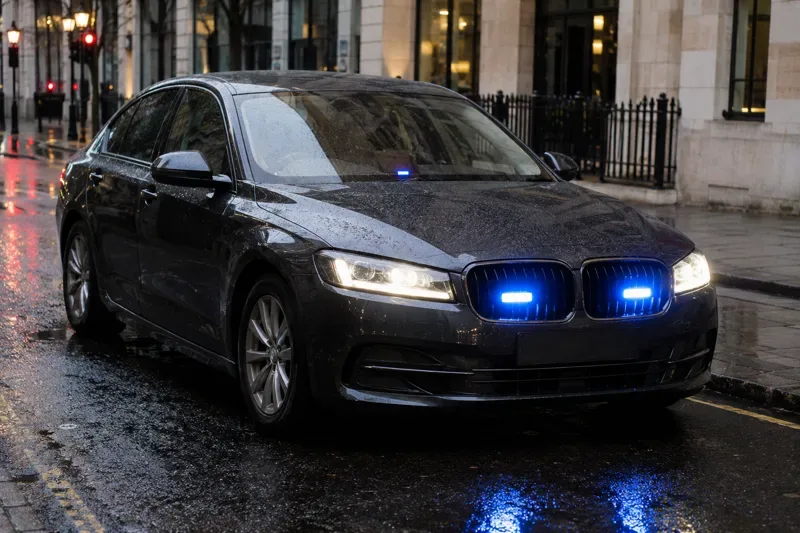
HMRC does more than assess tax and collect revenue. Its trained criminal investigators investigate serious tax fraud and other financial or organized crime. Covert vehicles can help officers observe suspects without revealing an operation prematurely. At a critical moment, however, a team may need to move urgently through traffic or become visibly recognizable to the public and other officers.
The Department for Transport's 2005 explanatory memorandum described the request from the former Customs and Excise, which had become HMRC. It specifically cited public and officer safety, urgent responses to intelligence in heavy traffic, and enforcement situations in which officers needed to switch from covert observation to overt identification. The document discussed flashing blue lights and sirens as public warning equipment, rather than as a routine feature of all HMRC cars.
That distinction matters. A surveillance car may deliberately look like an ordinary vehicle for much of an operation, while concealed equipment can be deployed when warning other road users becomes necessary. The existence of the power does not tell the public how many such cars HMRC uses today, where they are stationed, or whether any specific vehicle seen on the road belongs to the agency.
The Road Vehicles Lighting (Amendment) Regulations 2005 amended the 1989 lighting regulations' definition of an emergency vehicle. The added category covers a vehicle under the lawful control of the Commissioners for HMRC and used from time to time to investigate serious crime. The accompanying explanatory note makes clear that this permits qualifying vehicles to be fitted with a blue warning beacon, special warning lamp, or resembling device.
The broader regulation 16 normally restricts blue warning equipment to emergency vehicles and certain other defined exceptions. Regulation 27 also restricts when blue warning lights may actually be illuminated: for example, at an emergency scene, to convey urgency, or to warn road users of a vehicle or hazard. Permission to fit equipment and justification for using it are related but separate questions.
These particular lighting regulations apply in Great Britain—England, Scotland and Wales. Northern Ireland has a distinct road-traffic legislative framework, so the Great Britain amendment should not be presented as automatically establishing an identical entitlement there.
Sirens are governed separately from vehicle lighting. Regulation 99 of the Road Vehicles (Construction and Use) Regulations 1986 generally restricts sounding a siren or two-tone horn, with exceptions linked to specified emergency purposes and circumstances where warning other road users is necessary or desirable. The 2005 policy memorandum discussed the need to address both lighting and non-lighting rules. Consequently, a general claim that every HMRC employee can switch on a siren would be inaccurate.
Nor does a blue light itself prove an automatic exemption from every road rule. Speed-limit exemptions and other traffic-law exceptions have their own legal tests, including the vehicle's qualifying purpose and applicable statutory provisions. Emergency driving also requires due care for other road users. A vehicle cannot lawfully create an avoidable danger merely by displaying warning equipment.
No. A passing unmarked vehicle does not establish that its occupants are HMRC officers or that anyone nearby is under investigation. HMRC's published criminal-investigation safeguards explain that criminal powers are exercised by appropriately trained and authorized officers, and distinguish criminal evidence-gathering from civil tax assessments and penalties. Serious-crime operations are a narrower category than routine administrative compliance work.
Covert observation has its own rules. HMRC's surveillance guidance addresses the Regulation of Investigatory Powers Act 2000, authorizations, and privacy safeguards. The necessity and proportionality of an investigative technique matter. The legal ability to fit emergency lights does not substitute for the authorization needed to undertake regulated surveillance, nor does it transform a routine civil inquiry into a serious-crime operation.
The safest response is to follow Highway Code Rule 219: remain calm, assess where the vehicle is going, and make space only when safe while complying with traffic signs and signals. Pull over when appropriate, but do not drive through a red light, mount the sidewalk, stop on a blind bend, or brake suddenly at a junction to accommodate a vehicle behind you.
If an unmarked car signals for you personally to stop and you are unsure whether it is genuine, avoid dangerous maneuvers or confrontation. Move toward a safe, well-lit place if circumstances permit, and contact police on 999 if there is an immediate threat or you believe you are in danger. For non-emergency verification, use official agency contact details rather than a number provided by an unknown individual. Warning lights are a road-safety signal, not proof of a person's identity.
No verified new rule or fleet-wide announcement was identified in the official sources reviewed for this article on November 20, 2026. Future legislation, published HMRC policies or official statements could clarify equipment use or operating arrangements, but claims about new siren privileges, numbers of cars or specific deployments should not be treated as established without primary evidence. The present takeaway remains the limited serious-crime basis of the power, coupled with operational safety and statutory safeguards.
Yes, qualifying HMRC-controlled vehicles used for serious-crime investigations are included in the Great Britain emergency-vehicle definition under the 2005 lighting amendment. The law does not extend that category to every HMRC vehicle.
No. HMRC has specialized criminal-investigation powers for authorized and trained officers, but its powers are defined separately and are not identical to those of police officers.
No. Follow Highway Code Rule 219: help an emergency vehicle pass where safe, but keep obeying traffic signs and do not put anyone at risk.
The FTSE MIB closed down 2.48% on November 20, 2026. Selling in technology stocks weighed, but sources did not prove a single cause for the entire index.
The supplied Yahoo Finance snapshot shows the Euro Stoxx 50 down 2.81% on November 20. Here are the reported market pressures, data discrepancy, and conditional outlook for the next session.
The DAX 40 lost around 2.6 percent on November 20, 2026, closing at 24,802.78 points. This article discusses what has been confirmed, what factors are being discussed, and what will be important for the next trading day.
Lincolnshire A&E delays explained with latest NHS waiting-time figures, hospital access, cancer patient precautions, and help for families on Nov. 20, 2026.
An 83-year-old cancer patient reportedly waited nearly 48 hours for a bed at Lincoln County Hospital. Here is what the account and NHS data show.
Why can HMRC use unmarked cars with sirens and blue lights? Explore the UK's serious-crime vehicle rules, safety limits and what drivers should do.
England will face Norway in the 2026/27 UEFA Nations League quarterfinals. See the draw outcome, two-leg format, March dates and what remains unconfirmed.
England drew Norway in the 2026/27 Nations League quarter-finals. Find where to watch the draw replay and live matches in the UK, including UEFA.tv’s role.
Stonegate reportedly agrees to sell 300 pubs to Heineken for £300 million. See what is confirmed, why the deal matters and what remains unresolved.
Around 300 Stonegate pubs are reportedly set to transfer to Heineken’s Star Pubs & Bars. Here’s what UK customers and pub teams can expect—and what remains unconfirmed.