Home
» PC Tips
»
How to Change the Default User Account Avatar in Windows
How to Change the Default User Account Avatar in Windows
Every time you create a new user account in Windows, it sets a default user account picture. This article will show you how to change the default user account picture in Windows. You can use any picture of your choice. You can even standardize the default user account icon by preventing users from changing it.
Windows users can update their default account picture through the Settings app, the user account picture folder, or the online Microsoft control panel.
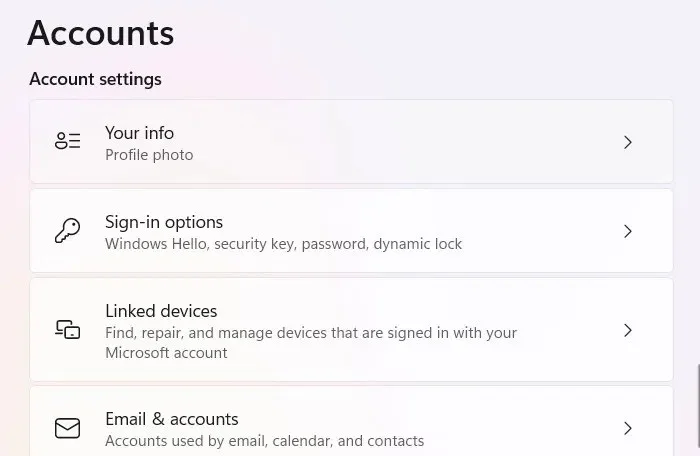
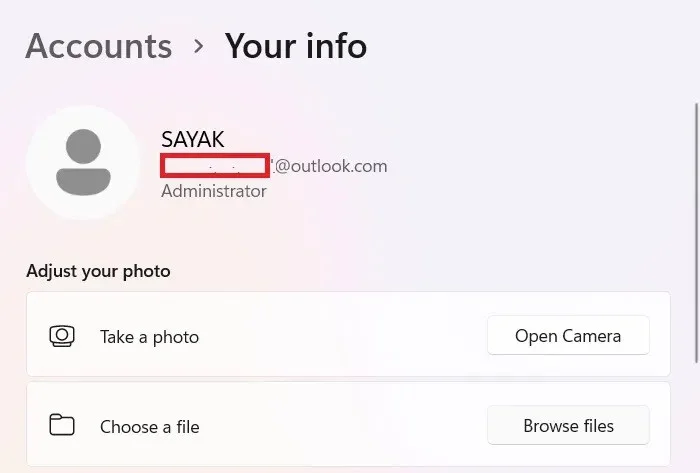
To access your profile picture, go to Settings -> Accounts -> Account settings -> Your info .
Go to Adjust your photo . Here you can change the default user account photo to any other photo of your choice by clicking Open Camera to take a photo or via Browse files .
New photos will be displayed immediately on the account page.
Previously, you could also change your user account picture from Control Panel. This option is now disabled.
From the User Account Pictures folder
Windows stores default user account icons in PNG format in the system folder in various sizes. By replacing these default images with icons of your choice, you can change your default account picture.
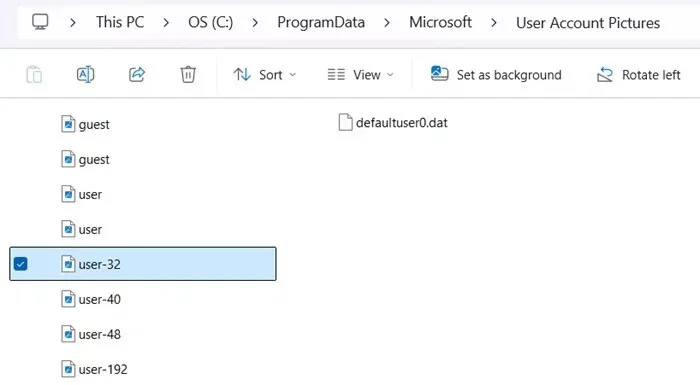
Launch File Explorer and go to the %ProgramData%\Microsoft\User Account Pictures folder . Here you will see all the default user account icons. We need to replace the user icon image files with another profile picture of the same size.
The "UserAccountsPictures" folder under "ProgramData" in Windows File Explorer.
First, download the image or icon of your choice that is at least 512px x 512px in size. Make sure the width and height are the same. Now, make 5 copies of the icon and resize and rename them. You can use MS Paint to quickly resize it to any of these sizes.
448 x 448 – user.png
192 x 192 – user-192.png
48 x 48 – user-48.png
40 x 40 – user-40.png
32 x 32 – user-32.png
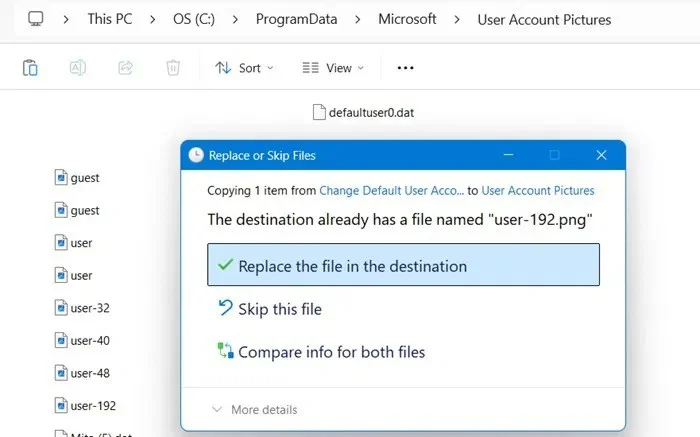
In the next step, simply copy and paste the default icon images for the above sizes into the User Account Pictures folder . You will need to click Replace the file in the destination to enable the new options. This will overwrite the old files, so creating a backup is essential.
You can save the backup files in any folder where they are easily accessible. Alternatively, you can use the .BKP extension for your backups. Rename “user.png,” “user-192.png,” “user-48.png,” “user-40.png,” and “user-32.png” to “user.png.bkp,” “user-192.png.bkp,” “user-48.png.bkp,” “user-40.png.bkp,” and “user-32.png.bkp” respectively. You can skip the “user.bmp” file.
Note : If you don't want to go through the renaming process, you can simply delete or replace them. But if you do, you may not be able to restore the default icons when you need them. However, you can copy the icons from another system.
From the Microsoft account dashboard
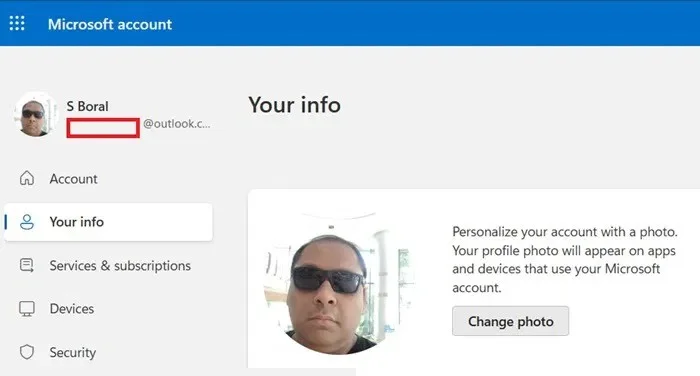
By default, your Microsoft account profile picture will sync to your Windows devices. This feature is also available to users with access to Microsoft 365, as well as to people who sync OneDrive or SharePoint to their computers.
Sign in to your Microsoft account online. When the dashboard appears, navigate to Your info . From there, you can select Change Photo to update your Microsoft user account photo.
A new pop-up window will open where you can browse your PC to add a new photo to your profile. Click Save to confirm. Then, select Update your Profile to save these changes to your Microsoft account.
Delete Windows user account picture
You can delete your Windows user account picture from the AppData folder or the Microsoft account control panel.
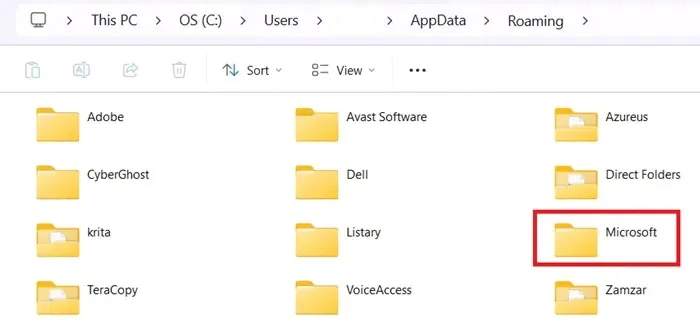
Open File Explorer and type %AppData% into the address bar, then navigate to the Microsoft folder. Alternatively, you can access this folder from This PC by following the admin user path to the Roaming folder .
Go inside the "Microsoft" subfolder in "AppData".
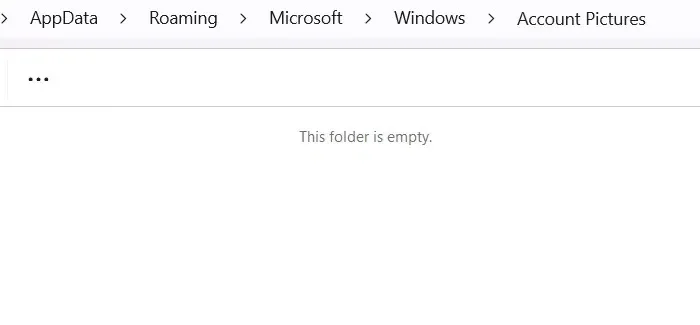
Once here, navigate to the Windows > Account Pictures folder , where you can delete any photos you no longer need. If this folder is empty, as it is on your PC, then that indicates that the photos are synced via the Microsoft cloud. This brings us to the next method for deleting photos.
Empty "Account Pictures Folder" in Windows 11 "AppData" folder.
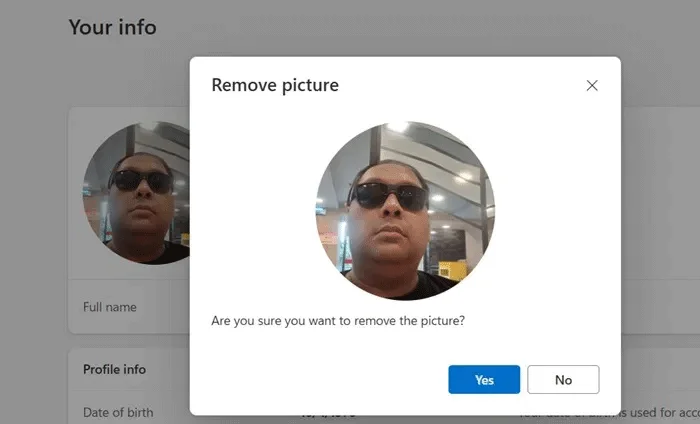
Return to your Microsoft account online dashboard. Click Your info , then select Change Photo . Your current profile picture will be displayed on your Windows device. Click Remove Photo and you will be prompted Are you sure you want to remove the picture? . Click Yes to confirm.
Remove your profile picture from your Microsoft online dashboard.
Restore default account picture
To restore Microsoft's default account picture, make the necessary changes in the Settings app and in the default User Account Pictures folder. First, go to Settings > Accounts > Account settings > Your info .
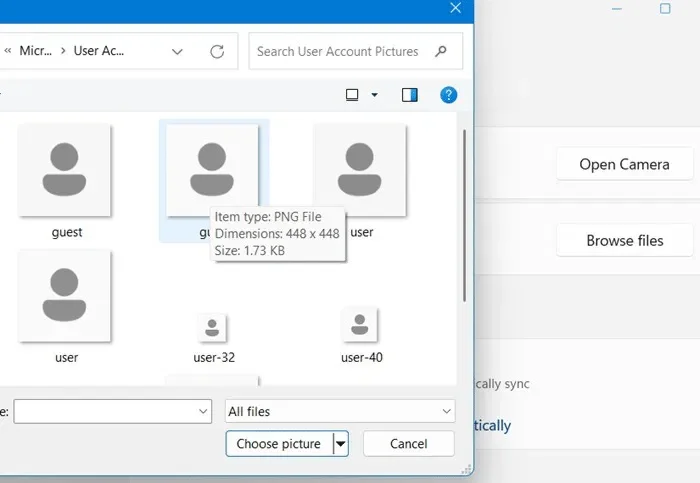
Now, load the old default image using Browse files . To do this, navigate to the %ProgramData% folder , then to the User Account Pictures folder . Here, you can select any guest or user image in PNG format (ignore BMP). This will be the default grid account image for your device.
Change Windows user account picture to default grid icon in PNH format.
Restoring your user account picture to the default will also update it in your Microsoft account. This can be beneficial for people who don't want to show their picture online.
Prevent users from changing account pictures
If you don't want users to change their user account pictures (this is one of the many pranks people play on Windows PC users), you can block that option. There are two ways to do this, through the Local Group Policy Editor and the Registry Editor.
Open the Start menu, search for “gpedit.msc” , right-click on it and select the Run as administrator option .
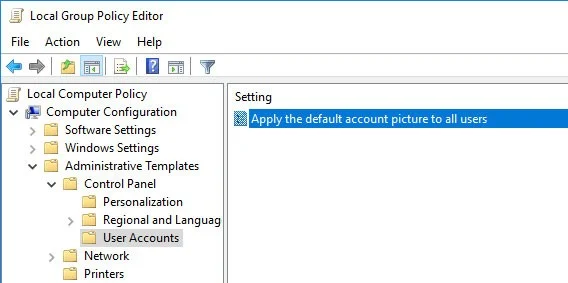
In Group Policy Editor, go to Computer Configuration -> Administrative Templates -> Control Panel -> User Accounts . In the right pane, double-click the Apply the default account picture to all users policy to open a new policy properties window.
Set Local Group Policy Editor to apply default account pictures to all users.
Next, you need to select Enabled in the policy properties window and click the OK button to save the changes.
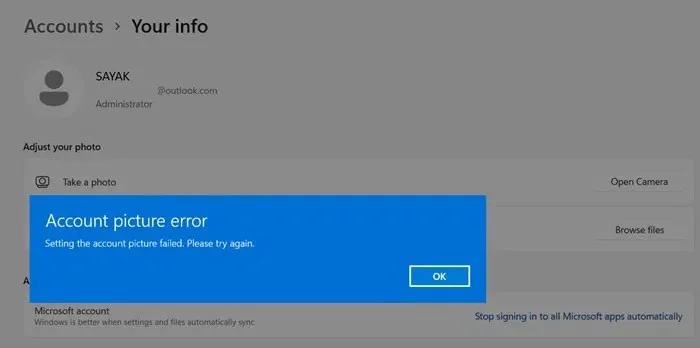
Restart the system. All users will no longer be able to change the default account picture. Instead, you will receive an Account picture error when trying to change the UAC picture from settings.
If you want to restore it, select the Disabled or Not configured option in the policy properties window.
Account picture error appears when trying to change UAC picture in Settings.
If you don't have access to the Group Policy Editor, you can do the same thing through the Registry Editor. Search for "regedit" in the Start menu, right-click on it, and select the Run as administrator option .
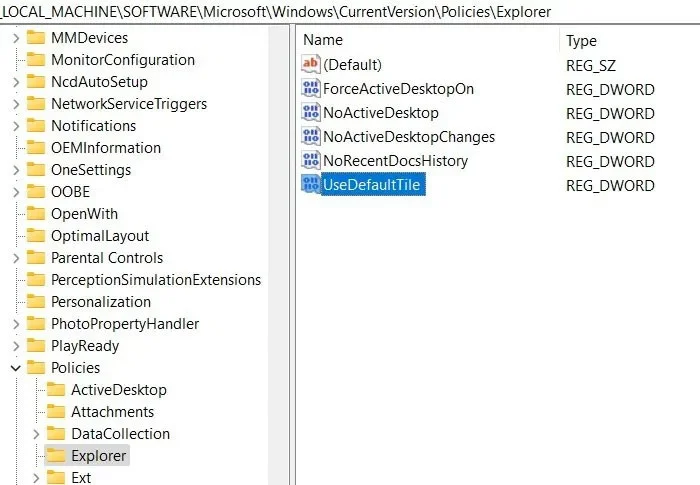
In the right pane, right-click and select New -> DWORD (32-bit) Value . Name the new value UseDefaultTile . Double-click the value, set the Value Data to 1 and click the OK button.
"UseDefaultTile", a 32-bit D-WORD value in Registry Editor
If you want to restore it, change the value data to 0 or delete the UseDefaultTile value itself . Make sure you back up the Windows Registry before and after any of these changes.
In this guide, we have explored all the default methods to change the User Account Control (UAC) image in Windows. If you are having any difficulty modifying admin rights, you may consider using a super admin account, which provides additional privileges.
See more articles below:
4 ways in this article will help your Windows 10 "speed like the wind"