Home
» Wiki
»
How to check computer hard drive capacity
How to check computer hard drive capacity
In addition to checking the Windows computer configuration such as RAM and CPU parameters, viewing the hard drive capacity is equally important. Then users will know the hard drive capacity in use and the remaining capacity of the hard drives on the computer or laptop.
Thus, we will calculate the division of the capacity of the drives, which drives should be limited, which drives should be increased, for example, how much capacity should drive C be reasonable , etc. The following article will guide readers on how to check the capacity of the hard drive of a computer or laptop.
How to check hard drive capacity of Windows 10 computer
Method 1: View computer hard drive capacity in My Computer interface
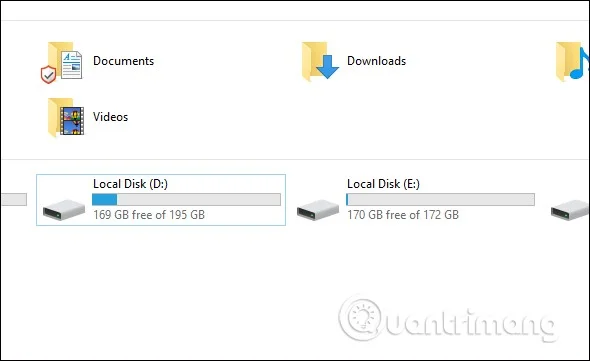
Currently, most computers also display free disk space right in the My Computer or This PC interface on Windows 8, 10 without having to do anything. Here you will know the free space in the total disk space.
Press Windows+E to open File Explorer, here:
On Windows 10, 8/8.1: Click This PC in the list on the left, then look to the right, you will see a list of hard drives on your computer, used hard drive capacity, and free space of each hard drive.
Similar to Windows 10 but on Windows 7 you choose Computer, on Windows XP it is My Computer, you will also see the capacity of the hard drives on the computer.
Method 2: Check hard drive capacity using Properties
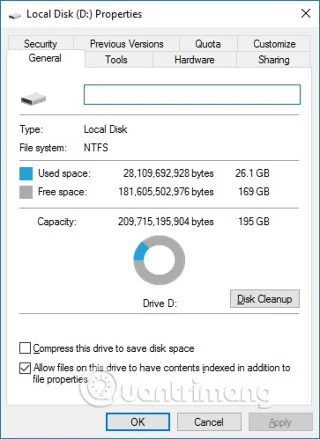
Right -click on the drive you want to check and select Properties .
Then it will display information about the used hard drive capacity at Used space and the free hard drive capacity at Free space. Below is a pie chart showing the used capacity.
Method 3: View hard drive capacity in Disk Management
Windows 10 Disk Management is a built-in utility that allows you to view and manage any internal and external hard drives connected to your computer. While in Disk Management, you can format and reformat your hard drive, create partitions, and view various information such as status, capacity, and percentage of available free space. You can also rename your hard drive, assign specific drive letters, and resize partitions on that hard drive.
If you are formatting an external hard drive for the first time, you will need to open the Disk Management utility so that your computer can communicate with it properly. While some external hard drives come with their own configuration software, you should check Disk Management to make sure everything is formatted correctly.
In today's article, learn how to view hard drive capacity in Disk Management
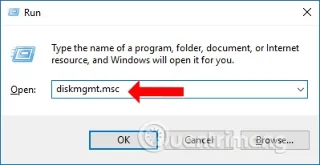
We press the Windows + R combination to open the Run dialog box interface, enter the keyword diskmgmt.msc and press OK to open the interface.
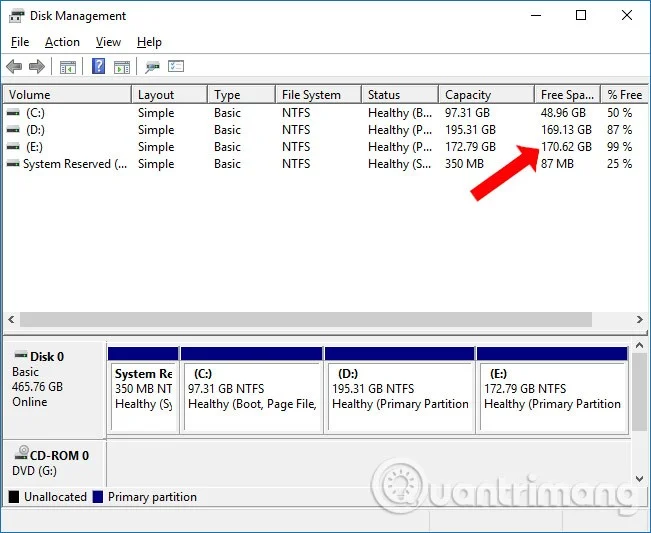
When the Disk Management window appears, you’ll see a few things. You’ll see an overview of all your connected hard drives in the top half. In the bottom half of the screen, you’ll see the same information, but instead of volume counts, you’ll see the number and graphical view of the partitions on each drive and the status of all your connected drives.
Note : If this is your first time using the Disk Management utility, only perform basic functions such as initializing the drive and formatting the drive. Performing advanced functions without prior knowledge may cause problems with your hard drive.
The Disk Management interface will display the full capacity of the drives in use on the computer. Disk 0 is the total capacity of the computer's hard drive, and Capacity shows the capacity of your computer's drives.
When the remaining free space on the hard drive is not much, the downloaded files will not have room to store. If your computer is old and the hard drive capacity is also small, the Full Disk error will often occur. Note to readers that drive C is the drive that runs the operating system or the drive that installs new software, so it should be prioritized to have a large storage capacity.
Method 4: Check free hard drive space using Command Prompt
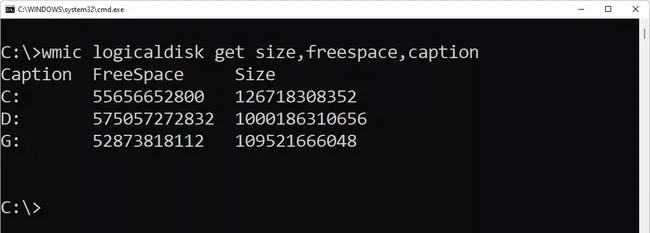
Another way to check free space is to use the Command Prompt. The results are not easy to read because the values are expressed in bytes instead of gigabytes, but it is still possible with this command:
wmic logicaldisk get size,freespace,caption
Check free hard drive space using Command Prompt
How to check hard drive capacity on Mac computer
Method 1: Look in the About section
From any Mac interface, click on the Apple icon in the upper left corner of the screen. Next, select About This Mac .
A new window will appear that will show you basic information about your Mac such as operating system version, device model, processor information, RAM, graphics...
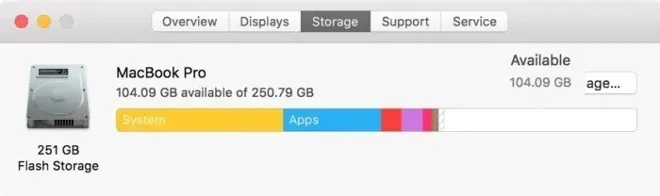
To see your hard drive capacity, you need to click on the Storage section at the top of the window. Here, you will see an overview of your hard drive with total capacity, used capacity and free capacity.
If you want to see more details about your Mac's hard drive, you will have to use the second method, which is to check in Disk Utility.
Method 2: Check Mac hard drive capacity using Disk Utility
To open Disk Utility, press Command + Space to access the search panel. Type Disk Utility and press search.
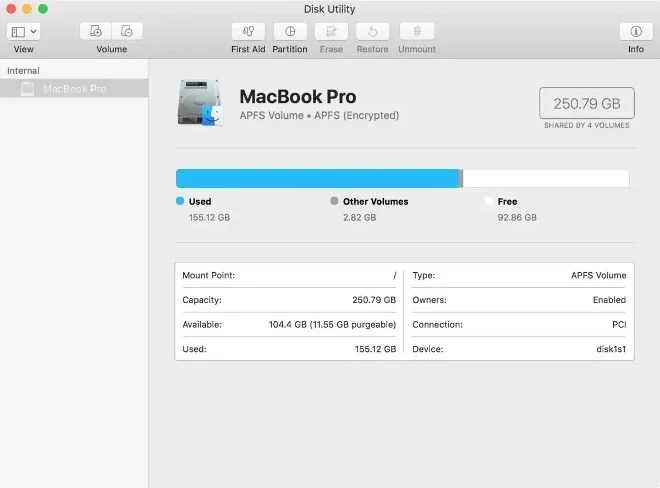
In the search results window, click on the Disk Utility line ( check hard drive capacity) .
A new window will appear that will give you information about your hard drive. You will see how much space you have in total, how many drives it is divided into, and other information. Data such as the operating system, used space, and free space will also be displayed.
You should note that due to the high price, the hard drive capacity of Mac computers is often not as large as Windows computers. Therefore, you need to have a reasonable usage plan to avoid running out of storage space.
How much free space do you need?
Previously, Microsoft recommended that you leave at least 100MB of free space on any drive that Windows is installed on to avoid problems. However, since problems have occurred at levels higher than 100MB, we recommend 10% free space instead.
How to Calculate 10% Free Space on Windows PC
To calculate 10% free space, simply take the number next to Capacity in section 3 and move the decimal one place to the left. For example, if the hard drive you're looking at has a total capacity of 80.0GB, moving the decimal one place to the left will give you 8.0GB, meaning you shouldn't let the free space drop below 8GB for that particular device.
Check which file types are taking up storage space
In Windows 11 & 10, you can find more detailed information about what types of files are using up drive space in Settings > System > Storage . Just select a drive you're interested in and Windows will analyze it, dividing it into categories like System & reserved, Temporary files, Apps & features, Pictures , etc.
There are also a number of free disk space analysis tools you can download for Windows 11 and older versions of Windows that will tell you which files and folders are taking up the most space.
In any version of Windows, selecting Disk Cleanup from the drive properties will launch the Disk Cleanup utility, a single tool for removing files that are no longer needed by Windows.