How to Deploy AI Factories and Physical AI in American Manufacturing: A 5-Step Guide
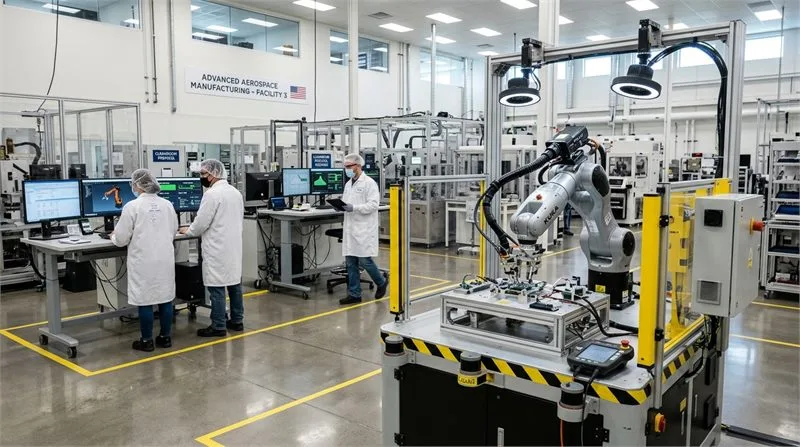
Master AI factories and physical AI in 5 proven steps to deploy digital twins, train robotics, and drive American industrial innovation.
The rapid convergence of AI factories and physical AI marks the most consequential turning point in American industrial competitiveness since electrification. While the initial wave of artificial intelligence centered on generative text and digital chat, the next frontier demands that software interface with physical reality. Industrial leaders, manufacturing plants, and supply chains across the United States are transforming compute infrastructure into dedicated intelligence engines—AI factories—that train, simulate, and orchestrate autonomous physical machines. This tutorial provides a practical, step-by-step implementation guide for operations leaders, automation engineers, and enterprise architects looking to deploy physical AI workflows using digital twin simulations and edge compute infrastructure.
Before launching an integrated physical AI deployment, ensure your engineering team has assembled the necessary hardware, networking, and simulation prerequisites detailed below.
| Requirement Category | Specification / Tooling | Notes & Dependencies |
|---|---|---|
| Compute Infrastructure | On-premise GPU cluster or dedicated cloud AI factory instance (e.g., NVIDIA HGX/DGX architectures) | Essential for synthetic data generation and foundation model fine-tuning |
| Simulation Platform | High-fidelity physics engine (e.g., Omniverse Isaac Sim, Gazebo) with USD asset pipeline | Enables photorealistic physics, sensor simulation, and digital twin alignment |
| Physical Robotics & Sensors | Industrial robotic arms, AMRs (Autonomous Mobile Robots), LiDAR, stereo depth cameras, tactile grippers | Equipped with industrial Ethernet/EtherCAT and ROS 2 / DDS connectivity |
| Edge Acceleration | Ruggedized edge AI compute modules (e.g., Jetson AGX Orin) mounted on physical units | Ensures sub-10ms inference latencies for safety-critical real-time control |
| Expected Timeline | 6 to 10 weeks (Proof of Concept to pilot deployment) | Assumes pre-existing factory floor network infrastructure |
| Implementation Difficulty | Advanced | Requires cross-functional expertise across robotics, machine learning, and OT systems |
To train physical systems effectively, treat compute infrastructure as a production engine rather than generic cloud storage. Configure an AI factory pipeline capable of ingesting plant-floor telemetry, running massive physics simulations, and outputting distilled model weights. Establish dedicated high-bandwidth interconnects (minimum 400 Gbps InfiniBand or RoCE v2) across GPU clusters to process synthetic environments and Vision-Language-Action (VLA) foundation models without memory bottlenecks.
Physical machinery cannot risk trial-and-error training directly on the factory floor. Build a millimeter-accurate digital twin of your production cell, including workpieces, conveyor belts, lighting conditions, and ambient clutter, using universal scene description standards. Calibrate physics simulation parameters—such as surface friction, mass distribution, sensor noise, and collision restitution—against real-world baseline measurements to prevent simulation-to-reality (sim-to-real) performance drift.
Figure 1: High-precision physical AI robotics synchronizing with real-time digital twin simulations inside an advanced manufacturing environment.
Because real-world robotics failure logs are scarce, leverage domain randomization within the AI factory simulation to generate millions of varied training scenarios. Alter virtual camera angles, surface textures, component orientations, and lighting shadows programmatically. Train spatial foundation models and multi-modal neural networks on these synthetic variations so robotic agents learn robust spatial reasoning and physical grasp planning across unpredictable operational states.
Quantize and optimize your trained neural network policies using tensor compilation frameworks to fit embedded edge hardware. Deploy the optimized model directly onto the robotic asset's edge computer via containerized CI/CD pipelines. Connect the inference engine to real-time sensor streams (LiDAR point clouds, depth cameras, and joint encoders) over deterministic industrial protocols to ensure real-time actuator control without dependence on external cloud connectivity.
Establish a telemetry feedback loop from the physical robots back to the AI factory. When an edge model encounters an out-of-distribution item, high mechanical resistance, or an inspection anomaly, capture the raw multi-sensor telemetry snippet. Route this edge event back into the digital twin simulation pipeline to automatically generate targeted synthetic test scenarios, retrain the policy, and push verified updates back to the fleet.
Deploying embodied intelligence into physical facilities frequently introduces operational edge cases. Address common failure modes with the diagnostic strategies below:
A conventional enterprise data center focuses primarily on hosting heterogeneous web applications, relational databases, and multi-tenant cloud storage with bursty traffic. In contrast, an AI factory is a purpose-built industrial compute facility engineered specifically for massive parallel GPU computation, non-blocking high-speed fabric networking, and liquid cooling. Its sole purpose is producing intelligence: training frontier AI models and continuously synthesizing physical simulations.
The United States faces ongoing demographic shifts and skilled labor shortages across precision machining, metal fabrication, and semiconductor manufacturing. Physical AI allows machines to perceive unstructured environments and adapt on the fly, moving beyond traditional rigid automation that required expensive retooling for every product revision. This flexibility enables American facilities to achieve high throughput and competitive unit economics domestically.
Physical machines operate under strict real-time kinematic constraints. Relying solely on remote cloud servers introduces latency fluctuations and network vulnerabilities that could lead to physical collisions or equipment damage. By housing inference models on ruggedized edge computers mounted directly on the robot, perception and actuation decisions execute reliably in milliseconds, even during intermittent facility network dropouts.
Master AI factories and physical AI in 5 proven steps to deploy digital twins, train robotics, and drive American industrial innovation.
Master Miami Art Week with this 5-step guide to ticketing, satellite fairs, transport, and installations for an optimal contemporary art experience.
Follow this 4-step tutorial to audit holiday budgets, verify charities, and mobilize community support to counteract seasonal consumerism.
Follow this 5-step guide to explore the history, technical feats, and visiting tips for the Rockefeller Center Christmas Tree to plan a seamless holiday trip.
Learn how Cyber Monday transformed holiday retail in 4 practical steps, from price-tracking to secure digital checkouts and maximal seasonal savings.
Browse 15 printable September 2027 calendar templates in landscape and portrait PNG formats. Open a full-size design or download a calendar for planning.
Browse 15 printable October 2027 calendar templates in landscape and portrait PNG formats. Open a full-size design or download a calendar for planning.
Browse 15 printable November 2027 calendar templates in landscape and portrait PNG formats. Open a full-size design or download a calendar for planning.
Browse 15 printable December 2027 calendar templates in landscape and portrait PNG formats. Open a full-size design or download a calendar for planning.
Browse 15 printable June 2027 calendar templates in landscape and portrait PNG formats. Open a full-size design or download a calendar for planning.