Home
» Today
»
How to Spot Fraud: Warning Signs to Recognize Before You Respond
How to Spot Fraud: Warning Signs to Recognize Before You Respond
Guidance checked: November 26, 2026, 6:29 p.m. UTC.
Fraud often begins with a request that seems ordinary: confirm a delivery, review an account alert, invest in an opportunity, or help someone you trust. The strongest warning signs are not limited to spelling mistakes or suspicious-looking websites. Watch for an unexpected approach, pressure to act immediately or secretly, requests for passwords or one-time codes, and instructions to send money to a new or “safe” account. One warning sign is enough to pause and verify the request through a contact method you find independently.
In the UK, the Take Five to Stop Fraud campaign advises people to stop, challenge and protect before sharing money or personal information. The National Cyber Security Centre (NCSC) explains that phishing can arrive by email, text or phone call. Fraudsters may copy the language, logos, names and details of real organizations, so a polished message is not proof that it is genuine.
Highlights
Unexpected contact combined with urgency or secrecy deserves a pause.
A genuine bank or public agency should not need you to reveal a password, PIN or one-time passcode.
Check links, phone numbers, firms and payment details using sources you locate yourself.
Fraud can look convincing; judge the request and verify it independently instead of relying on tone or appearance.
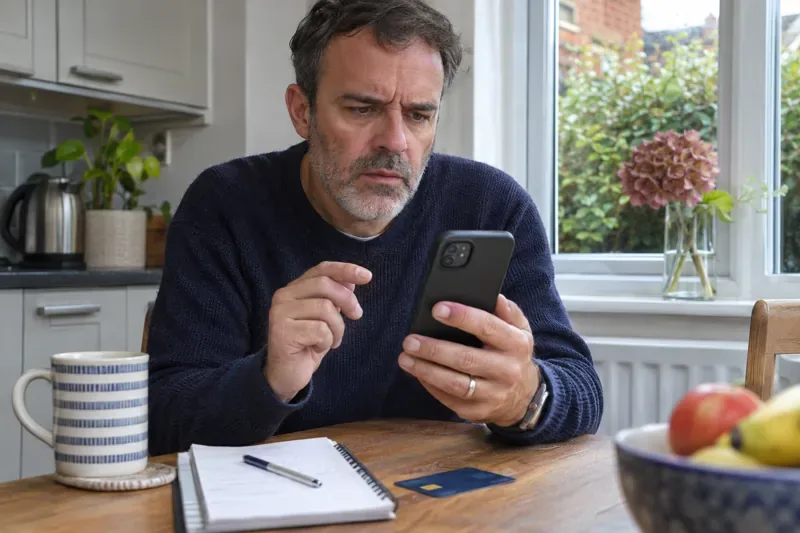
Illustrative image: pausing to review an unexpected message before responding.
What are the most common warning signs of fraud?
1. The message or call comes out of nowhere
Be alert when a person contacts you unexpectedly and claims to represent your bank, a government department, a delivery company, a utility, the police, a friend, or a business. The story may refer to a problem you did not know about, such as a blocked account, unpaid charge, suspicious transaction or parcel waiting for a fee. Unexpected contact is not proof of fraud by itself, but it is a reason to stop and check.
Caller ID, sender names, email addresses and message threads can be misleading or copied. A scammer may also know your name or other personal details. Do not treat familiarity or a correct detail as verification.
2. You are pushed to act fast, stay quiet or bypass normal steps
Urgency is designed to keep you from checking. A caller may claim your money is in immediate danger, threaten a penalty, say an offer expires in minutes, or insist you must not speak with family or bank staff. A request to move funds into a “safe account,” withdraw cash, buy gift cards or cryptocurrency, or hand money to a courier is a serious warning sign. Take Five specifically advises people to question pressure and requests to move money.
Legitimate organizations have ways to verify important requests. End the conversation if necessary and contact the organization using a number from its official website, an existing statement or the back of your card—not a number or link supplied in the message.
3. Someone asks for security details or remote access
Do not disclose a password, PIN, full security code, or one-time passcode to someone who contacted you. Treat a request to install remote-access software, share your screen, or approve a login or payment you did not start with the same caution. Criminals may pose as technical support or a bank employee and describe these steps as necessary to “secure” your account.
A bank may ask questions to confirm your identity through its normal process, but you should initiate contact through a verified channel if a request feels unusual. Never approve a notification just because a caller says it is a harmless test.
4. The deal promises unusually high rewards or guaranteed results
Fraudulent investments, jobs, prizes and shopping offers can promise large returns, guaranteed profits, exclusive access or unusually low prices with little effort or risk. Be wary if you must pay upfront to receive a prize, release earnings, secure a job, or unlock an investment. A persuasive testimonial, professional website or social-media endorsement can be copied or fabricated.
For financial services in the UK, use the Financial Conduct Authority’s (FCA) Firm Checker or Financial Services Register to check whether a firm is authorized for the service it offers. Find the checker yourself, then compare the firm’s contact details with the listing. The FCA warns that clone firms may copy the identity of a genuine authorized business. A match in name alone is not enough.
5. Payment instructions change at the last minute
Pause if a supplier, landlord, solicitor, employer or seller suddenly provides new bank details, asks you to pay a different person, or changes the method after you have agreed to a transaction. A compromised email account can be used to insert false payment instructions into an otherwise genuine conversation. Confirm any change using a separate, trusted phone number you already have—not by replying to the same email or calling the number in the new instructions.
6. The link, address or explanation does not quite add up
Look carefully at the full website address and the exact sender details, but remember that a convincing address is only one clue. Unexpected links that ask you to sign in, pay a fee, download a file or “verify” personal information can lead to copycat sites. The NCSC recommends avoiding links in suspicious messages and provides ways to report phishing emails, texts, calls, websites and adverts.
Errors in spelling, awkward wording, generic greetings, unusual attachments or mismatched branding can be clues. Their absence does not establish that a message is safe: fraudsters can write fluent messages and reproduce familiar designs. Pay more attention to whether the request is expected, sensible and independently verifiable.
How can you check a request without following a scammer’s instructions?
Stop before clicking, paying or sharing information. Open the official app or type a website address you already know, then look for the relevant account notice there. If someone claims to be a bank, government office or company, contact it using independently sourced details. For a financial firm, check both the authorization and the contact information on the FCA listing. If someone claims to be a friend or relative in an unusual emergency, verify the request by calling them on a saved number or contacting them another way.
These checks cannot guarantee that every offer or message is legitimate, and a suspicious detail does not automatically prove criminal activity. They do create time to verify facts outside the channel controlled by the person making the request. When doubt remains, do not proceed until you have checked.
Where can you report a suspicious message?
You can forward suspicious emails to the NCSC at report@phishing.gov.uk and suspicious UK text messages to 7726, following the NCSC’s reporting guidance. If you think you have been defrauded, contact your bank promptly. Report Fraud handles reports in England, Wales and Northern Ireland; in Scotland, contact Police Scotland on 101. This is brief signposting; for a step-by-step response after being targeted, use a dedicated recovery guide.
Frequently asked questions
Can a professional-looking message still be fraud?
Yes. Criminals can copy branding, use convincing language and include personal details. Verify the request through contact information you find independently.
Is a spelling mistake enough to prove a scam?
No. Errors can be a clue, but their absence does not prove a message is genuine. Check the request, sender and destination through trusted channels.
What should I do if someone asks me to move money to a “safe account”?
Do not transfer money based on the caller’s instructions. End the contact and call your bank using a number from a trusted source to verify the situation.