Home
» Discover
»
How to Support Independent Artists Online: Choose the Help That Fits Your Budget
How to Support Independent Artists Online: Choose the Help That Fits Your Budget
Supporting an independent artist online is not a single action with one universally “best” platform. A $5 monthly membership, a $40 print, a commission, a stream, or a thoughtful share can all be useful, but they solve different problems for the artist. The most effective choice depends on your budget, the kind of work the artist makes, and whether you want to provide immediate income, predictable recurring support, project funding, or simply more visibility.
The first rule is simple: start with the artist’s own website, profile link, newsletter, or pinned post. Independent artists often tell supporters where they prefer to be paid, what products are available, whether commissions are open, and which platforms they actively maintain. That preference matters because platform fees, payment processing, shipping, and rights arrangements can change how much value reaches the artist.
Fee note: The platform details below were checked against official documentation in September 2026. Fees and product rules can change, and creators may be on legacy plans or different account settings, so treat these figures as a comparison aid rather than a promise about one artist’s exact payout.
Compare the Main Ways to Support an Independent Artist
Support method
Best when you want to
Main advantage
Main tradeoff
Buy art, music, books, or merch directly
Give meaningful one-time support and receive something tangible or downloadable
Clear transaction with immediate value to both sides
Physical goods can add shipping, taxes, inventory, and fulfillment costs
Join a recurring membership
Help an artist plan month to month
Predictable recurring revenue can be more useful than sporadic purchases
You take on an ongoing subscription, and platform fees may apply every billing cycle
Send a tip or fund a commission
Give flexible support or request custom work
Low-friction for tips; commissions can provide high-value paid work
Commission slots are limited, and custom work requires time, scope, and communication
Stream, watch, or listen on mainstream platforms
Support discovery with minimal effort
Easy to repeat and easy to recommend to others
Revenue is indirect and depends on rights-holder agreements rather than a fixed “per stream” payment
Share, comment, subscribe, or join a mailing list
Help when you cannot spend money
Free for the supporter and potentially useful for discovery and retention
Algorithmic reach is unpredictable, so impact varies widely
1. Buy Directly When You Want the Strongest One-Time Signal
If an artist sells prints, originals, digital files, albums, books, zines, sample packs, presets, or merchandise, a direct purchase is usually the easiest way to turn appreciation into revenue. It also gives the artist information that passive engagement does not: what people are willing to pay for and which releases or products attract real buyers.
For musicians, Bandcamp provides a useful example of how a direct-sale platform differs from streaming. Its official artist page says Bandcamp takes a 15% revenue share on digital music and 10% on merchandise, with payment processing charged separately; it reports that artists or labels receive about 82% of a sale on average. See Bandcamp’s official artist pricing information. That does not mean every direct marketplace has the same economics, but it shows why checking the artist’s preferred sales link is worthwhile.
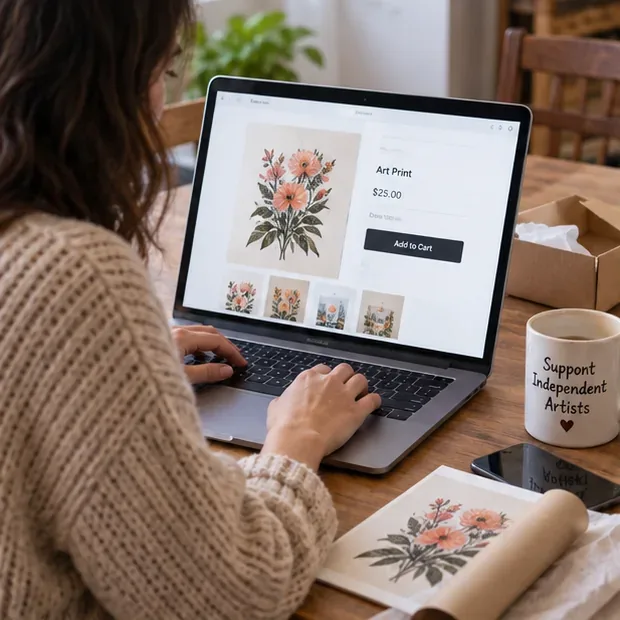
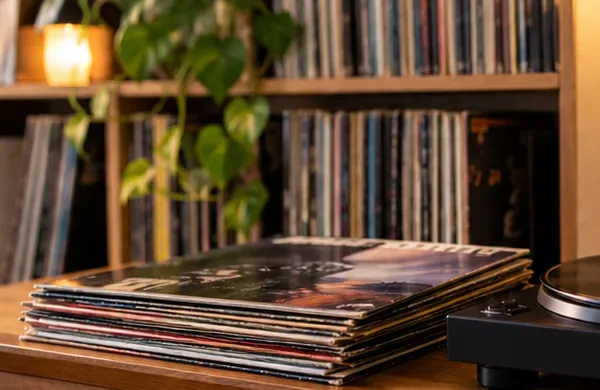
A direct purchase can provide meaningful one-time support while giving the buyer a finished artwork or product.
The tradeoff is that “direct” does not mean “fee-free.” Payment processors, storefronts, taxes, shipping, manufacturing, packaging, and returns can all reduce the artist’s net income. If your goal is to maximize support rather than obtain a specific product, check whether the artist also offers a tip link, digital item, or local pickup option. If your goal is to own the work, buy the format you genuinely value rather than trying to optimize every percentage point.
2. Choose a Membership When Predictability Matters More Than a Single Purchase
Recurring support can be especially helpful for artists whose work takes months to produce: illustrators building a book, musicians recording an album, filmmakers editing a project, or writers publishing on a schedule. A membership can smooth out the gap between major releases and let the artist budget for software, studio time, materials, collaborators, or basic operating costs.
Patreon is one common option. Its official help center says creator pages first published after August 4, 2025 use a standard 10% platform fee, with payment processing charged separately; older creators can remain on legacy pricing in some cases. The details are available in Patreon’s current standard platform fee documentation.
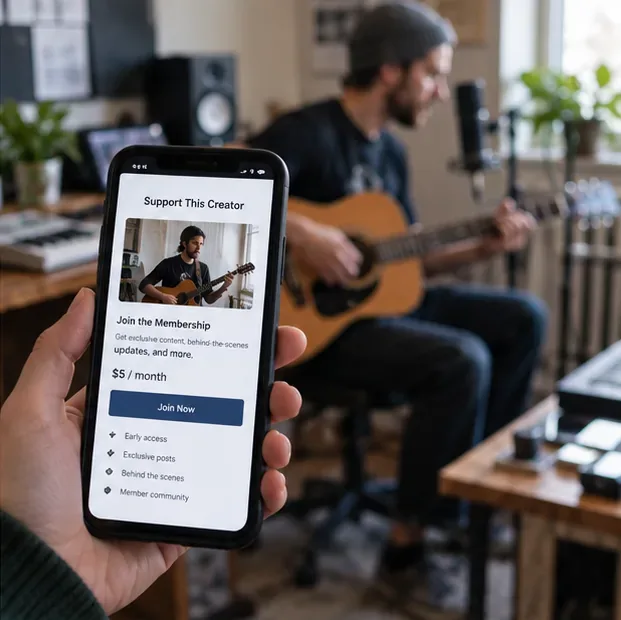
Recurring memberships trade flexibility for consistency, giving artists steadier support between major releases.
The key decision is whether you actually want an ongoing relationship. Memberships work well if you enjoy updates, early access, process notes, community posts, or simply the idea of providing steady backing. They are less suitable if you dislike subscriptions or expect elaborate rewards every month. In that case, a quarterly purchase or occasional tip may fit you better and create less pressure for both sides.
3. Use Tips for Flexibility and Commissions for High-Value Custom Work
Tips and commissions sit at opposite ends of the effort spectrum. A tip asks very little from the artist: it is essentially a thank-you payment. A commission asks for new labor, communication, revisions, deadlines, and a clear scope. Both can be valuable, but they should not be treated as interchangeable.
Ko-fi’s official fee page illustrates the range of creator settings available on a flexible support platform. It says a creator using its Free option can pay a 0% Ko-fi service fee on one-time tips, while memberships, shop sales, and commissions generally carry a 5% service fee; payment processor fees still apply. See Ko-fi’s official fee breakdown. Because account settings can differ, the practical lesson for supporters is to use the artist’s current link rather than assuming one payment route always produces the highest payout.
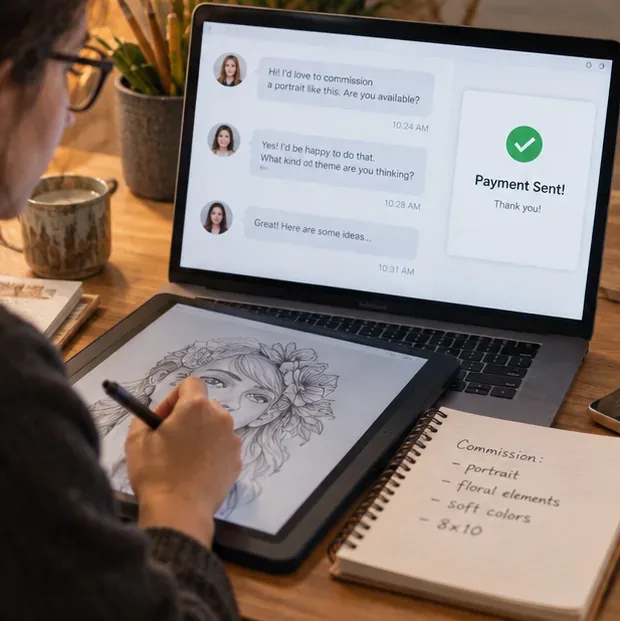
Commissions can create substantial paid work, but they also require clear scope, availability, and time from the artist.
Choose a tip when you want to say “I value what you already made.” Choose a commission when you genuinely need custom work and are ready to respect the artist’s rates, turnaround time, revision policy, and permitted uses. If you plan to use commissioned art commercially, ask about licensing before assuming the personal-use price includes business rights.
4. Stream and Watch for Reach, Not as a Substitute for Direct Support
Listening to music, watching videos, reading authorized posts, and following creators on mainstream platforms can help an artist stay discoverable. It is also the easiest form of support to repeat regularly. The tradeoff is that the money path can be indirect.
Spotify’s official royalties guide says it pays royalties to selected rights holders, which then pay artists and songwriters according to their agreements. Spotify also states that major streaming services do not use a single fixed per-stream rate. You can read the explanation in the Spotify for Artists royalties guide.
That distinction matters. Streaming is useful, but “I streamed the track once” and “I bought the album from the artist’s store” are not economically equivalent. If you have no budget, authorized streaming is still a real, legitimate way to engage. If you want to provide stronger financial support, combine streaming with a direct purchase, membership, ticket, tip, or commission when those options are available.
5. Use Free Support Strategically When Money Is Tight
You do not need to spend money to be useful. The best free actions are specific rather than performative: follow the artist’s official account, subscribe to their mailing list, leave a substantive comment, save or bookmark a release you want to revisit, share the original post with someone likely to care, and credit the artist when discussing their work.
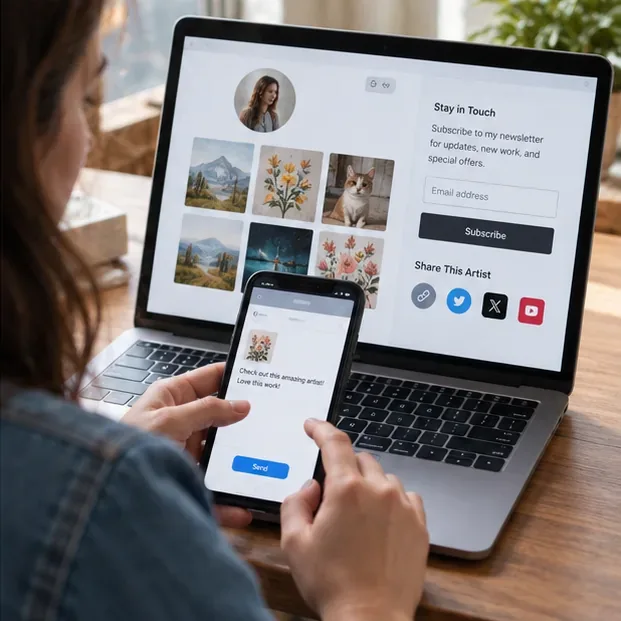
Newsletter subscriptions and targeted sharing can help an artist maintain a direct audience without requiring the supporter to spend money.
A mailing list is especially worth considering because it gives the artist a way to reach supporters outside a constantly changing social feed. Sharing can also help, but there is no honest universal conversion rate for a repost, comment, or like. The impact depends on the platform, your audience, timing, and whether the person you share with is actually interested. One sincere recommendation to a likely buyer, listener, curator, venue, editor, or collector can be more useful than broadcasting the same link everywhere.
6. Share the Artist’s Work Without Taking Control of It
Supporting an artist includes respecting how their work is copied and redistributed. A link to the artist’s original post is usually safer than downloading their image, removing a watermark, reposting the file, or uploading their music elsewhere. In the United States, the Copyright Office explains that copyright owners generally control reproduction, distribution, adaptation, and public display of protected work, subject to legal limitations and exceptions. Its guidance for visual artists also states that permission is generally required to use someone else’s work in those ways. See the U.S. Copyright Office guidance for visual artists.
There are exceptions, including fair use in U.S. law, and rules vary by country. The practical supporter action is simpler: when in doubt, share the artist’s own link or ask permission before re-uploading the work. Credit is good etiquette, but credit by itself is not the same as permission.
How to Pick the Right Kind of Support for Your Situation
If your priority is maximum one-time financial impact, start with the artist’s direct shop, an original work, a digital release, or a clearly priced commission. If your priority is steady support, choose a membership you can comfortably keep for several months. If you want low commitment, use a one-time tip or purchase a small digital item. If you have no budget, subscribe, share the original link with relevant people, attend free online events, and engage with authorized posts. If you mainly want discovery and convenience, streaming and mainstream social platforms are useful, but recognize that their economics are less direct.
There is also nothing wrong with mixing methods. A listener might stream an album for convenience, buy it directly after deciding it is a favorite, and join the mailing list for future releases. A visual-art fan might follow an illustrator for months, purchase a print when the right piece appears, then commission a portrait later. Support works best when it is sustainable for you and aligned with what the artist is actually offering.
A Practical Support Checklist
Open the artist’s official site or profile link before choosing a payment platform.
Decide whether you want a product, recurring relationship, custom work, or simply to help.
Check shipping, licensing, membership renewal, and commission terms before paying.
Use authorized streams and official sales links rather than copied or re-uploaded work.
When sharing, link to the artist’s original post and add a specific reason you recommend it.
If money is tight, subscribe to the artist’s newsletter or channel and stay engaged over time.
Bottom Line
The best way to support an independent artist online is the one that matches both your resources and the artist’s current needs. Direct purchases are strong for one-time income, memberships are strong for predictability, tips are flexible, commissions pay for new labor, streaming helps with access and discovery, and thoughtful sharing can expand an audience without costing you anything. Instead of chasing a universal “best platform,” follow the artist’s own preferred links, understand the tradeoffs, and choose a form of support you can sustain.