
Build a PipeWire Output Toggle Script That Moves Active Audio

Switch Debian audio between named PipeWire outputs with a pactl script that updates the default sink and reroutes streams already playing.
Windows 10's clipboard history feature allows you to save and retrieve multiple copied items without losing previous ones. While this is a handy feature, you need to activate it manually and it requires a special hotkey to display. Let's explore how to use the Windows 10 clipboard through the following article!
How to enable Windows 10 clipboard history
Windows 10's clipboard history feature isn't enabled by default, but it's easy to enable. Just press Windows key + V and your clipboard history will open in the lower right corner of your screen.
If the window says Your clipboard is empty or shows items you've previously copied, clipboard history is enabled. If it says Can't show history , click Turn on and Windows will enable it.
Note : Wondering where clipboard files are located in Windows 10? These items are stored as individual files in a hidden folder located at C:\Users\[username]\AppData\Local\Microsoft\Windows\Clip . You can't browse this folder directly, but you can view and manage past items through the Clipboard History feature.
How to add items to clipboard history
Now that the clipboard history is working, it's time to understand how it works. To start, try copying text and images to the clipboard. The methods for copying an item on the old clipboard will apply to the new clipboard, so copy items using Ctrl + C or right-clicking them and selecting Copy .
Now press Windows key + V to open your clipboard history. You will see all the items you have copied in a list, with the most recent item at the top.
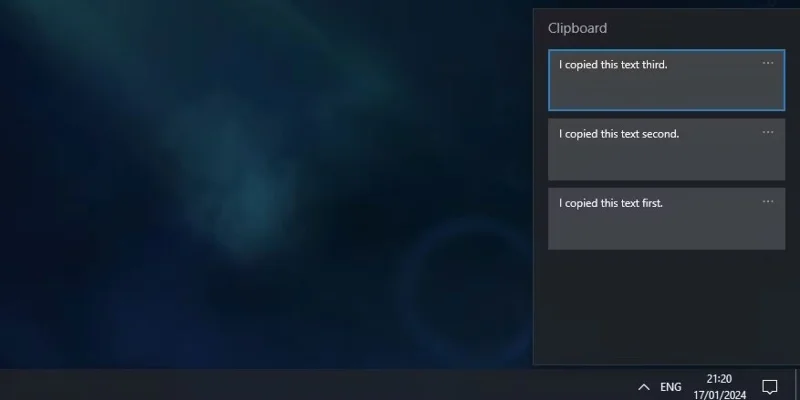
If you press Ctrl + V , you will paste the most recently copied item. You can also display the clipboard history and click on a previously copied item to paste. When you do this, Ctrl + V will paste the item you selected instead of the most recent item.
How to pin an item to the Windows clipboard history
When you restart your PC, items saved in the clipboard are automatically cleared. However, you can force items to stay in the clipboard by pinning them.
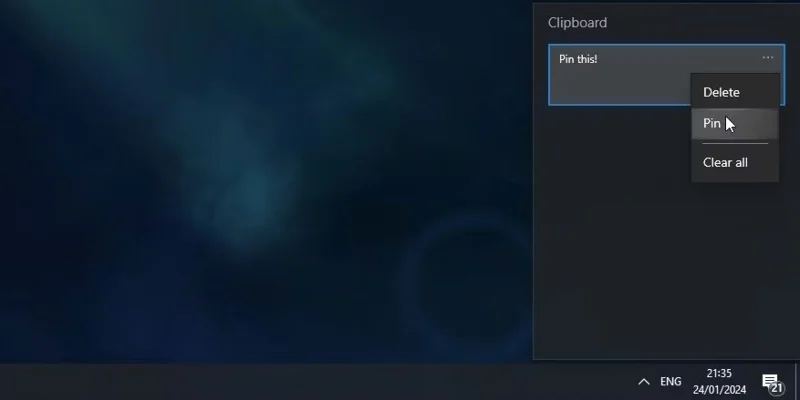
Press Windows key + V to open your clipboard history. Click the three-dot icon on the item you want to keep and tap Pin . Now, the item will remain on your clipboard even if you turn off your PC.
To remove a pinned item, click the three dots again and tap Unpin .
How to Sync Windows Clipboard History Across All Your Devices
If you use multiple Windows 10 devices, you can sync clipboard items between them. To sync your clipboard between devices, you must sign in to Windows with your Microsoft account, not a local account.
Once you've signed in to Windows with your Microsoft account, go to Settings > System > Clipboard and click the toggle button under Sync across devices .
Below this toggle there are two options: Automatically sync text that I copy and Never automatically sync text that I copy . The first option will sync everything you copy to your other devices, which is useful if you're the only one who uses one of the two devices.
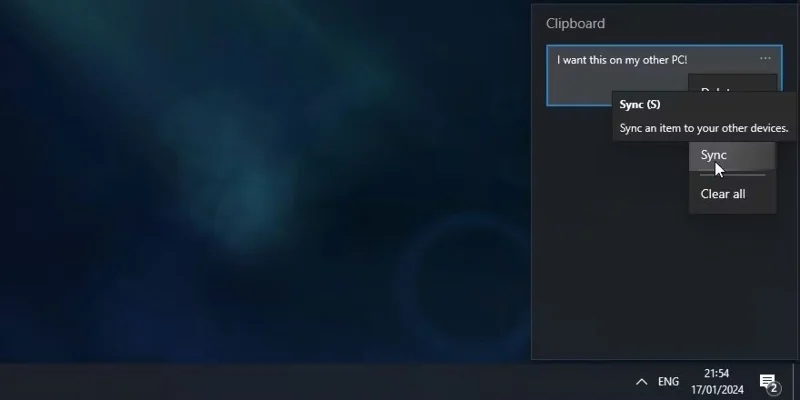
The second method won’t sync your items as soon as you copy them. Instead, you’ll need to open your clipboard history, click the three dots next to the item you want to transfer, and tap Sync . This option is best if you’re working with sensitive data and want to control what goes where.
How to delete items from clipboard history
You can clear the clipboard history at any time.
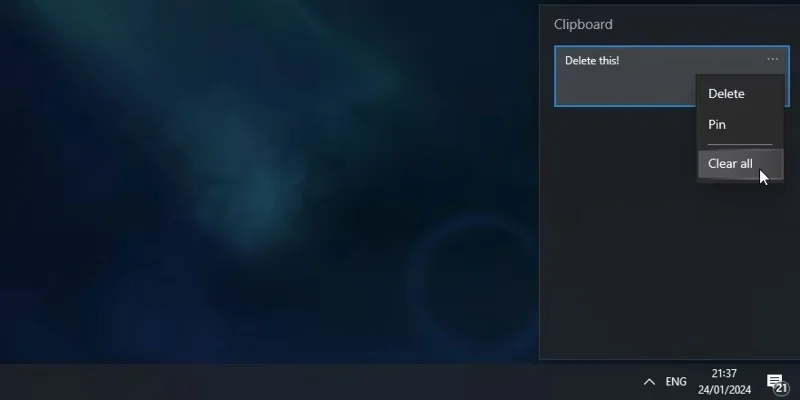
Press Windows key + V to open your clipboard history and click the three dots on an item. Then click Clear all at the bottom of the window. All items except pinned items will be deleted.
You can also use the above procedure to delete an item; just click Delete instead of Clear all .
How to disable Windows 10 clipboard history
If you don't want Windows to store clipboard history, you can turn it off.
Go to Settings > System > Clipboard and click the slider button under Clipboard history so it's set to Off . Keep in mind that doing this will clear your entire clipboard history (including pinned items).
Good luck!
See also:
Switch Debian audio between named PipeWire outputs with a pactl script that updates the default sink and reroutes streams already playing.
Get your Bluetooth headset mic working by selecting the right input, using a hands-free audio profile, and checking Ubuntu’s PipeWire route.
Learn why Flatpak apps may ignore Ubuntu 24.04 GTK themes and follow safe steps to check theme extensions, refresh Flatpak apps, and diagnose portal issues.
Install Ubuntu 24.04 alongside Windows 11 with BitLocker safely. Compare separate-drive and shared-drive paths, recovery keys, partitioning, and boot checks.
Diagnose NVIDIA driver failures after an Ubuntu kernel update. Check DKMS and Secure Boot, rebuild the matching module, enroll a MOK, and verify the fix.
Fix Ubuntu 24.04 Wi-Fi drops after suspend with checks for NetworkManager, radio blocks, updates, power saving, and drivers—then verify each resume.
Learn why tracker-miner-fs-3 uses high CPU in Ubuntu GNOME and how to check indexing, exclude folders, update Ubuntu, or safely rebuild the search index.
Fix Debian’s UEFI boot error by checking boot mode, the EFI System Partition, GRUB files, and firmware boot order—without reinstalling Debian first.
The Outlook Inbox Repair Tool fixes corrupted PST files quickly so you can recover emails and restore normal Outlook function. Follow these exact steps to run scanpst.exe without data loss.
Get the Adobe PDF Installer Offline to install Acrobat Reader on any PC without needing internet during setup. Follow these exact steps for the full standalone package.








