Home
» Discover
»
Indie Gaming in 2026: What Changed, What Matters, and Where Small Studios Go Next
Indie Gaming in 2026: What Changed, What Matters, and Where Small Studios Go Next
Updated September 14, 2026. Indie gaming in 2026 is no longer defined mainly by pixel art, tiny budgets, or a developer working alone. For this guide, “indie” means a game made with meaningful creative and business independence, whether that is a solo project, a small studio, or a larger independent team working with outside funding or a publishing partner.
The biggest shift is practical rather than aesthetic. Small teams have more ways to publish, test, measure demand, reach consoles, choose engines, and operate online games. The trade-off is that access is easier while attention is still scarce. In other words, getting a game onto a storefront is only the beginning; building evidence that players want it has become a core part of development.
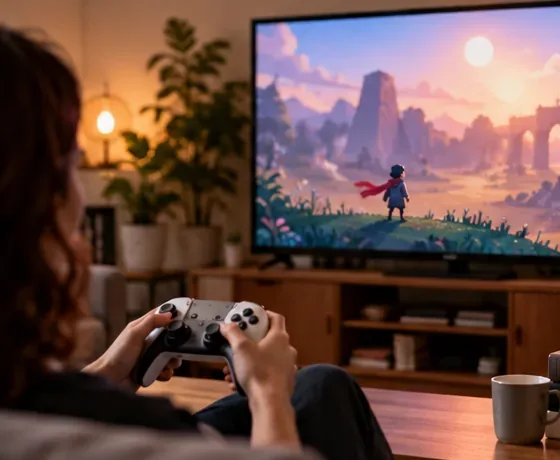
A player uses a controller in front of a television displaying a stylized adventure scene, reflecting how independent games now compete for attention in the same living-room spaces as larger releases.
The 2026 Indie Gaming Landscape at a Glance
What changed
What it means in practice
Who benefits most
Main trade-off
Demo-led discovery is more structured
Festivals, wishlists, store tags, creator pages, and first-party analytics can be planned as part of production rather than added after the game is finished.
PC-first teams with a playable core loop
A weak or premature demo can expose problems before the game is ready to make a strong first impression.
Store economics are more varied
Developers can compare Steam, Epic Games Store, itch.io, console stores, and direct/community channels instead of treating distribution as a single-store decision.
Self-publishers and studios with an existing audience
A better revenue split does not automatically produce more buyers or better discovery.
Console and cross-platform tooling is opening up
Public documentation, standardized SDKs, engine integrations, and backend services reduce some of the historical setup friction.
Small studios already building robust PC versions
Certification, QA, controller support, performance tuning, localization, and support still require real time and money.
Engine choice is broader
Unity and Unreal remain major options while Godot has matured into a credible production engine for many independent projects.
Teams that can choose technology around project needs
Switching engines late remains expensive, and platform support differs by engine and target.
Generative AI now has publishing-policy consequences
Studios need to track how player-facing AI-created content is produced, licensed, disclosed, and moderated.
Teams using AI-assisted pipelines or live AI features
Speed gains can be offset by legal, moderation, cost, and trust risks.
1. Discovery Has Become Part of Development
One of the clearest signs of indie gaming’s evolution is the importance of the demo. A demo is no longer just a small free sample created at the end of production. For many teams it is a testable marketing asset: players can try the core loop, developers can collect feedback, and the store can convert interest into wishlists.
Valve describes Steam Next Fest as an opportunity for developers to get early feedback and build an audience before launch. The October 2026 edition runs from October 19 through October 26, and Valve’s rules state that an eligible game can participate in only one Next Fest edition. That makes timing a strategic decision rather than a box to check. See the official Steam Next Fest: October 2026 documentation.
Steam has also expanded the data available to developers. Its 2026 Wishlist Data API provides programmatic access to wishlist totals and includes country and language breakdowns. A wishlist is a player’s opt-in signal that they want to follow a game and can receive notifications around release or discounts. For a small studio, language-level wishlist data can help answer practical questions such as whether localization interest is concentrated in a specific market. Valve’s announcement is available in the official Steamworks Wishlist Data API notice.
What this means for a small team
Build the store page and positioning early enough to learn from player behavior.
Do not launch a public demo merely because a festival date is approaching; the demo should clearly communicate the game’s strongest repeatable experience.
Use wishlists, demo completion behavior, feedback, and regional interest as signals, not as promises of future sales.
Treat festival participation as one milestone in a longer launch plan, not as the entire marketing plan.
2. Storefront Economics Give Indies More Choices, Not Easy Answers
Independent developers have more flexibility in where and how they sell games, but the “best” storefront depends on the audience a studio can actually reach.
Steam still has a relatively low barrier to entry at the application level: Valve charges a $100 Steam Direct fee for each new app, and says that fee becomes recoupable after the product reaches at least $1,000 in adjusted gross revenue from the Steam Store or in-app purchases. The current rules are in the Steam Direct Fee documentation.
Epic changed its store economics in June 2025, and that structure remains important in 2026. For Epic Games Store payments it processes, Epic says developers pay a 0% store fee on the first $1 million in revenue per app per year, followed by the regular 88%/12% developer/store split above that threshold. Epic also introduced hosted webshops for eligible out-of-app purchases. The terms are described in Epic’s official revenue-share and webshop announcement.
itch.io remains structurally different. Its “Open Revenue Sharing” model allows the seller to choose what percentage of sales goes to itch.io, from 0% to 100%, while payment-processing fees still apply. The platform also supports pay-what-you-want pricing above a minimum. See itch.io’s official creator payments documentation.
Which route fits which goal?
Goal
Strong starting option
Why
Watch for
Reach the largest established PC storefront audience
Steam
Mature discovery, community, wishlist, demo, festival, and release-management tools
Competition for attention and the need to build demand before launch
Maximize store-fee economics on early Epic revenue
Epic Games Store
0% store fee on the first $1 million per app per year for Epic-processed payments under the announced terms
Store economics and audience size are separate questions
Prototype, game jam, direct community selling, or flexible pricing
itch.io
Low publishing friction, open revenue sharing, and flexible pricing
Different discovery dynamics from the largest commercial storefronts
Reach console and subscription ecosystems
Platform programs such as ID@Xbox
Access to console distribution, platform services, and possible discovery opportunities
Certification, technical requirements, porting, and business approval processes
The practical lesson is simple: calculate net economics, but do not optimize only for the percentage a store takes. A 0% platform fee on sales that never happen is less useful than a higher-cost channel where the right audience already exists.
3. Cross-Platform Development Is Becoming More Accessible
Console development used to involve a much larger information barrier for newcomers. Microsoft’s 2026 changes illustrate how that barrier is shrinking. At GDC 2026, Xbox said developers could reach a working development environment in about 30 minutes, that its Game Development Kit (GDK) and documentation are public without an NDA for basic access, and that agreement handling had been heavily automated. Microsoft also says PlayFab core services are included at no additional cost for games shipping on Xbox and reports significantly faster package uploads. The details are in Microsoft’s GDC 2026 Xbox development update.
The broader Xbox developer portal currently advertises more than $5 billion paid to independent developers and positions ID@Xbox as the route for independent teams publishing to the Xbox ecosystem. Those are Microsoft’s own platform figures, so they are best treated as an indication of program scale rather than an independent measurement of indie profitability.
Engine vendors are also reducing platform-specific duplication. Unity 6.3 LTS, released in December 2025 and still current as a long-term-support production option in 2026, includes a Platform Toolkit designed to unify common platform features such as accounts, save data, controller ownership, and achievements across supported targets. Unity lists support including Windows/Steam, Xbox Series X|S, PlayStation 5, Nintendo Switch, and Nintendo Switch 2. See Unity’s official Unity 6.3 LTS announcement.
None of this makes a multi-platform release “one click.” The remaining costs are often the expensive ones: memory and performance budgets, certification, input behavior, save systems, achievements, online services, accessibility, localization, QA matrices, store assets, patches, and customer support. The tools reduce plumbing; they do not remove production discipline.
4. The Engine Conversation Is More Diverse
For years, indie engine discussions often collapsed into Unity versus Unreal. In 2026, that is too narrow.
Godot 4.7 shipped in June 2026, and Godot 4.7.2 became the current stable maintenance release on August 18, 2026. Godot describes the 4.7 line as adding features such as HDR output, a new Asset Store, and standalone Android exporting and publishing. The project’s own 4.6 release materials also stated that Steam received more than 1,200 new Godot games in 2025, a useful sign that the open-source engine has moved well beyond hobby-only use. Current release information is available from the Godot 4.7.2 maintenance release and the Godot 4.7 release page.
Unity 6.3 LTS emphasizes cross-platform production and two years of dedicated LTS support for standard users. Unreal Engine 5.7, released in November 2025, emphasizes high-fidelity world building, procedural content generation, animation, lighting, and large-scale rendering improvements. Epic’s release overview is in the official Unreal Engine 5.7 announcement.
A practical engine-choice rule
Choose the engine that minimizes the risks of your specific game, not the engine with the loudest community debate.
Choose around team skill: an engine your team can debug confidently is usually safer than a theoretically more powerful engine nobody knows well.
Choose around target hardware: verify export, middleware, certification, graphics, input, and online-service requirements before production locks in.
Choose around content scale: a 2D tactics game, a physics-heavy co-op title, and a photorealistic open world have different technical bottlenecks.
Choose around maintenance: confirm how long the production version will be supported and how disruptive upgrades are likely to be.
5. Generative AI Is Now a Production and Compliance Decision
Generative AI means systems that produce new text, images, audio, code, or other content from prompts or learned patterns. By 2026, the important indie-game question is not simply whether a team uses AI tools. It is what the tool creates, whether players consume that output, what rights the developer has to ship it, and how live output is controlled.
Steam’s current Content Survey separates player-consumed generative AI content into two broad categories. “Pre-Generated” content is created with AI assistance during development and ships with the game. “Live-Generated” content is created while the game is running. Valve says live-generated systems require developers to describe guardrails designed to prevent illegal output. Steam also makes clear that AI disclosure does not override its normal rules on illegal or infringing content. See the official Steam Content Survey documentation.
For an indie studio, this turns AI use into a pipeline question. Keep records of asset provenance, licenses, prompts or source material where appropriate, human review steps, model/provider terms, moderation behavior, and ongoing inference costs. A tool that saves a week of production may still be a poor choice if it creates uncertain rights or an expensive live-service obligation.
6. Indie Studios Are Becoming More Data-Driven Without Becoming Less Creative
The professionalization of indie development does not mean every studio needs a growth team or a dashboard for every decision. It means creative choices are increasingly paired with measurable launch decisions.
Steam’s 2026 additions illustrate the direction: wishlist data by country and language, improved financial reporting, developer and publisher homepage tools, extensive sale and festival calendars, and structured demo workflows. Microsoft is similarly reducing onboarding friction and bundling cross-platform backend services for qualifying Xbox games. These changes give small teams access to operational tools that once felt like publisher infrastructure.
The healthier interpretation is not “design by spreadsheet.” It is “use data to protect creative bets.” If a strange game concept is attracting unusually strong demo engagement in one region, that may justify localization. If players repeatedly quit before understanding the central mechanic, that is useful design feedback. If wishlists rise but demo sentiment stays weak, more marketing may not fix the product.
What 2026 Means for Different Types of Indie Creators
Solo developer
Prioritize scope control and distribution simplicity. A single polished PC build with a strong demo can be a better business than simultaneous ports with fragile QA. itch.io is useful for prototypes and direct community building; Steam provides a structured commercial launch path; other storefronts can follow when the game and support workload justify them.
Two- to five-person studio
This is where modern tooling has the most leverage. A small team can realistically use automated builds, shared analytics, platform SDKs, a cross-platform engine, localization vendors, external QA, and a planned demo campaign. The risk is acting like a 30-person studio and multiplying features, platforms, and online dependencies faster than the team can maintain them.
Established independent studio
The opportunity is portfolio thinking: creator pages, sequels, community carryover, multi-store releases, console versions, subscriptions, and direct relationships with players. The trade-off is that “independent” does not mean operationally small anymore. Finance, legal, accessibility, privacy, live operations, localization, and customer support can become permanent functions.
Players looking for interesting indie games
The best discovery strategy is broader than browsing “new releases.” Festival demos, developer pages, curated storefront events, itch.io communities, console indie showcases, and wishlists can surface games before algorithms have much historical sales data. Trying a demo is also a better signal than assuming “indie” describes a specific genre, art style, or production value.
2026 Indie Launch Checklist
Define independence: Know who owns the IP, who funds development, who controls the release date, and which decisions require outside approval.
Pick a primary launch platform: Build the best version for the audience most likely to buy before multiplying ports.
Create a discovery plan: Store page, demo, wishlists, festivals, creator/community outreach, and post-launch updates should connect to one timeline.
Model storefront economics: Compare platform fees, payment fees, taxes, regional pricing, refunds, and support costs rather than looking only at headline revenue share.
Validate the engine against shipping targets: Test actual platform requirements and third-party dependencies early.
Budget for QA and certification: Cross-platform tools reduce integration work, but every additional target expands the test matrix.
Document AI use: Track rights, provenance, disclosures, live-generation safeguards, and recurring service costs.
Keep production scope reversible: Prefer systems that can be cut or simplified without destroying the core game.
Use data to answer specific questions: Measure whether a demo teaches the game, whether localization demand exists, and whether marketing is reaching the intended audience.
Protect the creative identity: The advantage of an independent studio is still the ability to make a distinctive choice that a larger approval chain might reject.
Common 2026 Assumptions to Avoid
“Indie means low-tech.” Small teams now ship sophisticated 3D, multiplayer, procedural, and cross-platform projects.
“A lower store fee means a better launch.” Revenue share matters only alongside audience reach, conversion, payment costs, and marketing fit.
“More platforms always mean more revenue.” Ports can expand the market, but they also multiply QA, certification, patching, and support obligations.
“A festival will create demand for me.” Festivals amplify games that communicate well; they do not replace positioning or product quality.
“An AI disclosure makes any asset safe to ship.” Store policies still require developers to comply with applicable rights and content rules.
“Indie success now requires AAA polish.” Professional execution helps, but distinct mechanics, art direction, pacing, tone, and community fit remain reasons players seek independent games in the first place.
The Bottom Line
The evolution of indie gaming in 2026 is a shift from access to execution. Publishing tools are easier to reach. Store economics are more varied. Console documentation is more open. Engines are more capable and diverse. Analytics can tell a tiny studio where its wishlists come from. At the same time, each extra platform, online feature, localization target, AI dependency, and live-service promise increases operational complexity.
That makes the strongest indie strategy less about copying a universal formula and more about choosing constraints deliberately. A solo developer may be best served by one platform and a sharp demo. A five-person studio may benefit from a cross-platform engine and console program. An established independent developer may optimize store mix, localization, backend services, and community retention. The common thread is the same: use the increasingly professional infrastructure of 2026 to protect, test, and distribute ideas that are still unmistakably your own.