Keep Writer Revisions Visible When Exporting to DOCX
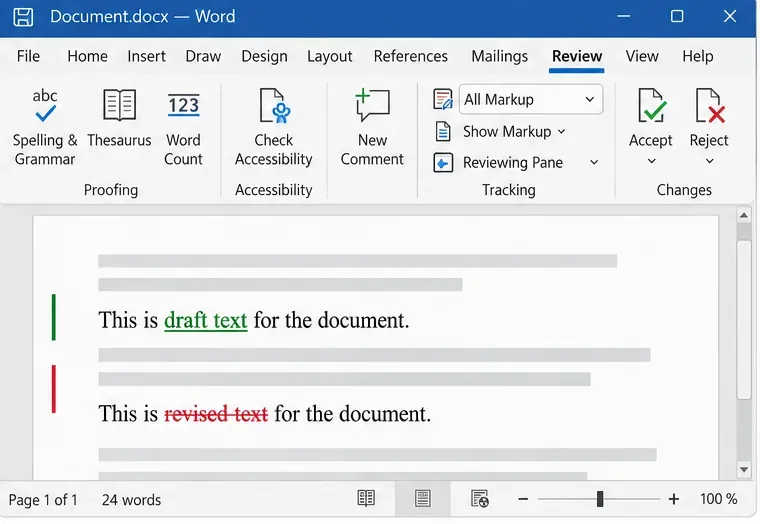
Track edits in Writer, preserve an editable ODT source, and check the exported DOCX in Word before sharing it.
If you have a website with thousands of URLs and want to shorten links to make money through 123Link , very simple, copy and paste the code into your website or blog. After that, the link will be updated automatically.
Step 1 : Log in to your 123link.co account.
Step 2 : Click Tools => menu Full Page Script .

On the right you will see two scripts
1. The first paragraph when inserted into the website or blog will automatically shorten all links containing domain names as follows: depositfiles.com, uploading.com, uploadable.ch

If you want to change each link to 123Link to make money on the web (without specifying the domain name), use the script below.
2. This second script, when inserted into a website or blog, will automatically shorten all links except the following domain name: example.com, yoursite.com. Therefore, you only need to replace the blog or web domain that do not want to shorten the link automatically. For example: 123link.co, 123Link ...

Just copy the last customization script into the website's </head> .
Above is how to shorten the URL via 123Link. Hope the article is helpful to you.
Good luck!
Track edits in Writer, preserve an editable ODT source, and check the exported DOCX in Word before sharing it.
Follow SUSE’s SP7 procedure to enable FIPS mode, reboot safely, verify the active policy, and check whether your compliance requirement calls for validated modules.
Compare YaST and cryptsetup for a new encrypted SLES data volume, choose LUKS1 or LUKS2, and verify unlock and mount behavior safely.
Create, refine, and verify a least-privilege AppArmor profile on SLES 15 SP7, with a clear note on SLES 16’s SELinux default.
Set up RMT on SLES 15, mirror entitled repositories, and verify HTTPS registration and package access from a test client.
Connect SLES 15 to AD with YaST’s SSSD-based logon management, then verify directory lookup, domain login, and Kerberos tickets.
Set up the right Live Patching path for SLES 16.0 or 15 SP7, apply eligible kernel fixes, and confirm what is active without confusing it with a reboot-required kernel update.
Load a custom SLES 15 kernel module without disabling Secure Boot. Match the running kernel, sign the .ko file, enroll a MOK key, and verify loading.
SLES 15 SP5 can migrate online to SP6, but each node must reboot. Use a tested rolling upgrade or blue-green cutover to keep workloads reachable.
Use SUSE’s supported STIG profile to scan SLES 15, test remediation, review remaining findings, and retain assessment evidence.








