Home
» Discover
»
Microlearning and Adult Education: Why the Future Is Short Lessons Plus Deeper Practice
Microlearning and Adult Education: Why the Future Is Short Lessons Plus Deeper Practice
Microlearning is often described as the future of adult education because it matches a problem that traditional training frequently struggles with: adults may want to learn, but they do not always have long, predictable blocks of time. The strongest case for microlearning, however, is not that short lessons should replace courses, credentials, or degrees. It is that focused learning units can lower the friction of starting, make practice easier to repeat, and fit into broader pathways that still provide depth, feedback, and proof of skill.
That distinction matters in 2026. The OECD's 2025 Trends in Adult Learning report found that time remains a major barrier to adult participation, especially because of work and family responsibilities. The same report also warns that an overreliance on short training can be inadequate for deeper reskilling. In other words, shorter can improve access, but shorter is not automatically better learning.
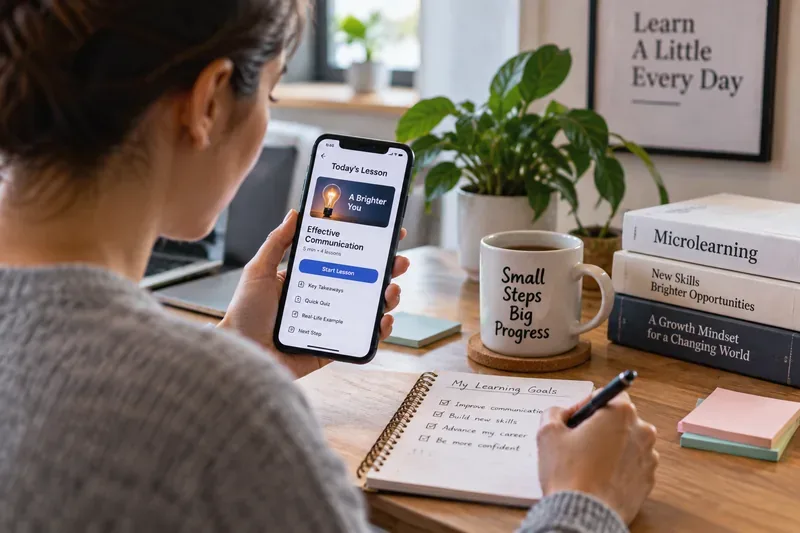
An adult learner uses a phone-based lesson alongside handwritten notes, illustrating how small learning sessions can fit into a busy day.
A hypothetical learner shows where microlearning fits
Consider a clearly hypothetical example. Maya is a 42-year-old operations supervisor who wants to become more confident with data analysis. She works full time, helps care for a parent, and can rarely protect an uninterrupted two-hour evening for study. She can, however, find 10 or 15 minutes before work, during lunch, or after dinner.
Maya's situation is illustrative, not a real learner, testimonial, or study result. It is useful because it exposes the design question at the heart of microlearning: what can a learner realistically accomplish in a small unit without pretending that a complex capability can be mastered in a few minutes?
A weak microlearning plan might give Maya a stream of unrelated tips: one chart shortcut today, one spreadsheet formula tomorrow, and one data-cleaning trick next week. Each item is short, but the sequence does not build toward a coherent skill.
A stronger plan would make each small unit serve a larger outcome. One lesson might help Maya identify a clean versus messy column. Another could ask her to choose the right chart for a business question. A later unit could require her to interpret a chart and explain the decision it supports. The short units remain manageable, but they accumulate toward a meaningful capability.
What microlearning actually is—and what it is not
There is no single universal time limit that turns a lesson into microlearning. In practice, the term usually refers to compact learning experiences built around a narrow objective, often delivered digitally and designed to be completed or revisited in small sessions. The important feature is focus, not a magic number of minutes.
A 2021 systematic literature review of mobile microlearning examined 26 studies published from 2015 through 2020 and found use across formal and informal settings, including just-in-time workplace learning. The review reported benefits in areas such as achievement, motivation, skills, and knowledge retention, while also identifying design and usability challenges. The authors specifically emphasized that microcontent needs to be meaningfully designed for the device and context rather than simply shrinking conventional material. See the original review in Interactive Learning Environments.
Microlearning is also not the same thing as a micro-credential. A microlearning unit is an instructional format. A micro-credential is evidence that a learner achieved defined outcomes in a short learning experience. The European Commission's micro-credentials framework stresses quality, transparency, comparability, recognition, and portability. A learner can complete dozens of microlearning activities without earning a micro-credential, and a micro-credential can include learning activities that are longer than a typical microlearning unit.
Why short learning can be especially useful for adults
It lowers the scheduling barrier
For Maya, the first advantage is obvious: a focused lesson can fit into a schedule that would defeat a conventional evening class. This addresses a real access problem. OECD data show that adults who want more training often cite lack of time because of work or family commitments. Short, flexible units cannot solve childcare, workload, or cost problems by themselves, but they can reduce the amount of uninterrupted time a learner needs to get started.
It can support just-in-time learning
Adults frequently learn because they need to perform a task now, not because they want to study a subject in the abstract. A supervisor may need to prepare for a difficult conversation, a technician may need to refresh a procedure, or a sales employee may need to understand a new product rule. Microlearning is well suited to a narrow need that appears close to the moment of use.
Workplace evidence also suggests that access alone is not enough. A 2023 case study of an internal microlearning platform at a Swedish retail group found that employees' self-regulated use was affected by factors including prioritization, competing learning platforms, and the relevance of content. That finding is a useful warning for employers: a library of short videos does not create a learning culture if employees cannot see why the content matters or do not have permission to prioritize it. The original study is available from The Learning Organization.
It can make repetition more practical
Short units can be easier to revisit than a long lecture. That matters because durable learning usually requires more than one exposure. Foundational research on the spacing effect has shown that separating learning episodes over time can improve later retention compared with massing them together. In a large study with more than 1,350 participants, the interval that worked best depended on how long the learner needed to retain the material. See the original spacing study indexed by PubMed.
For Maya, that means the best use of a five-minute lesson is not to watch it once and move on forever. A better pattern is to learn a concept, retrieve it later with a short question, use it on a real example, and then encounter it again in a more demanding context.
What current studies suggest—and what they do not prove
Recent controlled studies are encouraging, particularly in health-professions education and continuing professional learning. A 2025 pragmatic cluster-randomized trial used WhatsApp-based microlearning with nurses and community health workers at 50 clinics in South Africa. The study reported improvements in knowledge and in measured patient-care practices after the intervention. The population, subject matter, and delivery channel were specific, so the result should not be treated as proof that every microlearning program will work equally well. The original study is identified by DOI 10.1016/j.nepr.2025.104326.
A 2026 randomized controlled trial involving 70 nursing students also reported improvements in patient-safety knowledge, attitudes, and skills after a month of mobile microlearning compared with a no-training control group, with outcomes assessed three months after the intervention. Again, that is evidence for a particular educational design in a particular field—not a universal guarantee for adult education. The original study is identified by DOI 10.1016/j.nepr.2026.104880.
The practical takeaway is modest but useful: microlearning can be effective when the content is relevant, the learner is asked to do something with it, and the program includes enough structure to support retention. The evidence is much weaker for the idea that any five-minute video, by virtue of being short, will produce lasting expertise.
The trade-off: access versus depth
Microlearning is strongest when the learning target is narrow. It becomes weaker when a learner must integrate many concepts, practice a complex skill under varied conditions, receive expert feedback, or produce a substantial project. Those goals usually need larger learning experiences.
Learning option
Best fit
Main advantage
Main trade-off
Microlearning
Refreshers, narrow concepts, just-in-time support, repeated practice
Fits small time windows and is easy to revisit
Can become fragmented or shallow when units are not connected
Structured short course
Connected concepts, guided practice, project work
Creates a coherent sequence and more room for feedback
Requires larger and more predictable time blocks
Micro-credential
Shorter assessed learning with a formal signal of outcomes
Can make achievement easier to document and communicate
Value depends on provider quality, assessment, and recognition
Long-form certificate or degree
Broad foundations, regulated professions, deep specialization
Supports depth, cumulative knowledge, and extensive assessment
Higher time and cost commitment
The OECD's 2025 analysis makes essentially the same policy-level point: short formats can promote participation, but relying on them too heavily may limit deeper or more transformative reskilling. Modular pathways and stackable qualifications are one way to connect convenient short learning to larger outcomes.
How Maya's learning path becomes more than a feed of tiny lessons
Return to the hypothetical example. Maya does not need 100 disconnected clips about spreadsheets. She needs a pathway. Her week might contain several small lessons, but each one is tied to a common performance goal: turn a messy operational dataset into a clear recommendation.
On Monday, she learns one principle of data cleaning and identifies errors in a sample table. On Tuesday, she answers a retrieval question without reopening the lesson. On Wednesday, she applies the principle to a small dataset from a fictional business case. On Thursday, she compares two chart choices and explains which one better supports a decision. On the weekend, she spends a longer session combining the week's material into a simple analysis.
Nothing about that schedule proves Maya will master data analysis in a week. The point is that microlearning handles the small, repeatable pieces while a longer application session supplies integration. Feedback from a teacher, coach, peer, or well-designed assessment would add another layer that short content alone cannot provide.
What a high-quality microlearning program should include
For adult learners, employers, and education providers, quality is easier to judge when the program has a visible structure. Useful signs include a clear learning objective for each unit, active retrieval or practice rather than passive viewing alone, opportunities to apply the material, spacing or revisiting of important concepts, feedback on performance, and a clear connection between small units and a larger capability.
It is also worth asking what happens after completion. Does the learner simply receive a check mark, or is there an assessed task? Can progress count toward a recognized credential? Can the learner explain or demonstrate what changed? These questions become more important as microlearning moves from optional workplace refreshers into formal adult education.
So, is microlearning the future of adult education?
It is likely to be part of that future, but not the whole of it. The format addresses one of the most persistent problems in adult learning: limited time. It also works naturally with mobile delivery, just-in-time support, spaced review, and modular learning pathways. Recent research provides credible examples of benefits in workplace and professional education.
But the future is unlikely to be an endless feed of ever-shorter lessons. Adults still need coherent mental models, practice, feedback, assessment, and sometimes substantial periods of sustained attention. For a learner like the hypothetical Maya, the winning design is not “microlearning instead of real education.” It is microlearning used as the accessible front door to deeper practice and progressively larger achievements.
That is the more useful way to think about microlearning in 2026: not as a shortcut around learning, but as a way to make lifelong learning easier to start, easier to continue, and easier to fit into adult life.