Home
» Today
»
UK Home Office Facial Recognition: Immigration Pilot Plans, Nov. 4, 2026
UK Home Office Facial Recognition: Immigration Pilot Plans, Nov. 4, 2026
Information checked: November 4, 2026, at 5:17 p.m. in London, Greenwich Mean Time (GMT, UTC+00:00), also 17:17 UTC. This is the verification time, not the publication time or the start of any deployment.
The UK Home Office is preparing for a broader, more formal use of live facial recognition (LFR) in immigration enforcement, with updated guidance allowing carefully authorized pilot deployments at ports, transport connections, and locations linked to particular events. The technology has already been tested at Holyhead port in Wales. That does not mean a nationwide system is now operating, or that every immigrant, asylum seeker, or traveler is being placed on a facial recognition watchlist.
A separate but important development came on November 4, 2026: the Home Office announced plans for a clearer statutory framework governing facial recognition and other biometric surveillance by police and certain public bodies. It proposes independent oversight, testing for bias, and a legally backed code of practice. These are government plans for legislation, not new powers already enacted on that date. The distinction matters because Immigration Enforcement's current operational policy and the broader policing legislation are related but not identical.
Key Highlights
Immigration pilot: Immigration Enforcement's October 2026 policy permits overt, intelligence-led deployments beyond its earlier port-based trials, subject to authorization and proportionality checks.
Existing tests: Official deployment records document live facial recognition sessions at Holyhead in November 2025 and February 2026; they do not establish a nationwide rollout.
November 4 proposal: The government says a future legal framework would require stronger safeguards, independent oversight, and testing against discriminatory errors.
Individual protections: Published policy requires human review of alerts, excludes under-18s from Immigration Enforcement watchlists, and sets deletion rules for operational images, with exceptions for lawful case records.
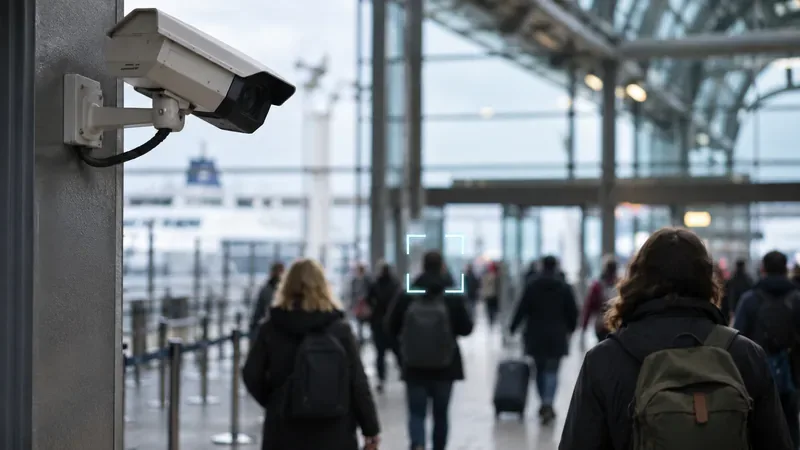
Illustrative image of a security camera in a transit terminal. This is not a photograph of a Home Office facial recognition deployment.
What is the Home Office considering for UK immigration checks?
Immigration Enforcement, a Home Office function, has published a live facial recognition policy, version 2.3, updated October 8, 2026. It describes three kinds of deployments: planned operations at locations such as transport hubs or route junctions; operations tied to ports and travel routes; and operations associated with events where foot traffic is expected to rise.
According to that policy, the location and timing must be supported by an operational rationale, and each proposed deployment must be assessed for necessity and proportionality. More sensitive deployments, including high-footfall sites and operations outside ports, carry enhanced approval requirements. A possible deployment in a train station or at an event is therefore not confirmation that cameras have been installed at any particular station or event.
On October 29, 2026, the Home Office also updated its legal mandate, describing a move from proof of concept into a pilot exercise. The government explicitly says the update clarifies existing legal authority and safeguards; it does not itself create new enforcement powers.
How does live facial recognition work during an Immigration Enforcement operation?
Unlike a passport photograph taken for a visa or a routine identity check at a border desk, live facial recognition continuously compares faces seen by a camera in a designated area with a prepared list of reference images. The principal steps are:
An authorized team prepares a deployment-specific watchlist of people who satisfy defined legal criteria.
Cameras capture faces entering a specific recognition zone and software converts the images into numerical biometric templates.
The software compares those templates against watchlist templates and generates an alert if a similarity threshold is met.
A trained operator checks the alert. Officers must conduct further verification before deciding whether any engagement or enforcement action is lawful.
Importantly, an alert is not proof of identity or immigration status. The Home Office says no arrest, detention, or removal decision can be made by the algorithm alone. Nevertheless, people not named on the watchlist can still pass through the camera zone and have their faces processed briefly for comparison. This is why data protection and proportionality questions affect the broader public, not only the people officials want to locate.
Who could appear on an immigration facial recognition watchlist?
The published categories include people subject to current deportation orders; people wanted on UK court warrants for immigration-related offenses; and people actively sought for enforcement or removal after failing to comply with immigration conditions or lawful directions, where less intrusive ways of locating them are insufficient. The policy says children younger than 18 must not be placed on Immigration Enforcement LFR watchlists.
Officials also say watchlists must be specific to the approved operation, should not be assembled for general monitoring, and cannot be justified solely by vague intelligence interest or outdated noncompliance. These are the stated limits of the program, not independent proof that every future deployment will apply them without error. There is no official basis here for claiming that all people with pending visa applications, all asylum seekers, or all foreign nationals will automatically be watchlisted.
Has the UK already used facial recognition for immigration enforcement?
Yes, on a limited and documented basis. The Home Office's deployment results, last updated October 15, 2026, list multiple Holyhead operations in November 2025 and February 2026. The records include the number of faces seen, watchlist size, alerts, interventions, and outcomes by deployment. This is evidence of trials, not evidence that similar equipment is active throughout the United Kingdom.
The results also need careful interpretation. A zero false-alert figure in an individual small deployment does not prove an algorithm has zero error risk in other locations, under different lighting, or with different populations. Equally, the existence of a successful identification in a trial does not establish the effectiveness of a national program. The government has not confirmed an exact timetable or complete location list for any broader rollout in the official materials reviewed for this article.
What privacy safeguards does the Home Office say will apply?
Human review, notice, and limits on data retention
The Home Office's operational documents provide for signage and public information at deployments. Where feasible and consistent with the operation, officials aim to publish notice at least five days beforehand; exceptions must be justified and recorded. The policy also states that people are not required to cooperate simply because a camera is present. That does not cancel separately existing lawful powers an officer might have in a particular encounter.
The retention rules are more nuanced than a blanket statement that all images are kept for 24 hours. Images that do not produce alerts are to be automatically deleted. Images and related operational records for false alerts are normally deleted within 24 hours or sooner under the authorization. Operational artifacts following true alerts are also time-limited, but lawful immigration casework or criminal justice records resulting from an encounter may be retained under separate applicable rules. The Home Office also published a data protection impact assessment on October 22, 2026.
What are the unresolved risks?
Possible errors, unequal performance across demographic groups, mistakes in source images, and the chilling effect of biometric surveillance remain important concerns. The UK's Information Commissioner's Office warned in August 2026 that false matches can lead to serious consequences and reported shortcomings in governance and data protection practices at police forces it audited. Those findings concern policing and should not be misreported as an audit verdict on the Immigration Enforcement pilot itself. They illustrate questions any expanding biometric program must address with independent testing, documentation, and oversight.
What did the Home Office announce on November 4, 2026?
In its November 4 announcement and a statement to Parliament, the government said it would use the Police Reform Bill to introduce a framework for biometrics, facial recognition, and certain overt surveillance systems used by law enforcement. The consultation drew more than 13,800 responses. Proposed measures include an independent watchdog with enforcement powers, a statutory code of practice, and stronger expectations for independent testing of bias.
The announcement primarily addresses policing and related law enforcement activities in England and Wales; the treatment of other public bodies and reserved UK-wide functions depends on the eventual legal scope. It should not be described as an immediate, stand-alone authorization for immigration officers to scan everybody in public spaces. Nor is the proposed regulator already operating merely because the Home Office has announced it.
What could change next for travelers and people affected by immigration enforcement?
The most important near-term question is where the pilot will actually be deployed, and with which approved watchlist categories, authorizations, notice arrangements, and published results. Travelers should not confuse ordinary airport or passport biometrics with an Immigration Enforcement watchlist operation. They perform different functions and are subject to different processes.
If the Home Office schedules additional deployments, their effect will depend on the exact area, operational objective, and whether a lawful match is established after human checks. If Parliament passes the proposed legislation, stronger independent rules may follow; their scope and start date cannot be assumed before the law is finalized. Readers can check the official Immigration Enforcement LFR collection for notices, policy updates, and deployment statistics rather than relying on rumors about particular locations.
Bottom line: the Home Office is moving beyond initial testing toward a more structured immigration enforcement pilot while proposing wider biometric oversight rules. Actual deployment sites, real-world fairness, and the effect of future legislation remain separate questions that require continuing public evidence.
FAQ
Is the UK using facial recognition to identify people for immigration enforcement?
Yes. Official records confirm limited trials at Holyhead, and the Home Office has published rules for further authorized pilot deployments. A nationwide rollout has not been confirmed in the reviewed sources.
Will everyone entering the UK be added to a facial recognition watchlist?
No such blanket policy is confirmed. The published Immigration Enforcement watchlist rules specify defined enforcement categories. People passing through an authorized camera zone may still have their faces temporarily processed for comparison.
Can facial recognition alone lead to deportation or arrest?
No. Home Office policy says alerts require human review and subsequent action must rely on verified identity and existing lawful powers. Facial recognition does not itself confer new arrest or removal powers.