Beyond BMI: Practical UK Health Measures for 2026
BMI is only one part of the picture. See how UK adults can use waist-to-height ratio, clinical checks and body composition measures to discuss health risks.
Information checked November 12, 2026, at 1:43 a.m. in London, Greenwich Mean Time (GMT, UTC+00:00; the same time in UTC). The UK government has announced plans to ease packaging-waste charges affecting pubs and drinks suppliers, but the major change will not take effect until April 2027. Under the announcement made on November 11, 2026, glass drinks containers sold directly by producers to licensed hospitality venues will no longer attract Extended Producer Responsibility (EPR) packaging fees. That is prospective cost relief—not a new fee charged to every pub and not a promised reduction in the price of a pint.
For pub owners, the immediate question is whether lower supplier costs will reach their invoices and margins. For customers, the impact on beer and wine prices remains uncertain: a manufacturer might absorb the savings, pass them through a wholesaler or adjust trade prices only when contracts renew. The government's November 11 announcement estimates potential savings of up to 6p per beer bottle and 10p per wine bottle, but these are illustrative upper-end amounts, not automatic discounts at the bar.
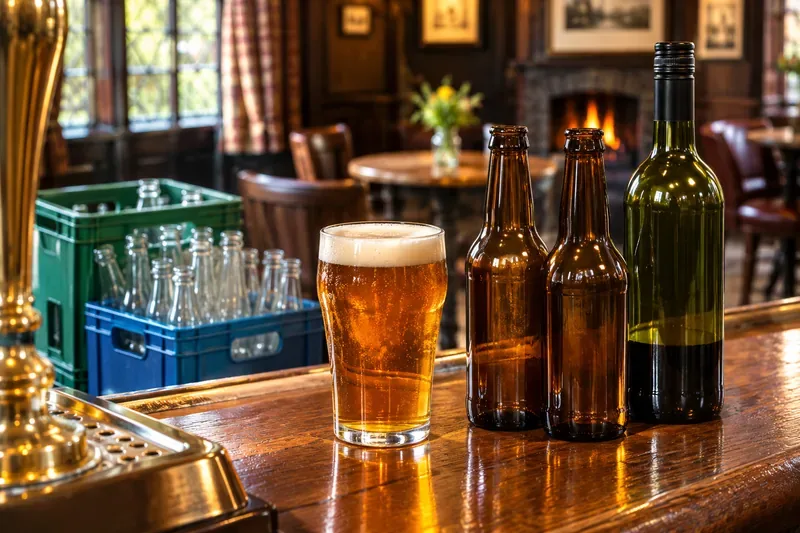
The Department for Environment, Food & Rural Affairs (Defra) says it intends to stop charging packaging EPR fees on glass drinks containers supplied directly from producers to pubs, restaurants and other licensed hospitality businesses from April 2027. The change is designed to address a complaint that commercial venues effectively pay twice for some glass recycling: EPR costs can be reflected in the purchase price of drinks while pubs also pay commercial contractors to take away glass.
It is important to distinguish an announced policy from an implemented charge change. As of this November 12 check, the April 2027 relief is a government commitment for the future; it does not itself rewrite existing supply contracts or erase current invoices. The government also plans to consult on restructuring material-based fees so that easy-to-recycle packaging, including glass and paper, could attract lower fees than harder-to-recycle packaging. Officials say the future proposals could lower fees for highly recyclable packaging by up to 40% annually, but that figure describes a potential outcome subject to further work, not a confirmed cut already in force.
Not necessarily. Packaging fees are primarily obligations on qualifying packaging producers rather than a new line-item tax charged to every customer ordering a drink. A pub can nevertheless feel the effect if a brewer, bottler, brand owner or distributor builds EPR-related costs into wholesale prices. Conversely, lower producer costs could eventually reduce some upward price pressure—but only if the savings travel through the supply chain.
Defra's examples describe savings of up to 6p per beer bottle and up to 10p per wine bottle. It also gives an illustrative pub selling 10,000 beer bottles and 3,700 wine bottles that could save up to £870 a year. That estimate should not be treated as a universal entitlement or a per-item discount: bottle types, sourcing arrangements, the applicable fees and the share passed on all matter.
A bottle of wine sold as several individual glasses illustrates why consumers should avoid assuming a 10p reduction on each glass. Any packaging saving would relate to the container as a whole and then depend on how suppliers and the venue account for it. A draft pint served from a keg is also not equivalent to a bottle of beer for this specific glass-bottle measure. A headline about bottle charges cannot reliably predict the price of all pints.
The UK's packaging EPR system shifts eligible costs of handling packaging waste toward the producers placing it on the market. The official PackUK waste-disposal fee guidance explains that qualifying large producers pay annual waste-disposal fees for specified packaging types; those payments help fund local-authority waste services. The financial burden may then influence trade prices, although the scheme is not a blanket invoice sent to every landlord.
Bars and restaurants generally arrange their own commercial glass-waste collections. The industry argues it is unfair when packaging disposed of through that separately funded commercial channel is also counted in a way that adds producer-level waste-disposal costs to the goods purchased by the venue. Defra's November 11 response specifically addresses glass supplied directly into hospitality, where the route to the final business user is easier to establish.
Existing government guidance on household and non-household packaging makes the distinction between direct and indirect supply important: the classification can depend on who ultimately uses the packaging and what evidence the producer retains. That does not mean every bottle delivered to any pub is automatically excluded today or that a retail sale to a consumer is identical to a bottle opened and recycled on the premises.
This is one of the most significant unresolved practical issues. The November announcement explicitly describes direct sales from producers to licensed venues. It does not establish a blanket exemption for every intermediary supply chain. In the government's own release, British Beer and Pub Association chief executive Emma McClarkin welcomed the direction of the change but warned that roughly 12,000 leased and tenanted publicans should also benefit.
The British Soft Drinks Association likewise called for a solution to indirect supply, indicating that the announced change is only a first step. A small independent pub buying through a regional distributor should therefore ask whether the producer's fee treatment will change and whether any saving will be reflected in the distributor's prices. It would be premature to budget as though every bottle bought through a wholesaler automatically qualifies for April 2027 relief.
Smaller businesses should also distinguish producer registration duties from waste-disposal fees. Under the government's guidance for small packaging producers, businesses classified as small producers may have registration and reporting duties but do not pay packaging EPR waste-disposal fees. The legal classification depends on the organization's activities, turnover and packaging volumes, not simply whether it operates a pub.
The next firm date in the new announcement is April 2027, when the government says directly supplied glass drinks containers will cease to be liable for the specified EPR charges. It also says it plans a December 2026 call for evidence on wider reuse of packaging and an early-2027 PackUK call for evidence on packaging-fee design. Consultations are not final fee schedules; the exact effect on suppliers and prices will depend on the resulting rules.
For customers, there is no basis to claim that pints will fall by a fixed amount on a specific date. Businesses continue to face other costs, including wages, energy, rent and tax, that can offset any saving on bottled packaging. A pub could use the relief to stabilize prices rather than cut them, while another could pass part of it on. The clearest test will be actual changes to supplier invoices and the prices venues choose to charge after the measures take effect.
The available official information confirms the government's decision to pursue relief and its illustrative savings, but it does not confirm a nationwide retail-price reduction, a fully resolved indirect-supply exemption or individual pub savings. Pub operators should monitor Defra’s official announcement and subsequent PackUK guidance for the detailed implementation.
No. The November 11 announcement is about planned relief from existing packaging EPR costs on qualifying glass bottles supplied directly to licensed venues from April 2027, not a new tax on each drink sold.
No fixed reduction has been promised. The government's up-to-6p example concerns a beer bottle, not a pint poured from a keg, and any retail-price change depends on supplier and pub pricing decisions.
Not on the evidence announced so far. The direct-supply measure is explicit, while industry organizations are seeking clarification and fair treatment for indirect distribution, including leased and tenanted pubs.
BMI is only one part of the picture. See how UK adults can use waist-to-height ratio, clinical checks and body composition measures to discuss health risks.
BYD confirms a Great Tang wheel-rim mix-up in China. Compare 2026 SUV specs, charging and rear-wheel steering, plus what Australian EV buyers should know.
BYD’s Australian EV and plug-in hybrid range is growing. Compare charging, real-world range, warranty, prices and tax rules before you buy.
Where was the Brooklyn building collapse? What to know about 1321 Flatbush Avenue, two deaths, 17 injuries and the investigation as of November 12.
BYD’s ATTO 2 DM-i joins Australia’s lineup as the brand posts strong October sales. See its listed specs, launch offer, and what buyers should check.
Connor Wickham joins Crawley Town on a deal until early January 2027. Get the confirmed contract facts, announcement, debut goal and next fixtures.
Hunting Alice Bell premiered on Channel 4 November 11. Explore the plot, real-life inspiration, cast and how to stream the six-part UK thriller.
A building collapsed beside a construction site in Flatbush, Brooklyn. Here is the latest on the rescue, reported casualties, inspections and road closures.
The UK plans to remove EPR fees on glass bottles supplied directly to pubs from April 2027. See possible savings, risks for tenants and drink-price effects.
Connor Wickham scored on his Crawley debut, but the Reds’ 2–1 loss to Brentford U21 ended their EFL Trophy run. Here’s what his short-term signing could mean for the League Two campaign.