Home
» Today
»
Wind Turbine Blades: Why Their Curved, Twisted Shape Works — November 9, 2026
Wind Turbine Blades: Why Their Curved, Twisted Shape Works — November 9, 2026
Information checked: November 9, 2026 at 01:14 UTC (UTC+00:00). This is an engineering explainer, not a report of a new turbine launch or safety incident.
Wind turbine blades are shaped like long, twisted airplane wings because aerodynamic lift—not simply the wind pushing against a flat surface—does most of the work. Their curved cross-sections create a force that turns the rotor; a shaft and generator convert that rotation into electricity. The blade's thickness, width, and angle change from root to tip to capture energy efficiently without creating unnecessary drag or mechanical stress.
That design matters in Australia, where wind generation is one part of the electricity system. The Australian Government's Net Zero Economy Authority explanation describes how the rotor, shaft, generator, and transformer work together to deliver electricity to the network. Understanding the blades reveals why a wind turbine can look almost still from the ground yet generate substantial power.
Destaques
Lift turns the rotor: A blade is an airfoil, not a flat paddle; its motion through the air helps create a useful turning force.
Twist and taper have jobs: Twist keeps different blade sections at effective airflow angles, while taper helps balance aerodynamic performance and weight.
Pitch protects the turbine: Control systems rotate the blades around their long axes to adjust energy capture and reduce loads in strong winds.
Size matters, but there are limits: A larger swept area captures more available wind, while engineering constraints and the Betz limit prevent perfect extraction.
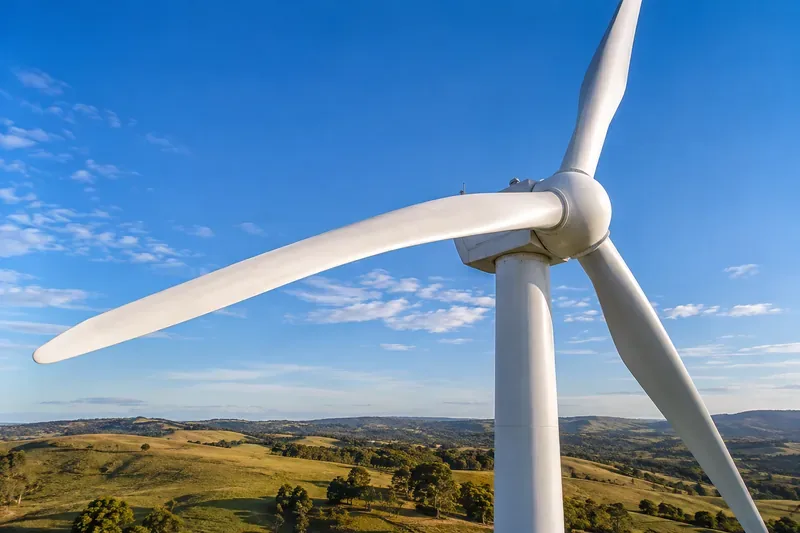
A three-bladed wind turbine seen from below. The broad inner sections and slender outer sections illustrate how blade geometry changes along the rotor.
How do wind turbine blades actually work?
As air flows around each rotating blade, differences in pressure and changes in the air's direction produce aerodynamic lift and drag. Designers position the blade so that a component of the lift force acts in the direction of rotation. The resulting torque spins the hub and main shaft. In a geared turbine, the gearbox increases rotational speed before the generator; in a direct-drive design, the generator is coupled to the rotor without that gearbox. Both approaches convert mechanical energy into electricity.
Wind turbines therefore do not operate like ordinary desk fans in reverse. A fan consumes electrical energy to move air; a wind turbine removes some kinetic energy from moving air and sends it through a generator. The U.S. Department of Energy's turbine explanation describes how lift from an airfoil generates rotation and how different drivetrains connect the rotor to the generator.
Why are wind turbine blades curved, twisted, and tapered?
Why are the blades curved instead of flat?
Look at a blade's cross-section: it is an airfoil, typically with a rounded leading edge and a thinner trailing edge. When the airfoil meets the apparent wind at an appropriate angle, airflow around it produces lift with less drag than a simple flat paddle would generate in comparable operation. Lift is especially useful because a large part of it can be directed tangentially, keeping the rotor moving.
Curvature alone does not guarantee performance. The blade's angle of attack, local wind speed, surface condition, and airfoil profile all matter. A rough or damaged leading edge can disturb the airflow and reduce output. The Department of Energy's airfoil engineering case study explains why researchers refined blade profiles after discovering that dirt and wear could hurt performance.
Why does a wind turbine blade twist from root to tip?
The inner and outer portions of a blade are not moving through the air at the same speed. A point close to the hub travels a relatively short distance in each revolution; a point near the tip travels much farther in the same time. As a result, the direction of the relative wind—the airflow experienced by the moving blade—changes along its length.
The blade is built with a gradual twist to give each section a productive angle of attack. The inner portion generally has a different pitch orientation than the outer portion. Without this twist, one region might operate efficiently while another suffered excessive drag or approached an aerodynamic stall. Twist is built into the blade's shape and is distinct from the active pitch adjustment made by the turbine's control system.
Why are blades wider and thicker near the hub but narrow at the tip?
The root must transmit enormous bending and twisting loads into the hub. It therefore needs a thick, strong structure. Farther out, the blade normally becomes narrower and more slender because aerodynamic conditions change and excess mass near the tip would add weight and loads. This narrowing is called taper. Engineers optimize it together with the airfoil and twist, rather than simply making every blade as thin as possible.
Modern designs also account for deliberate flexibility. The Department of Energy describes bend-twist-coupled blades, which can twist as they flex under gusts, changing the angle of attack and helping reduce structural loads. Such approaches illustrate an important trade-off: the best blade is not merely the one with the highest aerodynamic efficiency in a perfectly steady wind.
Why do most large wind turbines have three blades?
Three blades are a widely used compromise among power capture, smooth running, structural loads, rotor speed, noise, and manufacturing cost. Two-bladed and other arrangements exist, but the three-bladed, horizontal-axis rotor is the common sight at large wind farms. Adding more blades does not increase energy capture in proportion to their number: extra blades also change aerodynamic interactions, weight, and loads. The Department of Energy identifies three blades as the established choice for most modern horizontal-axis machines in its wind-turbine overview.
How does blade pitch control power and protect the turbine?
Blades on many large turbines can rotate around their own long axes. This pitch control changes how the air meets the blade. At useful operating wind speeds, the controller seeks a suitable combination of torque, rotor speed, and output. As the wind grows stronger, pitching can limit power and loading. During shutdown or dangerous conditions, the blades can be feathered to greatly reduce aerodynamic driving force.
Pitch is not the same as yaw, which turns the nacelle so the rotor faces the wind. It is also not the same as the permanent twist molded into a blade. The Department of Energy's illustrated component guide distinguishes pitch, yaw, the rotor, and the different generator configurations.
Do longer blades always produce more electricity?
Longer blades sweep a wider circle, which allows a rotor to intercept more moving air. The area is proportional to the square of the rotor radius. The power available in the wind, before conversion losses, follows the relationship P = ½ × air density × swept area × wind speed³. That cubic wind-speed term explains why site conditions matter so much: doubling wind speed would multiply the power available in the airflow by eight, although actual electrical production does not keep rising indefinitely because generators have rated capacities and turbines use protective controls.
There is also a physical ceiling. The Betz limit says an ideal rotor cannot extract more than 16/27, or approximately 59.3%, of the wind's kinetic power passing through its swept area. The air must still flow downstream; it cannot be stopped completely at the rotor. Real machines capture less than this ideal limit, and the final electric output is further affected by mechanical and electrical losses. These principles and the power equation appear in the Department of Energy's Small Wind Guidebook.
Longer blades can improve energy production, particularly at suitable wind sites, but they are harder to manufacture, transport, install, and maintain. Engineers must also manage fatigue, storm loads, ground and tower clearance, and the economics of the complete wind farm.
Why can turbine blades make a whooshing sound?
Blade movement creates complex airflow and turbulence, especially around the trailing edge and near the tip. That interaction produces the characteristic swishing or whooshing sound. The noise depends on blade shape, operating speed, wind conditions, and distance. Rotor speed and quieter blade-edge designs are therefore part of the engineering trade-off, not just a cosmetic detail. The Department of Energy's wind-turbine sound guidance describes aerodynamic and mechanical sources of noise, as well as efforts to reduce them.
What is changing in blade design, and what could it mean for Australia?
Research continues into stronger composite materials, erosion-resistant leading edges, adaptive bending and twisting, and blade shapes that reduce unwanted loads. Those developments could help future turbines operate more reliably or capture more energy at suitable sites, but their benefits depend on the design and operating conditions. They should not be read as a guarantee of lower costs or greater output for every project.
For Australian wind projects, the practical question is not just how long a blade can be. It is how the full turbine design matches local wind patterns, transport routes, maintenance needs, grid connections, and environmental requirements. Wind varies over time, so energy planning must also consider how wind generation interacts with storage and other electricity sources. The Australian Government's wind-energy explainer notes the role of combining wind with solar and energy storage.
FAQ
Are wind turbine blades shaped like airplane wings?
Yes. Their airfoil cross-sections create lift as they move through the wind, but a turbine converts that aerodynamic force into rotation instead of using it to keep an aircraft aloft.
Why aren't wind turbine blades straight and the same width throughout?
Different parts of a blade move through the air at different speeds. Twist helps maintain a useful angle of attack, while taper and thickness changes balance power capture, weight, and strength.
Can wind turbines work when the wind is very strong?
Only within their operating limits. Many turbines adjust blade pitch to regulate output and feather the blades or stop when conditions exceed safe thresholds. Exact settings vary by turbine model.