Home
» Today
»
AI Chatbots and UK Tax Rules: How to Verify Advice With HMRC (November 11, 2026)
AI Chatbots and UK Tax Rules: How to Verify Advice With HMRC (November 11, 2026)
Verified and updated November 11, 2026 at 1:09 PM London, GMT (UTC+00:00); 13:09 UTC.
AI chatbots can make UK tax questions easier to understand, but a plausible answer is not a substitute for HM Revenue & Customs (HMRC) guidance. On November 10, 2026, HMRC urged taxpayers to begin their 2025–26 Self Assessment returns early rather than wait for January. The agency confirmed that online returns and tax payments are due by January 31, 2027. Anyone using an AI answer to decide whether to file, claim a deduction, or calculate tax should check the relevant rule on GOV.UK before acting.
The practical approach is to use a chatbot to identify the question, then verify the applicable tax year, UK jurisdiction, eligibility conditions, official deadline, and source. HMRC has its own digital assistant, but that should not be confused with a general-purpose, third-party AI chatbot. Neither a confident tone nor an AI-generated link establishes that a tax answer is correct. HMRC’s November 10 announcement is the starting point for the latest Self Assessment reminder.
Destaques
Latest HMRC reminder: Online 2025–26 Self Assessment returns and payments are generally due January 31, 2027.
Best verification method: Compare every important AI claim with an applicable, dated GOV.UK page or an HMRC tool.
Watch for context: A tax answer can change with the tax year, income type, residency, and whether Scottish rules apply.
When to escalate: If the official guidance does not resolve a complex situation, contact HMRC or a qualified tax professional.
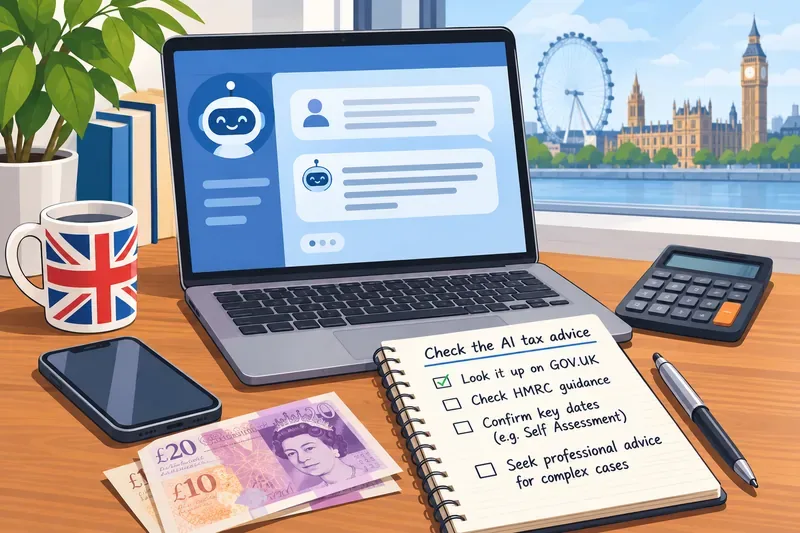
Illustration: A UK taxpayer checking chatbot-generated tax information against HMRC guidance. This is not a screenshot of an HMRC service.
What Has HMRC Said About the Upcoming UK Tax Deadline?
In its November 10, 2026 update, HMRC encouraged Self Assessment customers to start early. It reported that approximately 12 million people are expected to file a return each year and that around 5 million often delay completing the task until January. Those figures describe HMRC’s Self Assessment workload; they do not measure how many people use AI chatbots for tax advice or establish whether chatbot answers are accurate.
For the tax year running April 6, 2025 through April 5, 2026, the normal online filing deadline is January 31, 2027, at 11:59 p.m. in London, GMT (UTC+00:00). Payment is generally due by the same deadline. The ordinary paper-filing deadline of October 31, 2026 has passed. Some people, such as those who register late and receive a separate notice, can have a different filing deadline; that does not automatically extend the payment deadline. See the official Self Assessment deadlines before relying on a date produced by AI.
How Can You Fact-Check AI Chatbot Tax Advice Against HMRC?
1. Ask the chatbot for the exact rule, not just a conclusion
Start with a narrowly framed question such as: “For the UK 2025–26 tax year, what are the Self Assessment filing requirements for a sole trader, and which current GOV.UK pages support each point?” Treat its answer as a checklist of claims to test. If it provides no sources, vague citations, or links that do not open, do not treat its conclusions as established.
2. Confirm the right tax year and country within the UK
UK tax years normally run from April 6 through April 5. An allowance or rate for 2026–27 must not automatically be applied to a return for 2025–26. Also, Scottish Income Tax bands differ for non-savings, non-dividend income, while the treatment of savings and dividends has separate rules. Check HMRC’s tax-year comparison of rates and allowances and, where relevant, Scottish Income Tax guidance. Do not assume the same calculation applies to every UK taxpayer.
3. Find the official page and read the conditions
Open GOV.UK directly, rather than trusting an AI summary or an unfamiliar website that looks official. Search the precise issue: “Self Assessment who must file,” “trading allowance,” “rental income,” or “tax code.” Inspect the effective date and any exceptions, footnotes, and links to related guidance. A threshold may refer to gross receipts rather than profit; an eligibility rule may depend on income from several sources. Those distinctions can change the outcome.
4. Use a government checker when one exists
For the 2025–26 tax year, HMRC offers a tool to check whether a Self Assessment return is needed. It asks about your situation and offers a more tailored route than a generic chatbot response. The tool does not replace a formal filing notice: if HMRC has asked you to submit a return, follow the notice or resolve the issue with HMRC. HMRC also provides a tax filing and payment deadline checker for selected taxes, including Self Assessment, VAT, and employer PAYE.
5. Keep a record of the official source you relied on
Record the page title, URL, date accessed, tax year, and the exact conditions that matched your circumstances. If the AI answer conflicts with GOV.UK, investigate the difference rather than choosing the easier or more favorable outcome. For complex matters, check whether the page refers to legislation, detailed HMRC manuals, or an adviser. HMRC explains that its technical manuals are not comprehensive or definitive in every case, so even a genuine manual paragraph may require interpretation.
What Mistakes Can AI Chatbots Make About UK Tax Rules?
Common risks include mixing different tax years, treating a general allowance as unconditional, applying an England-based example to someone subject to Scottish Income Tax, quoting a deadline without its exceptions, and inventing an authoritative-sounding citation. A chatbot can also confuse being required to declare income with necessarily owing additional tax. Each error matters because taxpayers act on specific facts rather than an average case.
For example, HMRC says a sole trader who earned more than £1,000 before expenses in a tax year generally falls within its Self Assessment filing criteria. That is a gross receipts test in the cited list, not a statement that £1,001 in sales produces a £1,001 tax bill. Whether any tax is due depends on the full circumstances. Check the HMRC filing criteria and relevant allowance guidance before making a decision.
Is HMRC’s Own Digital Assistant the Same as ChatGPT?
No. HMRC’s digital assistant is a government support channel reached through official GOV.UK pages. HMRC’s published Ask HMRC Online transparency record describes a system used to direct customers to information and self-service processes. According to HMRC’s Self Assessment contact page, users can ask its digital assistant about registering, filing, payments, penalties, refunds, and Making Tax Digital for Income Tax; if necessary, they can request a webchat with an adviser when available.
A general-purpose AI product is not HMRC and cannot itself amend your tax records, issue official rulings, or file a return merely by answering a question. Even when using an official assistant, check important outcomes against the relevant service, notices, and written guidance.
Should You Share Tax Records With an AI Chatbot?
Minimize personal and financial information shared with third-party chatbots. You can often get a useful explanation by using hypothetical or rounded amounts rather than entering a National Insurance number, Unique Taxpayer Reference, bank details, payslip, address, or full return. Review the provider’s data-handling settings before uploading any documents. To see or change your actual UK tax information, use the official HMRC account or service reached from GOV.UK. Treat links in unsolicited messages cautiously; HMRC publishes instructions for reporting suspicious messages.
What Should You Do If the Chatbot and HMRC Disagree?
Do not file or claim an amount simply because the chatbot sounds certain. First ensure both answers address the same tax year and facts. Next, review the current government page and any linked exception or technical guidance. If the difference remains significant, use HMRC’s official help routes or a qualified accountant or tax adviser, especially for residence, international income, capital gains, business expenses, or substantial liabilities.
Looking ahead, AI may remain useful for translating dense tax terminology into plain English and preparing questions for an adviser. That is a potential benefit, not proof that a given system’s output is dependable. The safest division of work is to let AI explain what to investigate while letting current HMRC sources, actual records, and professional judgment determine what you submit.
Frequently Asked Questions
Can I use ChatGPT to calculate my UK tax bill?
You can use it to understand a calculation or produce a rough illustration, but confirm the applicable year, bands, allowances, and income categories on GOV.UK. Use an official service or professional advice for consequential decisions.
Does HMRC accept “the AI told me” as proof that a tax return is correct?
Do not assume so. Your obligations depend on tax rules and your circumstances, not a third-party chatbot response. Keep documentation and seek official clarification where necessary.
When is the 2025–26 online Self Assessment deadline?
The standard online filing and payment deadline is January 31, 2027, at 11:59 p.m. London, GMT (UTC+00:00). Separate notice-based filing arrangements may apply to some taxpayers.