Home
» Today
»
AMD Radeon: What’s Driving Interest in AMD’s Latest Graphics Cards?
AMD Radeon: What’s Driving Interest in AMD’s Latest Graphics Cards?
AMD Radeon is drawing fresh attention in September 2026 for a combination of hardware expansion and software updates rather than one single launch. The most recent official change is AMD Software: Adrenalin Edition 26.9.1, released September 3, 2026, which adds support for new games and fixes several issues affecting Radeon RX 9000-series cards. Just two weeks earlier, the WHQL-recommended 26.8.1 driver added support for the Radeon RX 9050 4GB, extending the RDNA 4 family farther down the product stack. At the same time, the Radeon RX 9070 GRE, introduced globally in June, gives shoppers another option between AMD’s mainstream and higher-end models.
For PC gamers, builders, and creators comparing graphics cards right now, the practical story is broader than raw frame rates. AMD’s current Radeon pitch combines RDNA 4 hardware, larger parts of the RX 9000 product range, machine-learning features under FSR “Redstone,” AV1 media support, modern display outputs, and a driver stack that continues to add compatibility and fixes. That combination helps explain why searches for “AMD Radeon” can rise even when there is no single blockbuster GPU launch on a given day.
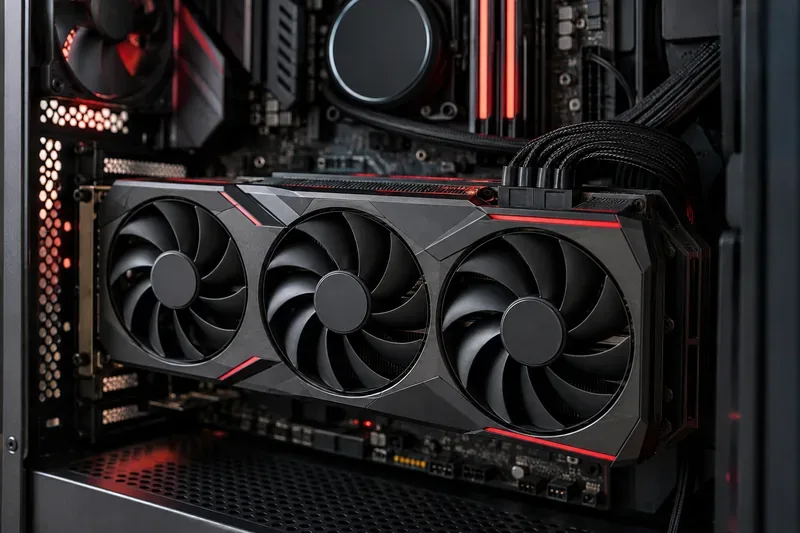
A modern desktop graphics card inside a gaming PC highlights the large coolers, dedicated power connections, and airflow considerations typical of current Radeon-class hardware.
What changed most recently?
The clearest short-term update is software. AMD’s Adrenalin Edition 26.9.1 release notes, last updated September 3, 2026, list new game support for Onimusha: Way of the Sword and The Blood of Dawnwalker. The same release also fixes intermittent crashes in Starfield and Apex Legends on Radeon RX 9000-series products.
The previous recommended driver, Adrenalin Edition 26.8.1, arrived August 20, 2026 and added support for the Radeon RX 9050 4GB. That matters because it shows AMD continuing to broaden the RX 9000 family rather than limiting RDNA 4 to enthusiast-class cards.
There is also an important caveat for buyers: the latest optional driver is not automatically the best choice for every PC. AMD distinguishes between WHQL-recommended and optional packages, and its release notes continue to list known issues. Users who value maximum stability over day-one game support may prefer the latest recommended driver unless a newer optional release fixes a specific problem they are experiencing.
The RX 9000 lineup now covers more of the market
AMD’s current Radeon desktop graphics page centers on the RX 9000 series and RDNA 4. The lineup includes the Radeon RX 9070 XT, RX 9070, RX 9070 GRE, RX 9060 XT, RX 9060, and RX 9050 variants. That wider spread gives shoppers more performance, memory, power, and price-positioning combinations to compare.
Model
Memory
Compute units
Typical board power
Best fit to investigate
Radeon RX 9070 XT
16GB GDDR6
64
304W
High-refresh 1440p and 4K gaming
Radeon RX 9070
16GB GDDR6
56
220W
High-end gaming with lower power than the XT
Radeon RX 9070 GRE
12GB GDDR6
48
Check board-partner design
1440p-focused buyers comparing the gap below RX 9070
Radeon RX 9060 XT 16GB
16GB GDDR6
32
160W
1440p gaming where extra VRAM matters
Radeon RX 9060
8GB GDDR6
28
132W
1080p gaming and lower-power builds
Radeon RX 9050
Up to 8GB depending on variant
16
92W on AMD’s 8GB specification
Entry-level RDNA 4 systems
Specifications can vary by exact board and memory configuration, so buyers should verify the specific card they are considering rather than relying only on the family name. AMD’s own listings show, for example, both 8GB and 16GB versions of the RX 9060 XT. The RX 9060 XT 16GB product page lists 32 compute units, a 160W typical board power, a 128-bit memory interface, DisplayPort 2.1a, HDMI 2.1b, and AV1 encode/decode support.
Why the Radeon RX 9070 GRE is part of the renewed interest
At Computex 2026, AMD announced a global rollout for the Radeon RX 9070 GRE beginning June 2 with a suggested launch e-tail price of $549. AMD’s official announcement specifies 48 RDNA 4 compute units, 12GB of memory, and a boost clock of up to 2.79GHz. The RX 9070 GRE product page positions the card for 1440p gaming.
That model is notable because GPU buying decisions often happen around the gaps between products. Someone who does not need an RX 9070 XT may still want more headroom than a midrange card can provide. The GRE creates another comparison point for shoppers balancing resolution, refresh rate, VRAM, power supply capacity, physical card size, and local pricing.
RDNA 4 brings AMD’s AI and ray-tracing features closer to the center
The RX 9000 family is built on AMD’s RDNA 4 architecture. AMD describes it as using third-generation ray-tracing accelerators and second-generation AI accelerators. Those blocks matter because current graphics performance is increasingly shaped by more than traditional raster rendering. Upscaling, frame generation, ray reconstruction, and other machine-learning-assisted techniques can materially change the experience in supported games.
This does not mean a feature label guarantees the same benefit in every title. Performance depends on the game, resolution, quality mode, CPU, driver, and whether the developer has integrated the relevant technology. Buyers should therefore compare the games they actually play rather than treating architecture-level features as a universal benchmark result.
FSR “Redstone” is now a bigger reason to compare Radeon generations
AMD’s FSR technology page now groups its latest machine-learning gaming features under the FSR “Redstone” name. The suite includes FSR Upscaling, FSR Frame Generation, FSR Ray Regeneration, and FSR Radiance Caching. AMD also notes that the former “FSR 4” name is now used as part of the broader Redstone family rather than as a standalone umbrella term.
Compatibility is one reason the current Radeon discussion is more nuanced than a simple RX 9000-versus-RX 7000 comparison. AMD states that the full Redstone feature set is aimed at RX 9000-series graphics, while machine-learning FSR Upscaling is also available on RX 7000-series cards with sufficiently recent drivers. AMD says RX 6000-series support for that upscaling path is planned for 2027. In other words, software support is extending some newer image-quality technology backward, but not every feature applies equally to every Radeon generation.
VRAM capacity is becoming a more visible buying question
The current lineup also puts memory capacity in the spotlight. The RX 9070 XT and RX 9070 carry 16GB, the RX 9070 GRE carries 12GB, and the RX 9060 XT is sold in both 8GB and 16GB versions. The RX 9050 line also includes lower-memory configurations.
More VRAM is not automatically faster in every game, but capacity can matter when high-resolution textures, ray tracing, mods, large creative projects, or future titles push memory use upward. AMD’s own September 2026 driver notes specifically mention that Cyberpunk 2077 recommends at least 6GB of video memory and advises Radeon RX 9050 4GB users who encounter problems to reduce graphics-intensive settings. That is a useful reminder to evaluate memory capacity against the games and workloads you expect to run, not just the GPU model number.
Power, connectors, and case fit still matter as much as headline specs
Modern GPUs can differ sharply in power needs and physical size. AMD lists a 304W typical board power and a 750W minimum PSU recommendation for the RX 9070 XT, while the RX 9070 is rated at 220W with a 650W recommendation. The RX 9060 XT 16GB is listed at 160W with a 450W recommendation.
Those figures are a starting point, not a substitute for checking the exact board-partner card. Cooler thickness, card length, power connector placement, factory overclocks, and PSU quality can all affect compatibility. Before buying, confirm the case’s GPU clearance, the number and type of required power connectors, and whether airflow is adequate for the card’s cooler.
Media and creator features add another reason Radeon gets searched
AMD’s current RX 9000 product pages list AV1 hardware encode and decode support, along with HDMI 2.1b and DisplayPort 2.1a on models such as the RX 9060 XT. For streamers and video creators, AV1 can provide better image quality at a given bitrate than older codecs when the full workflow supports it. For high-refresh and high-resolution displays, modern output standards also matter when choosing a GPU for a monitor upgrade.
These features do not replace application-specific testing. A creator using Blender, DaVinci Resolve, Adobe software, local AI tools, or a specialized encoder should verify support and acceleration in those exact applications. Gaming benchmarks alone do not establish creator-workload performance.
What should buyers take away from the current Radeon interest?
The latest AMD Radeon attention is being driven by several overlapping developments: the RX 9000 family now spans more price and performance tiers, the RX 9070 GRE has expanded globally, the RX 9050 has recently gained driver support, and FSR “Redstone” makes machine-learning features a more visible part of AMD’s graphics platform. Continued Adrenalin updates also keep the hardware relevant after launch by adding game support and fixing issues.
For a buyer in September 2026, the useful question is not simply whether Radeon is “hot” right now. It is whether a specific card fits the intended resolution, games, VRAM needs, power supply, case, monitor, creator apps, and budget. Check the exact model specifications, compare current street pricing, review the latest driver notes, and treat vendor performance claims as one data point rather than a substitute for testing in the workloads that matter to you.
Current as of September 20, 2026. Product availability, board-partner designs, driver status, supported games, and pricing can change. The official AMD pages linked above are the appropriate sources to re-check before a purchase.