Home
» Today
»
How the Swallowable Sponge Test Checks for Early Esophageal Cancer Signs | Nov. 16, 2026
How the Swallowable Sponge Test Checks for Early Esophageal Cancer Signs | Nov. 16, 2026
Last checked: November 16, 2026, at 1:06 p.m. GMT (UTC+00:00).
The NHS capsule sponge test, sometimes called Cytosponge or the “sponge on a string,” collects cells from the esophagus to look for Barrett’s esophagus and other abnormal changes that may need further investigation. It is already used in some UK care pathways, and a two-year NHS pilot announced in July 2025 was intended to offer testing to around 1,500 people through pharmacies or community clinics in parts of England. That is a limited pilot, not a confirmed nationwide offer: availability depends on the local pathway and the patient’s circumstances.
The test can help clinicians decide who should have a gastroscopy, but it does not diagnose or rule out cancer on its own. A positive result generally needs confirmation by gastroscopy, and persistent or concerning symptoms still deserve medical assessment even after a negative sponge test.
Destaques
A small capsule dissolves in the stomach, releasing a sponge that is pulled back up on a thread and collects esophageal cells.
Laboratory analysis looks for cell changes associated with Barrett’s esophagus and possible cancer risk.
A positive result usually leads to gastroscopy; a negative result is not a guarantee that disease is absent.
NHS access varies across the UK, and evidence is still being gathered on the test’s long-term effect on cancer outcomes.
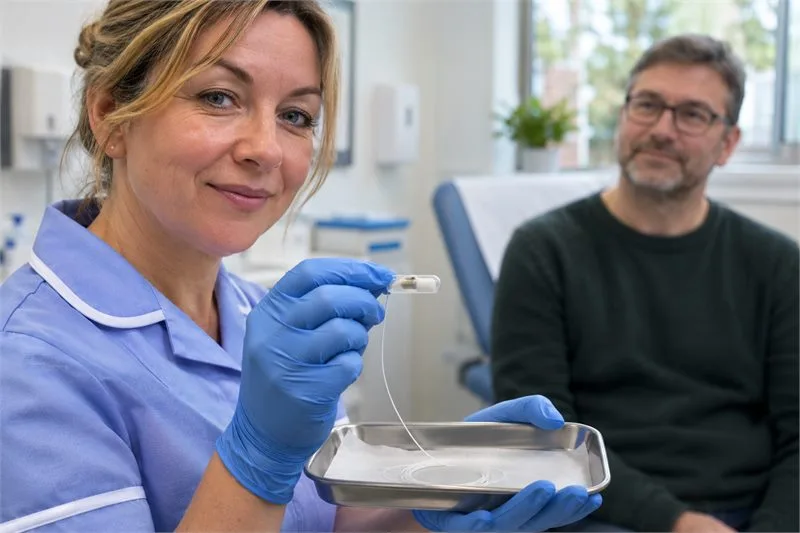
Illustrative clinic scene: a nurse holds a capsule sponge device before a test.
How does the swallowable sponge test work?
A nurse or other trained health professional gives the patient a small capsule attached to a fine medical thread. The patient swallows it with water. Once the capsule dissolves in the stomach, a compressed sponge expands. After a few minutes, the clinician gently draws the sponge back up by the thread. As it passes through the esophagus—the food pipe—it picks up cells from the lining.
The sample goes to a laboratory, where specialists examine it for markers and cell changes linked with Barrett’s esophagus or other esophageal abnormalities. Barrett’s is a change in the lining that can develop after long-term reflux. It increases the risk of esophageal cancer for some people, but most people with Barrett’s do not develop cancer. The test is designed to gather cells without putting a camera down the throat; it is not a home test or a self-screening kit.
Does the test detect esophageal cancer directly?
It can help identify people who may have Barrett’s, precancerous changes, or signs that need closer assessment. It is best understood as a way to collect a sample and guide the next step, rather than as a standalone cancer diagnosis. If the result is abnormal, clinicians may arrange a gastroscopy, which lets a specialist inspect the esophagus and take targeted biopsies. That examination can confirm whether cancer is present and how extensive any abnormality is.
Results also have limits. Cancer Research UK’s professional guidance says that some Barrett’s cases can be missed even when the swallow is completed. An incomplete swallow may mean the test needs repeating. A sore throat is a common short-lived side effect; serious complications are rare, but the clinical team can explain individual risks and alternatives before the procedure. Because the device samples the esophagus, it cannot investigate every possible cause of indigestion or stomach symptoms.
Who might be offered a capsule sponge test in the UK?
It may be used to triage people with reflux symptoms who are waiting for gastroscopy, to monitor selected people with known Barrett’s, or to investigate people considered at higher risk. The best route depends on clinical criteria and local NHS arrangements. In July 2025, Cambridge University Hospitals described a new England pilot in which Boots pharmacies and community clinics were expected to offer the test to around 1,500 people in London and the East Midlands from early 2026. The pilot was set to run for two years, with an independent evaluation informing decisions about any wider rollout. That announcement does not establish that every pharmacy—or every person with indigestion—can access the test.
Cancer Research UK’s guidance, reviewed in July 2026, describes capsule sponge use as being at different stages across the UK. It says the test is available nationally in Scotland and Wales, while England has national supply routes and funding but pathways are still being adapted; Northern Ireland does not yet have a defined implementation pathway. Patients should ask their GP or specialist whether it is available locally and suitable for them.
What does the evidence say about endoscopy and early detection?
In England and Scotland, evaluations have found that capsule sponge triage can reduce demand for endoscopy, helping reserve appointments for people who are more likely to need investigation. Cancer Research UK summarizes reported reductions of 78% in an England evaluation and 77% in a Scotland evaluation, while noting that patient outcomes and access inequalities need further study. These findings concern service pathways; they do not mean the sponge test has been shown to prevent deaths by itself.
The ongoing BEST4 trial is studying whether offering capsule sponge testing to people taking long-term heartburn medication can reduce deaths and the need for intensive treatment through earlier detection. NICE’s technology appraisal on triage and surveillance is expected to conclude in 2027, according to Cancer Research UK. Those are future evidence milestones, not proof of a benefit already established for all patients.
When should persistent indigestion be checked?
Heartburn and indigestion are common and usually have causes other than cancer. But persistent reflux, repeated symptoms despite treatment, or new symptoms should be discussed with a GP, who can assess the full picture and decide whether tests or referral are appropriate. Seek medical advice promptly for difficulty or pain when swallowing, food sticking, unexplained weight loss, vomiting blood, or black stools. Do not wait for a capsule sponge appointment if symptoms are worsening or worrying you.
Frequently asked questions
Is the Cytosponge test painful?
Most people swallow the capsule without pain. The sponge is pulled out by a clinician; a mild sore throat can occur afterwards.
Can a negative sponge test rule out cancer?
No. It can miss some abnormalities and does not replace clinical follow-up or gastroscopy when symptoms or results warrant further checks.
Can I request the test from my GP?
You can ask, but eligibility and availability depend on your symptoms, risk factors, and local NHS pathway. Your GP can advise on the appropriate investigation.