Home
» Today
»
NHS Sponge Test: What It Could Mean for Indigestion and Endoscopy Waits | November 16, 2026
NHS Sponge Test: What It Could Mean for Indigestion and Endoscopy Waits | November 16, 2026
Checked and updated: November 16, 2026, 1:07 p.m. GMT (UTC+00:00).
An NHS England evaluation found that a swallowable capsule sponge pathway reduced demand for endoscopy by 78% among patients with routine, lower-risk reflux referrals who completed the test. The approach may help services prioritize people whose results point to a higher risk of Barrett’s esophagus or related abnormalities, while some patients avoid an endoscopy. But the reported figure comes from a specific NHS pilot; it does not mean every patient with indigestion can get the test or will see their wait shortened.
The pilot ran across more than 30 hospitals in England between February 2021 and March 2024 and tested more than 8,500 patients. As of this update, the evidence reviewed here does not establish a universal national rollout. Access and referral pathways may vary by NHS trust, so patients should ask their GP or specialist what is currently offered locally.
Destaques
The NHS England pilot reported a 78% reduction in endoscopy demand in its routine-referral pathway.
A capsule sponge is a triage test; it does not replace endoscopy when clinicians consider further investigation necessary.
A positive result can lead to endoscopy and a longer diagnostic pathway, while a negative result still needs to be considered alongside symptoms.
Persistent or changing symptoms deserve medical review; patients should not wait for a sponge test to become available.
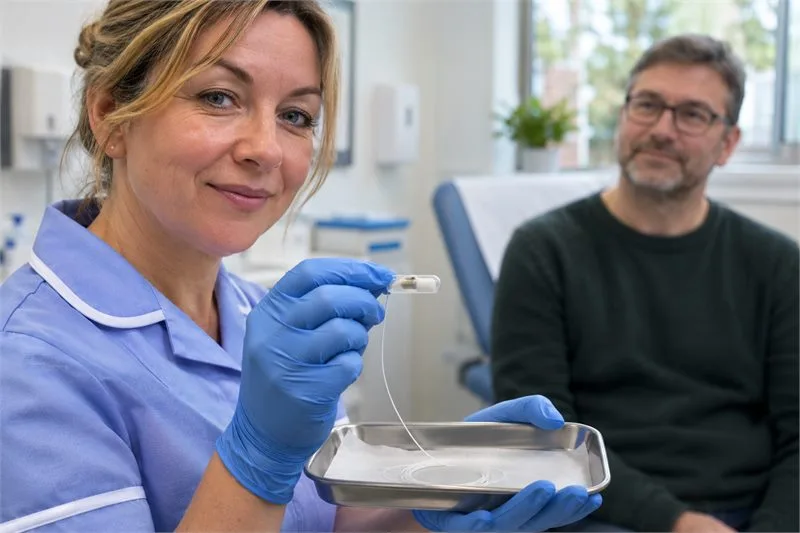
Illustrative image: a nurse explains a capsule sponge test during a patient consultation.
What is the NHS capsule sponge test?
The capsule sponge, often called Cytosponge or a “sponge on a string,” is a small capsule attached to a retrieval thread. A patient swallows it with water. After the capsule dissolves, a soft sponge expands in the stomach; a clinician withdraws it using the thread, collecting cells from the esophagus on the way out. A laboratory examines the sample for markers associated with Barrett’s esophagus, a change in the esophageal lining that can increase the risk of cancer.
The procedure is intended to help clinicians decide who may need an endoscopy. It is not a cancer diagnosis by itself, and it does not inspect the esophagus directly. The NHS England pilot describes it as a triage option for selected routine, lower-risk patients referred for endoscopy, including some people with reflux symptoms or Barrett’s surveillance needs.
Does the sponge test reduce NHS endoscopy waiting times?
It can reduce demand on endoscopy services in the pathway studied. NHS England’s published evaluation says the pilot reduced secondary-care endoscopy demand by 78%; nearly eight in ten patients who completed a test were discharged or monitored rather than continuing to endoscopy. NHS England also reported that patients who needed an onward endoscopy were more likely to receive an urgent referral and be seen more quickly.
That is a service-level finding, not a personal waiting-time guarantee. People with a positive result may need endoscopy and can wait longer overall while those investigations are arranged. The pilot evaluation also noted limitations, including lack of long-term follow-up for patients removed from the waiting list. Its findings cannot by themselves establish how much waiting times will change across every hospital or future NHS service.
The results are nevertheless relevant when services have limited endoscopy capacity: if suitable lower-risk patients can be assessed another way, clinicians may be able to focus procedural capacity on people with higher-risk findings or urgent symptoms. Whether this benefit persists depends on local staffing, laboratory capacity, referral criteria, and how each service manages follow-up.
Who might be offered a capsule sponge test?
The evaluated pathway involved selected patients referred for routine endoscopy, rather than everyone with indigestion. Eligibility is determined by clinicians and local service arrangements. The test should not be treated as a self-referral cancer screen, and an invitation is not assured simply because someone has heartburn or takes reflux medicine.
In the BEST3 randomized trial, offering Cytosponge-TFF3 to people taking medication for reflux increased detection of Barrett’s esophagus compared with usual care. In the intervention group, nine people were diagnosed with dysplastic Barrett’s or stage I cancer. The results show potential for earlier detection in an appropriate pathway, but the trial was not proof that the device alone prevents cancer deaths or replaces standard investigation.
What should you do if indigestion persists?
Book an appointment with a GP if indigestion or reflux keeps returning, is not improving with treatment, or is affecting daily life. Explain how long symptoms have lasted, what medicines you have tried, and whether symptoms are changing. Your clinician can consider your history, risk factors, treatment response, and whether an investigation or referral is appropriate. Ask whether a capsule sponge pathway is available in your area and whether it fits your situation.
Do not delay seeking care while waiting to find out about this test. Contact a GP promptly about difficulty swallowing, unexplained weight loss, persistent vomiting, or other concerning changes. If symptoms are severe or rapidly worsening, use NHS 111 or urgent care for advice; call 999 for a life-threatening emergency. These are general pointers, not a diagnosis.
A negative sponge result does not mean every cause of symptoms has been ruled out. The NHS evaluation describes clinician interpretation in context and safety-netting arrangements that varied across trusts. If symptoms continue or worsen after a test, tell your clinician and follow the advice provided about reassessment.
What happens next for the NHS test?
The completed national pilot has produced evidence that capsule sponge triage can reduce endoscopy demand in the studied setting. NHS England describes the results as supporting its use, while also noting that the pilot’s effect on an individual’s care depends on the pathway. The evidence does not confirm that all NHS areas now offer it routinely. Wider access, if adopted, would require local services to establish clinical criteria, trained staff, sample processing, results communication, and follow-up capacity.
For patients, the practical takeaway is straightforward: the test may help some services sort routine reflux referrals and preserve endoscopy capacity, but persistent indigestion still needs an appropriate clinical assessment. Ask your care team what options are available now, what a result would mean for your next step, and how to seek help if symptoms change.
Frequently asked questions
Is the capsule sponge test available to everyone with heartburn?
No. It has been evaluated for selected patients in specific NHS pathways. Local availability and eligibility vary, so ask your GP or specialist.
Does a positive sponge result mean I have cancer?
No. It identifies findings that may require further assessment, commonly an endoscopy. The test alone does not diagnose cancer.
Can a negative result replace endoscopy?
Not in every case. Clinicians interpret the result alongside symptoms and medical history, and may still recommend endoscopy or other tests.