Home
» Today
»
Apple iPhone 18 Pro Max review: what’s new, how it performs, and who should buy it
Apple iPhone 18 Pro Max review: what’s new, how it performs, and who should buy it
The biggest new development is now confirmed: Apple officially launched the iPhone 18 Pro Max on September 9, 2026, with retail availability beginning September 18. That matters because months of rumor can now be separated from the product Apple is actually selling. The headline upgrades are a 48MP main camera with variable aperture, the A20 Pro chip, a redesigned vapor-chamber cooling system, a smaller Dynamic Island, longer battery life, and iOS 27 with the new generation of Apple Intelligence and Siri AI.
This is a launch-period review based on Apple’s published specifications, product pages, and release documentation. It is not presented as an independent laboratory test, and there has not yet been enough time to establish long-term battery aging, durability, or sustained real-world behavior across months of use. Where Apple publishes performance claims, those claims are identified as Apple’s own figures rather than treated as independently verified results.
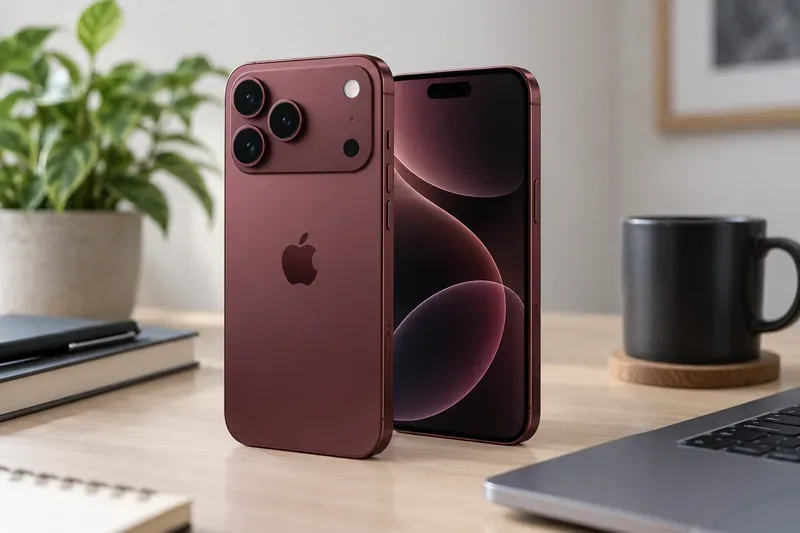
Apple lists burgundy as one of four iPhone 18 Pro Max finishes, alongside black, silver, and glacier; the phone is aimed squarely at buyers who want Apple’s largest Pro display and longest-rated Pro battery life.
iPhone 18 Pro Max at a glance
The iPhone 18 Pro Max is Apple’s largest and most expensive conventional iPhone for 2026. It has a 6.9-inch Super Retina XDR OLED display, an aluminum unibody, Ceramic Shield 2 on the front, Ceramic Shield on the back, and a stated weight of 249 grams. Storage starts at 256GB and runs through 512GB, 1TB, and 2TB.
In the United States, Apple lists the iPhone 18 Pro Max from $1,299 for 256GB. Apple’s current store also lists higher-capacity configurations, while trade-in and carrier promotions vary. You can verify current pricing on Apple’s official iPhone 18 Pro purchase page.
The biggest camera change: variable aperture
The camera is the most meaningful hardware change for photographers. Apple’s new 48MP Fusion Main camera introduces variable aperture on an iPhone for the first time. Apple says the mechanism uses six blades and can adjust aperture automatically, with manual aperture control also available through the Camera app’s new Pro controls.
Apple specifically describes four aperture settings and gives practical examples: a wider aperture can help in low light, while a narrower aperture can keep more of a group in focus. The company also added manual control over shutter speed and white balance, plus a histogram. For users who already shoot in ProRAW or treat the iPhone as a serious secondary camera, this is more significant than a routine megapixel increase.
The rest of the rear system remains a three-camera 48MP Pro Fusion setup, covering Main, Ultra Wide, and Telephoto. Video features include Dolby Vision recording up to 4K at 120 fps in supported modes, ProRes, ProRes RAW, Apple Log 2, and additional post-capture Cinematic controls. Apple also introduced Apple Reference Image, a mode intended to preserve a signed reference of what the sensor captured for later comparison with edited versions.
Apple’s camera details and sample descriptions are available in the company’s iPhone 18 Pro launch announcement. The important caveat is that image-quality leadership cannot be established from manufacturer samples alone. Buyers who care about skin tones, motion handling, flare, low-light consistency, or telephoto quality should compare independent full-resolution samples before upgrading specifically for the camera.
Performance: A20 Pro is a major architectural update
The iPhone 18 Pro Max uses Apple’s A20 Pro, built on a 2-nanometer process. According to Apple, it combines a 6-core CPU, a 7-core GPU with Neural Accelerators, and a dual 16-core Neural Engine. Apple says memory bandwidth is 50% higher than on A19 Pro, GPU performance can be up to 40% faster, and the new Neural Engine doubles AI processing capability compared with the prior generation.
Those numbers come from Apple and should be treated as manufacturer claims until independent testing establishes performance across real apps, games, thermal conditions, and battery states. Still, the hardware direction is clear: the 18 Pro Max is designed not just for short benchmark bursts but for longer high-load work.
That point is reinforced by a redesigned vapor chamber. Apple says the new thermal system has three times the surface area of the previous generation and can enable up to a 40% gain in sustained performance versus iPhone 17 Pro. For gaming, long video exports, computational photography, and on-device AI, sustained performance may matter more than peak benchmark numbers.
For buyers who mainly use messaging, social apps, web browsing, and streaming, A20 Pro is likely to be far beyond what is necessary today. Its value is stronger for people who keep phones for several years, play demanding games, shoot and edit high-resolution video, or rely heavily on Apple’s on-device AI features.
Display: familiar size, improved presentation
The iPhone 18 Pro Max keeps a 6.9-inch OLED display with a 2868-by-1320 resolution at 460 ppi. ProMotion remains, with adaptive refresh rates up to 120Hz, along with Always-On Display, HDR, True Tone, P3 wide color, and a peak outdoor brightness rating of 3,000 nits.
The more visible change is the redesigned Dynamic Island. Apple says it is smaller and can display up to three Live Activities at once. That is a useful refinement rather than a reason by itself to upgrade. The core display experience is still defined by the large 6.9-inch canvas, high refresh rate, and high brightness.
Battery life is one of the strongest reasons to choose the Max
Apple rates the U.S. eSIM-only iPhone 18 Pro Max for up to 45 hours of video playback and up to 30 hours of “typical use” under its newer battery usage model. Apple says removing the physical SIM tray in eSIM-only markets creates room for a larger battery and contributes to longer endurance.
Charging is also faster. Apple states that the Pro models can reach up to 50% charge in around 15 minutes with the required compatible high-power adapter and cable, while MagSafe or Qi2 wireless charging can reach up to 25W. Apple also says five minutes of wired charging on the Pro Max can provide around seven hours of video playback under its test conditions.
These are controlled ratings, not guarantees of your daily experience. Navigation, cellular signal quality, camera use, gaming, display brightness, background apps, and AI workloads can change endurance substantially. Even so, if battery life is the deciding factor between the 18 Pro and 18 Pro Max, Apple’s own ratings clearly favor the Max.
Connectivity and everyday hardware
The iPhone 18 Pro Max supports 5G, Wi-Fi 7, Bluetooth 6, Thread, second-generation Ultra Wideband, NFC, and USB-C with USB 3 data transfer up to 10Gb/s. Apple’s N1 networking chip handles Wi-Fi, Bluetooth, and Thread, while the new C2 modem is used in the Pro line. Apple says C2 improves upload performance and reduces power use compared with C1X.
In the U.S., the iPhone 18 Pro Max remains eSIM-only. That is convenient for many domestic users and travelers with eSIM support, but it can still be a limitation if you frequently use carriers or regions that rely on physical SIM cards. Apple says eSIM-only Pro models are also offered in several other markets, so frequent travelers should check carrier support before buying.
iOS 27, Apple Intelligence, and Siri AI
The phone ships with iOS 27. Apple Intelligence is integrated across the system, while Siri AI is rolling out as a beta. Apple says the new Siri can use personal context, understand what is on screen, work across information in messages, email, and photos, and provide a camera-based Siri mode.
The key buying point is that some AI features may vary by language, region, and rollout stage. Apple explicitly describes Siri AI as a beta at launch. If a specific AI function is central to your purchase decision, verify current availability instead of assuming that every announced feature is fully available everywhere. Apple maintains current details on its Apple Intelligence page.
Design, size, and the biggest trade-off
The Pro Max is large and heavy. At 249 grams, it is not an ideal choice for everyone who simply wants the “best” iPhone. Its 6.9-inch display is excellent for video, games, maps, reading, camera framing, and editing, but the size makes one-handed use less comfortable and adds weight in a pocket.
Apple offers black, silver, glacier, and burgundy finishes. The chassis is aluminum rather than titanium, with Ceramic Shield 2 on the front and Ceramic Shield on the back. Apple lists IP68 water and dust resistance under IEC 60529, with testing at up to 6 meters for up to 30 minutes. Water resistance is not permanent and should not be treated as permission for intentional underwater use.
Which storage size makes sense?
Storage
Best fit
What to consider
256GB
Most buyers using cloud storage and normal photo/video capture
Lowest entry price; enough for many users if large files are offloaded
512GB
Heavy photography, games, offline media
A practical middle ground for people keeping the phone several years
1TB
Frequent ProRes/ProRAW and local media
Expensive, but useful if large creative files stay on the device
2TB
Professional video and maximum local storage
Only makes financial sense if you know you need the capacity
For most people, 256GB or 512GB is the rational range. The 1TB and 2TB models are specialized choices, especially for creators who record high-bitrate video or keep large project files locally.
Who should buy the iPhone 18 Pro Max?
The strongest case is for buyers who want the largest display, Apple’s longest-rated Pro battery life, the new variable-aperture camera, and the highest sustained performance available in a current iPhone. It also makes sense for creators who will use ProRes, ProRAW, manual camera controls, fast USB transfers, and the highest storage tiers.
It is a weaker upgrade for someone with a recent Pro Max who is happy with current battery life and camera performance. The new camera controls and thermal architecture are substantial on paper, but the practical value depends on whether you actually shoot manually, run sustained workloads, or need the extra endurance.
Owners of older standard iPhones may notice a much larger overall jump because they are gaining ProMotion, the larger display, the Pro camera system, newer connectivity, faster USB, substantially newer silicon, and current Apple Intelligence features all at once.
Buying advice: what to verify before spending $1,299 or more
Size: handle a 6.9-inch Pro Max in person if possible. Weight and reach matter more than spec sheets suggest.
Storage: check how much storage your current phone actually uses before paying for 1TB or 2TB.
Camera needs: variable aperture and manual controls matter most to people who actively use them.
Battery priority: if maximum endurance is important, the Pro Max has the strongest Apple rating in the lineup.
AI expectations: verify whether the Siri AI and Apple Intelligence features you want are currently available in your language and region.
Trade-in math: compare Apple’s direct price with carrier credits carefully; large promotional credits often come with plan, installment, or eligibility conditions.
Early verdict
The iPhone 18 Pro Max looks like a more substantial Pro update than a routine annual refresh, mainly because of three changes: variable aperture, the A20 Pro plus redesigned thermal system, and the large battery gains Apple is claiming. The smaller Dynamic Island, expanded camera controls, new AI features, and faster connectivity add useful depth rather than defining the phone on their own.
What is already verified is the hardware specification, official pricing, feature set, and Apple’s stated performance and battery targets. What is not yet mature enough to call settled is long-term battery behavior, durability, sustained performance across independent workloads, and whether the new camera system consistently outperforms alternatives in uncontrolled real-world scenes.
For buyers who want Apple’s largest screen and most ambitious camera-and-performance package, the iPhone 18 Pro Max is the model to examine first. For everyone else, the smarter decision is to compare the 18 Pro’s smaller body and lower price against the Max’s battery and screen advantages rather than assuming the more expensive model is automatically the better fit.