Pop Culture Costume Ideas That Will Dominate Halloween 2026

Plan a recognizable Halloween 2026 look with pop culture costumes inspired by Spider-Man, Supergirl, Toy Story 5, Moana, Mario, and Wednesday.
A team of astronomers using the W.M. Keck Observatory in Hawaii has stumbled upon a surprising discovery: A distant exoplanet hurtling through space with a tail hundreds of thousands of kilometers long.
The exoplanet, called WASP-69 b, is located 164 light-years away from Earth. As the planet moves, it creates a long tail of gas behind it — much like a comet. Although scientists discovered WASP-69 b in 2014, recent studies have only determined that the exoplanet has a long tail of gas.
Structurally, WASP-69 b is a so-called hot Jupiter, meaning a gas giant orbiting very close to its star. WASP-69b is 1.1 times the diameter of Jupiter, but orbits so close to its star that a year on the planet lasts less than four days and has a scorching temperature of more than 600 degrees Celsius. WASP-69b is comparable to Mercury, the closest planet to the Sun, which orbits the Sun every 88 days.
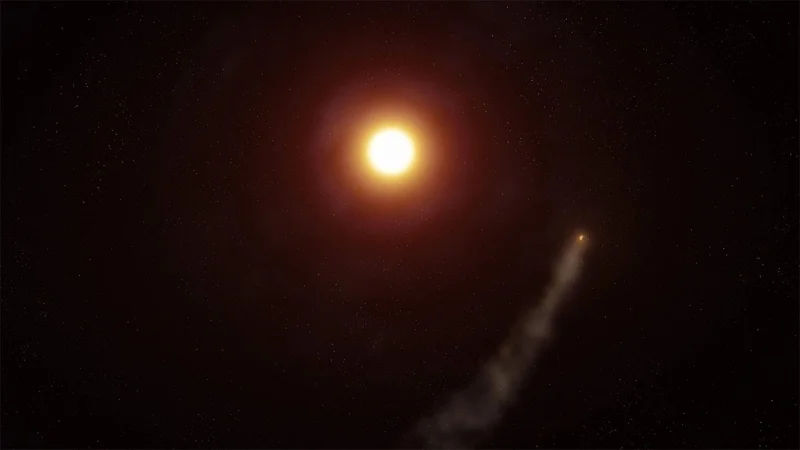
Such close proximity to its host star also gives WASP-69 b a very distinctive feature: a long tail. Radiation from the host star “bombards” WASP-69 b’s atmosphere, stripping away gases like hydrogen and helium. And when streams of particles from the host star called stellar winds hit the planet, they pull these escaping gases into a tail shape. The tail is observed to be more than 7.5 times the radius of the planet, meaning it stretches for more than 350,000 miles, or 560,000 kilometers.
In fact, WASP-69 b’s tail could be even longer, as researchers haven’t had enough time to observe its entire length with their telescopes. However, since it’s formed by a stellar wind, it’s entirely possible that the tail could shrink over time if the wind weakens.
The process of planets losing their atmospheres over time is common, and is thought to be similar to what happens to planets like Mars in our own solar system. What’s remarkable is that the tail formation is unusual. However, while WASP-69 b is losing a lot of gas, at a rate of 200,000 tons per second, given its massive size (about 90 times the mass of Earth), the planet won’t lose its entire atmosphere anytime soon — and will continue to exist for thousands of years, with its distinctive tail trailing behind it.
Plan a recognizable Halloween 2026 look with pop culture costumes inspired by Spider-Man, Supergirl, Toy Story 5, Moana, Mario, and Wednesday.
Sort leftover Halloween candy safely, share or repurpose sealed treats, and choose food use or compost for pumpkins based on their condition.
Compare workplace Halloween costume choices by respect, dress code, mobility, and safety—and learn when a subtle accessory or a policy check is the better option.
Find a couples costume that fits your style, budget, and comfort level, from Addams Family classics to original inside-joke duos.
Need a last-minute high school Halloween costume? Compare 10 easy closet-based ideas by prep time, comfort, school-day practicality, and simple safety checks.
Use a simple 2026 Halloween decorating timeline for indoor décor, outdoor displays, and fresh pumpkins, with practical adjustments for weather and events.
Mix five vivid, approachable Halloween cocktails with measured recipes, simple prep tips, and an alcohol-free option for your party guests.
Find 15 office-friendly Halloween costume ideas for 2026, with practical checks for dress codes, respectful themes, comfort, and workplace safety.
Plan a fun elementary school Halloween party with easy crafts, games, inclusive treats, costume tips, and a sample 75-minute classroom schedule.
Compare realistic side hustles for 2026 by startup cost, fees, flexibility, and income control, with current tax and scam guidance from official sources.








