Spooky but Sweet: Halloween Party Ideas for Elementary Schools
Plan a fun elementary school Halloween party with easy crafts, games, inclusive treats, costume tips, and a sample 75-minute classroom schedule.
A great elementary school Halloween party does not need fake blood, jump scares, or expensive decorations. A few playful activities, cheerful fall colors, and a plan that includes every child can make the celebration feel special without turning the school day upside down.
Consider this hypothetical planning example, which we will use throughout the article: Ms. Rivera teaches 24 third graders. Her school permits a 75-minute classroom party on a Friday afternoon, allows costumes under a school dress code, and requires advance approval for any food. She has three parent volunteers and a modest supply budget. This classroom, teacher, schedule, and outcome are illustrative—not a report of an actual event.
Her goal is simple: children should leave having made something, played with classmates, and felt comfortable participating. Here are the spooky-but-sweet Halloween party ideas she could use, along with variations for kindergarten through fifth grade.
“Spooky” means different things to a kindergartner and a fifth grader. For a school party, friendly ghosts, smiling jack-o'-lanterns, silly bats, and colorful leaves are usually more flexible themes than haunted-house effects. Ask the teacher or school administrator which decorations, costumes, food, and volunteer activities are permitted before inviting families to contribute.
In Ms. Rivera's imagined classroom, the group votes on “Friendly Ghosts and Pumpkin Pals.” The theme shapes everything from the craft materials to the music. Any child who dislikes Halloween imagery can still join a fall-leaves craft, an autumn word game, or a kindness activity.
Make attendance and participation comfortable rather than compulsory. Offer a quiet spot away from music and busy stations, avoid surprise loud sounds and flashing lights, and let students participate without wearing a costume. These are practical design choices, not a substitute for accommodations in a student's school plan.
For a group of 24, Ms. Rivera could divide the class into four groups of six. Each station lasts roughly 12 minutes, with a few minutes between activities for transitions. A classroom teacher and three approved volunteers could each supervise one station, subject to the school's staffing rules.
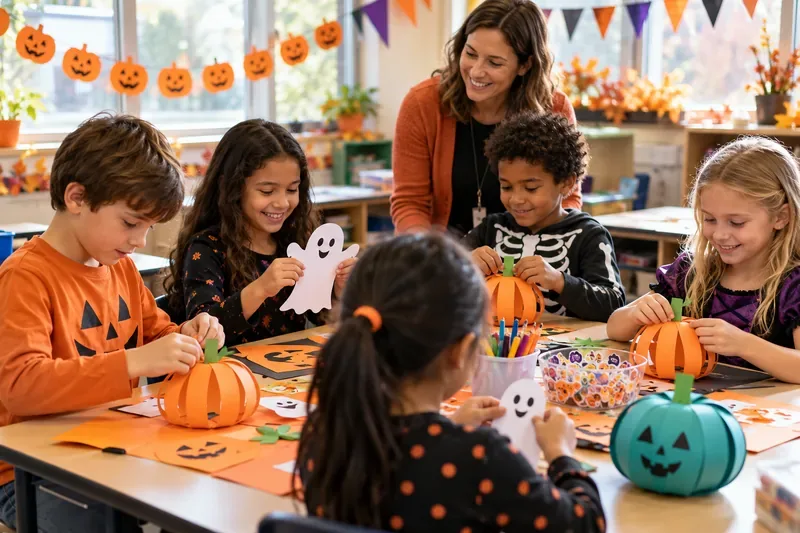
Set out orange paper strips, washable markers, glue sticks, and precut green leaves. Students turn the strips into round paper pumpkins or decorate flat pumpkin shapes with goofy faces. Younger children can work with large precut pieces; older children can add patterns, symmetry, or a written description of their pumpkin character.
In the example classroom, the finished pumpkins become a hallway display after the party. Avoid knives, hot glue, and other tools children are not authorized to handle. The American Academy of Pediatrics' Halloween guidance recommends having younger children decorate rather than carve pumpkins.
Give each child a friendly ghost outline and the prompt “You make our class brighter when you…” Children write or draw a kind message for a classmate, school helper, or family member. Volunteers can offer sentence starters and help students who prefer to dictate their message.
Ms. Rivera would assign recipients or guide the distribution rather than let popularity determine who receives a note. That turns a cute Halloween craft into a deliberately inclusive activity. For students who do not want ghost imagery, use a star, leaf, or pumpkin outline instead.
Put large paper pumpkins on the floor or attach them to sturdy, low targets. Students toss soft beanbags from a clearly marked line. They can count successful throws, add numbers printed on the pumpkins, or cooperate to reach a group total. Keep lanes separated and make the targets accessible from a seated position.
For kindergarten, use close, oversized targets and no scoring pressure. For grades four and five, try estimation or mental-math challenges. There is no need to award candy or declare one child the winner; a shared goal keeps the atmosphere light.
Play brief, low-volume sounds such as rustling leaves, footsteps, or an owl's call and let students guess the source. Then build a story together: “On a windy October afternoon, a pumpkin rolled into the library…” Each student adds a sentence or a drawing.
Because some children are sensitive to audio, let them see picture clues, read the prompts, or join the storytelling without sound. Avoid startling effects, shrieks, or a sudden blackout. The objective is imagination, not fear.
Schools do not need to run all ten ideas. Choose two or four that match the age group, room size, available adults, and time.
Choose flat paper garlands, window pumpkins, washable window clings, and a cheerful door display. A single decorated bulletin board can do more for the room's atmosphere than covering every surface. Keep visibility clear, leave doorways and exit routes unobstructed, and do not hang fabric near heaters or lights.
Skip open flames entirely at school. Battery-operated lights can create a warm jack-o'-lantern glow, but check the school's rules and keep loose batteries and small detachable pieces away from children. AAP guidance also favors flameless lighting inside pumpkins.
For Ms. Rivera's classroom, orange and purple paper chains made during art time serve as decorations and an advance class project. That is simpler than asking volunteers to buy elaborate props.
Costumes are optional fun, not a requirement for enjoying the party. Before sending invitations, confirm whether the school allows costumes, face paint, accessories, and character masks. A low-stress alternative is “fall colors or a favorite festive shirt.”
Where costumes are allowed, ask families to choose outfits that fit well, permit normal vision and movement, and do not include sharp props. The AAP's costume safety recommendations specifically address tripping hazards, obstructed vision, and sharp costume accessories. Teachers should apply the school's dress and accessibility policies rather than invent new restrictions on party day.
In the example, Ms. Rivera tells families that costumes are welcome but unnecessary, and no activity depends on children dressing up. This also reduces pressure on families that do not wish to purchase a costume or participate in Halloween traditions.
A Halloween classroom party can be memorable without a candy table. The CDC's school nutrition guidance notes that schools can use healthier celebration foods and nonfood rewards, while local school wellness policies may set standards for items provided during celebrations.
Food allergies also require specific planning. The CDC's food-allergy guidance for schools emphasizes prevention and emergency-response plans. Ask the teacher and school nurse about relevant student plans and school rules before choosing or distributing snacks; do not assume that a homemade item, a food labeled “nut-free,” or a food without a particular ingredient is safe for every child.
If the school permits food, use approved items with readable original labels, follow school procedures for distribution and handwashing, and avoid pressure to taste or trade snacks. A nonfood celebration is often easier to manage. Bookmarks, stickers, larger school-appropriate pencils, and take-home art make good alternatives; evaluate small objects for age-related choking risks.
The Teal Pumpkin Project from Food Allergy Research & Education encourages nonfood treats as a way to make Halloween more welcoming for children with food allergies. The idea works in classrooms too: every student can receive the same craft or bookmark without being singled out.
This is an illustrative schedule for Ms. Rivera's third-grade classroom, not a tested timetable. Adjust it for transitions, the school's dismissal routine, and student needs.
| Minutes | Activity | Planning note |
|---|---|---|
| 0–8 | Welcome and expectations | Explain stations, bathroom access, and the quiet option. |
| 8–20 | Station rotation 1 | Small groups begin at their assigned station. |
| 20–23 | Transition | Collect loose supplies and change stations. |
| 23–35 | Station rotation 2 | Offer help without rushing children. |
| 35–38 | Transition | Check movement paths and reset materials. |
| 38–50 | Station rotation 3 | Keep instructions short and visible. |
| 50–53 | Transition | Let groups switch calmly. |
| 53–65 | Station rotation 4 | Students complete the last activity. |
| 65–75 | Share, clean up, and close | Thank helpers and pack take-home crafts. |
In this version, children rotate through the four featured stations rather than trying every option in the article. If there are fewer adults, turn the event into two supervised stations with longer activity blocks or run a single whole-class activity. Do not use unsupervised stations just to preserve the timetable.
Send one concise message several days ahead explaining the theme, time, costume policy, food rules, and any approved donation requests. Specify the exact materials needed instead of asking every family to bring “something Halloween-themed.”
For Ms. Rivera's hypothetical party, reusable classroom supplies might cover much of the materials list. If money is limited, prioritize paper, markers, a few beanbags, and reusable game cards. An elaborate snack buffet or expensive goodie bags add cost without necessarily improving participation.
Rather than judging the event by the number of decorations or bags of candy, look for three useful signs: children could participate in a way that suited them, transitions were manageable, and the classroom was left ready for the next school day. Ask a few students what they enjoyed and what they would change, including students who chose quieter activities.
The example party could succeed even if Ms. Rivera shortens a game, skips a station, or replaces a Halloween activity with a fall-themed one. Flexibility is part of good planning. What makes elementary school Halloween parties memorable is not how scary they are, but whether children feel welcomed, creative, and connected to their classmates.
Plan a fun elementary school Halloween party with easy crafts, games, inclusive treats, costume tips, and a sample 75-minute classroom schedule.
Compare realistic side hustles for 2026 by startup cost, fees, flexibility, and income control, with current tax and scam guidance from official sources.
Upgrade your home office ergonomics with current OSHA and NIOSH guidance on chair fit, monitor height, laptop setup, lighting, and movement.
Learn why emotional intelligence matters in leadership, where it helps most, how to strengthen it, and how to tell whether your approach is working.
A practical roadmap for moving into tech without a degree: choose an accessible role, build job-ready skills, prove them with projects, and use hiring feedback to improve.
Build a credible LinkedIn personal brand in 2026 with current profile, content, newsletter, analytics, verification, and visibility guidance from LinkedIn.
Quiet quitting and quiet firing are catchy labels, not diagnoses. Learn what is verified, what depends on context, and what employees and managers can do next.
Fractional executives offer senior leadership without a full-time hire. Learn when the model works, what to ask, and the risks to manage.
Prepare a stronger Q4 raise request with current wage data, timing options, compensation tradeoffs, and scripts for yes, partial, or no outcomes.
Choose a high-income skill you can realistically start before 2026 ends, with current pay data, learning priorities, and a practical self-check.