Home
» Wiki
»
How to Transition to a Tech Career Without a Degree: A Results-First Roadmap for 2026
How to Transition to a Tech Career Without a Degree: A Results-First Roadmap for 2026
Moving into tech without a college degree is possible, but the useful question is not “Can I get a tech job without a degree?” It is “Which tech role gives me a realistic entry point, what evidence will prove I can do the work, and how will I know whether my plan is working?”
That distinction matters in 2026 because “tech” is not one labor market. The U.S. Bureau of Labor Statistics says some computer user support candidates may qualify with a high school diploma plus relevant IT certifications, and educational requirements for web developers can range from a high school diploma to a bachelor’s degree. By contrast, BLS still lists a bachelor’s degree as the typical entry-level education for software developers, QA analysts and testers, and information security analysts. Exceptions exist, but they should not be treated as the baseline.
There is also a newer work-based route worth watching. On April 29, 2026, the U.S. Department of Labor launched the Tech Registered Apprenticeship Innovation Network to expand Registered Apprenticeship in areas including AI, cybersecurity, and digital infrastructure. Its list of high-demand tech occupations includes application developer, customer service tech support, cybersecurity support technician, data analyst, IT generalist, network support technician, and software developer. Registered Apprenticeship combines paid work experience, mentoring, classroom instruction, wage progression, and a portable credential.
Start by choosing a specific entry role rather than trying to “learn tech” as a broad category. Different roles have very different degree expectations and skill requirements.
Step 1: Choose an entry role where skills can realistically substitute for a degree
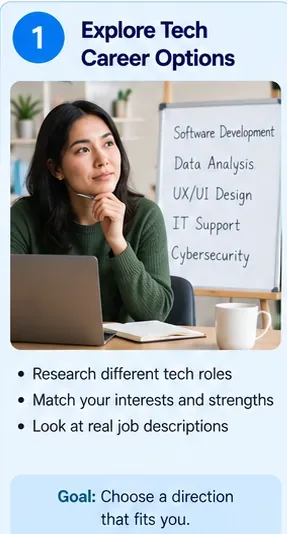
Your first outcome should be a narrow target such as “computer user support specialist,” “junior web developer,” “technical support specialist,” or another role you can describe in one sentence. Avoid starting with a vague goal such as “work in AI” or “get into cybersecurity.” Those fields contain many jobs with different experience and education expectations.
Two practical entry lanes are worth comparing first. For computer support, BLS says user support specialists typically need some college coursework, but some candidates may qualify with a high school diploma plus relevant IT certifications. O*NET describes real tasks such as setting up equipment, installing software, diagnosing computer problems, answering user questions, and verifying that systems work correctly. That makes the role testable in a home lab.
Web development can also be portfolio-friendly. BLS says educational requirements range from high school diploma to bachelor’s degree and notes that developers may not need specific education credentials if they can demonstrate ability through previous work or projects.
Software development and cybersecurity can still be valid long-term goals, but BLS lists a bachelor’s degree as typical for software developers/QA and for information security analysts; security analysts also commonly need related work experience. A realistic route may therefore be support → systems/networking → security, or web development → broader software engineering, rather than assuming every entry-level posting will ignore degree filters.
You are ready to move on when you can collect roughly 15–20 current job descriptions for the same target role and see a repeating core of skills. The exact number is only a practical sampling rule, not an industry benchmark. If every posting you save asks for a different job, your target is still too broad.
Step 2: Turn job descriptions into a skill map
Make a simple table with four columns: skill, how often it appears, how you will learn it, and how you will prove it. For IT support, that might include operating systems, networking basics, troubleshooting, ticket documentation, customer communication, account permissions, and common hardware/software tasks. For junior web development, it might include HTML, CSS, JavaScript, Git, HTTP basics, responsive layouts, accessibility, APIs, and deployment.
Separate knowledge from performance. Knowing what DNS means is knowledge. Diagnosing why a machine cannot resolve a hostname is performance. Knowing JavaScript array methods is knowledge. Building and debugging a working interface that consumes an API is performance. Employers ultimately need the second category.
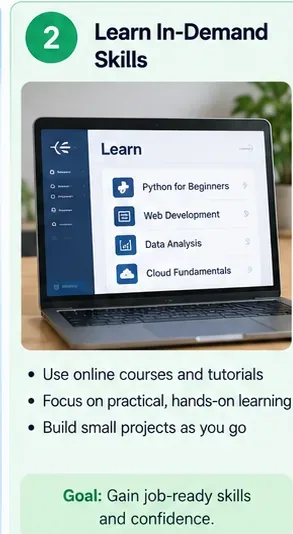
Use courses to fill the skills on your role map, but connect each topic to hands-on practice instead of collecting unrelated tutorials.
Step 3: Learn only what your target role requires, then practice immediately
Structured courses can be useful, especially when you are changing careers after work and need a sequence. Google’s IT Support Certificate is explicitly designed for entry-level IT support and says no prior experience or degree is required. Microsoft’s Azure Fundamentals credential is beginner-level and covers cloud concepts, core services, management, and governance. AWS positions Certified Cloud Practitioner as a foundational certification and provides official labs, practice questions, and Skill Builder preparation.
Use certifications carefully. A credential can make your knowledge easier to recognize, but it is not the same as work evidence. A cloud fundamentals certificate plus no deployed project is weaker than the same certificate plus a documented project in which you created resources, configured permissions, broke something, diagnosed it, and explained the fix.
Do not judge progress by hours watched or certificates completed. A stronger sign is that you can perform common tasks without following a tutorial line by line and can explain why each step is necessary. If you repeatedly finish courses but cannot build or troubleshoot independently, pause new courses and spend more time on labs.
Step 4: Build a portfolio that looks like evidence, not homework
A portfolio should answer three questions: What problem did you solve? What did you personally do? How can someone verify the result?
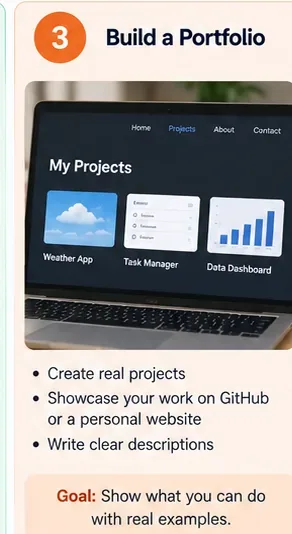
For a web developer, one project could be a responsive site that consumes a real API, handles errors, includes accessible forms, and is deployed publicly. Another could show authentication, persistent data, or automated tests. For IT support, your “portfolio” can be a documented home lab: user account setup, permissions, a small network diagram, troubleshooting notes, a PowerShell or shell automation, and short incident-style writeups showing symptom → diagnosis → fix → verification.
GitHub’s own career guidance recommends highlighting three to five strong projects and using a profile README to explain your background, skills, experience, and best work. Quality beats volume. Three projects with clear READMEs, screenshots, setup instructions, design decisions, and known limitations are more useful than 20 tutorial clones.
A strong portfolio makes your ability inspectable. Each project should explain the problem, your contribution, the technology used, how to run it, and what you would improve next.
Change approach if your projects are mostly exact copies of tutorials, cannot be run by another person, have no explanation of tradeoffs, or break as soon as you change one requirement. Rebuild one project with a different dataset, user flow, architecture, or constraint so that the reasoning is genuinely yours.
Step 5: Get external proof before expecting a full-time offer
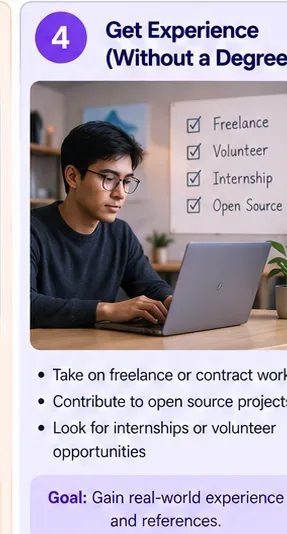
Personal projects prove you can learn and build. External work proves you can deal with requirements, other people, deadlines, and feedback. That proof can come from a Registered Apprenticeship, contract assignment, open-source contribution, volunteer project, internship that accepts career changers, or an internal transfer at your current employer.
Apprenticeship is especially relevant for a no-degree transition because it combines learning with paid experience rather than requiring you to become fully job-ready in isolation. The Department of Labor’s current technology apprenticeship initiative covers multiple pathways, including support, networking, data, cybersecurity, and development.
External experience does not have to begin with a permanent full-time job. Apprenticeships, small contracts, volunteer work, and open-source contributions can supply evidence that personal projects cannot.
Quality check
You have useful experience when you can describe a real stakeholder, constraint, problem, decision, and result. “I built a website” is weak. “I rebuilt a local nonprofit’s event page, reduced manual updates by moving event data into a simple CMS, documented the handoff, and fixed two accessibility problems after feedback” is much stronger.
Step 6: Write a resume around proof and transferable value
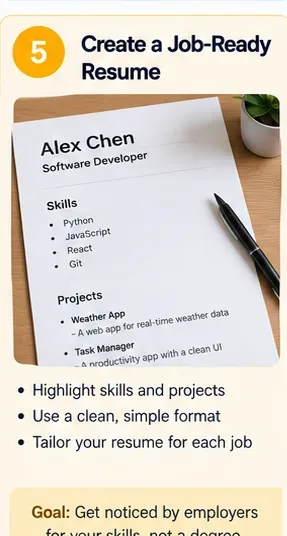
Do not make “no degree” the headline of your resume. Make the target role, relevant skills, projects, and measurable accomplishments the headline. If your previous career involved customer service, operations, sales, teaching, finance, logistics, healthcare, or management, translate the relevant parts instead of erasing them.
A former teacher may already have strong explanation, documentation, presentation, and stakeholder-management skills. A retail manager may understand incident handling, prioritization, metrics, and difficult customer conversations. Those abilities matter in support, implementation, customer engineering, technical account work, and many cross-functional roles.
Keep the resume honest. Do not imply that a certificate is a degree or call a personal project professional employment. Tailor the top third of the resume to the job: target title, strongest matching skills, and the most relevant proof.
For a no-degree transition, the resume should make relevant skills and verifiable projects easy to see quickly while accurately describing prior work and credentials.
Step 7: Apply in feedback loops instead of sending applications forever
Track applications in a small funnel: roles applied to, recruiter screens, technical screens, final interviews, and offers. The pattern tells you where the problem is.
Signal
Likely issue
What to change
Many targeted applications, almost no screens
Role mismatch, resume relevance, degree filters, or weak proof
Narrow the target, rewrite the resume, strengthen the portfolio, or focus on employers/roles with more flexible education requirements
Recruiter screens but few technical interviews
Story or baseline skill credibility
Practice explaining projects, strengthen fundamentals, and show clearer evidence
Technical interviews but no finals
Technical depth, debugging, communication, or interview format
Review failed topics and practice the exact type of assessment you are receiving
Final interviews but no offers
Competition, role fit, communication, or closing-stage gaps
Ask for feedback when possible and improve behavioral stories and role-specific examples
A practical personal checkpoint is to review your strategy after roughly 20–30 well-matched applications if you have received no interviews. That number is not a published hiring benchmark; it is simply a way to avoid repeating the same approach for months without diagnosing it. If most rejections explicitly cite a degree requirement, stop trying to “out-apply” the filter and shift toward roles, companies, apprenticeships, or smaller employers where demonstrated skill carries more weight.
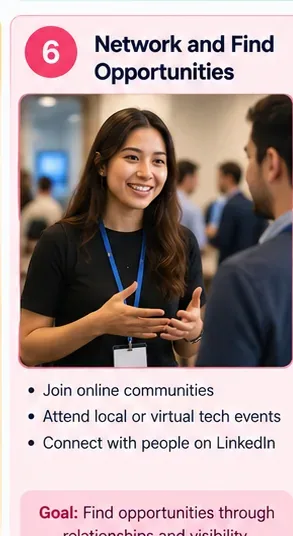
Networking works best when it is specific: ask people in your target role about real tasks, hiring signals, portfolio quality, and entry paths rather than asking strangers for a job.
Step 8: Prepare to demonstrate the work, not just talk about motivation
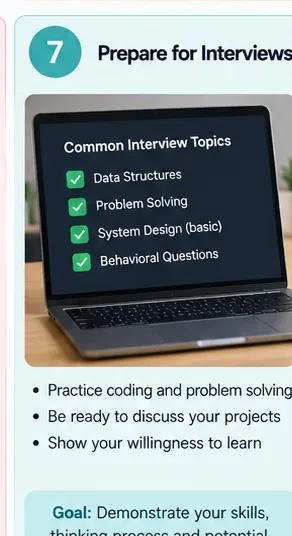
Interview preparation should mirror the job. Web developers should be ready to explain code, debug, reason about browser behavior, discuss projects, and handle an unfamiliar requirement. Support candidates should be able to troubleshoot logically, ask clarifying questions, document steps, and communicate with a frustrated user. Cloud candidates should understand core infrastructure concepts and be able to walk through a small deployment or incident.
Do not memorize only ideal answers. Practice explaining what you do when you do not know the answer. Strong entry-level candidates can state assumptions, isolate variables, search documentation intelligently, test a hypothesis, and verify the result.
Prepare for the interview format used by your target role and be ready to discuss your own projects in detail, including mistakes and tradeoffs.
How to know when you are job-ready
You do not need to know everything. A better readiness test is whether you can consistently produce evidence across four areas:
Task ability: You can perform the common tasks found in the job descriptions you sampled.
Proof: You have three to five projects, lab writeups, or real contributions that another person can inspect.
Explanation: You can explain your decisions, mistakes, troubleshooting process, and what you would improve.
External signal: At least some recruiters, mentors, maintainers, clients, or apprenticeship programs respond positively to your work.
If one category stays weak, target it rather than adding another random course. A new certificate will not fix a portfolio that contains no working projects. More projects will not fix an interview in which you cannot explain your own code. More applications will not fix a target role that is consistently degree-gated in your local market.
What certifications can and cannot do
Certifications are most useful when they remove uncertainty about a specific foundation. They can show that you know the vocabulary and core concepts of a platform or support domain. They can also give you a structured syllabus when you do not yet know what to study.
They cannot guarantee employment, replace all practical experience, or override every employer’s education policy. Before paying for an exam, check whether the credential appears repeatedly in the job descriptions you are targeting. If it does not, a project or work sample may produce more value.
The limits of the no-degree path
A skills-first strategy is not a promise that degrees do not matter. Some employers use degree filters. Some government, research, specialized engineering, leadership, or highly competitive roles may prefer or require formal education. Immigration and visa rules can also create education requirements that are separate from an employer’s skills assessment. Those constraints vary by country and role.
There is also no universal timeline. Someone with strong spreadsheet automation, customer support, or technical operations experience may move into IT quickly. Someone starting from zero and aiming directly at software engineering may need a longer runway. Your financial situation matters too; a transition plan should be sustainable enough that you can keep learning without assuming a job offer will arrive on a fixed date.
The first job is not the end of the transition. Keep building deeper skills after entry so that your career is not limited to the easiest role you could obtain without a degree.
A strong outcome is not “I finished a bootcamp”
The result you want is a credible professional story: you selected a realistic role, learned the required fundamentals, produced inspectable work, solved problems for someone besides yourself, and can explain your thinking under interview pressure. A degree is one way employers reduce uncertainty about a candidate. If you do not have one, your strategy is to reduce that uncertainty with better evidence.
That is also why the plan should change when the evidence says it is not working. If employers are not opening the door, improve targeting and proof. If interviews expose technical gaps, study those gaps. If a role remains heavily degree-gated, enter through an adjacent position and build experience from inside the industry. The goal is not to prove that credentials never matter; it is to find the most efficient path from the experience you have now to work you can demonstrably do well.