The Teal Pumpkin Project is a simple way to make Halloween more welcoming for children who cannot safely eat many traditional treats. A teal pumpkin or sign tells trick-or-treaters that your home has non-food items available, such as stickers or glow bracelets. For 2026, FARE (Food Allergy Research & Education), the organization behind the project, is encouraging households and community groups to participate and is promoting Community Captains who invite more neighbors, schools, businesses, and events to join.
The key distinction is easy to miss: a teal pumpkin signals that a non-food option is available. It does not certify that the house, its candy, or every item being handed out is safe for every allergy. The most useful participation is clear, consistent, and honest about what is being offered.
Quick reference: what the teal pumpkin means
| Signal or choice | What it tells families |
|---|
| Teal pumpkin or Teal Pumpkin Project sign | Non-food treats are available at this stop. |
| Separate bowl of non-food items | Children can choose a non-food option without reaching into the candy bowl. |
| Candy in its original wrapper | Families can review the package; it does not guarantee that a particular child can eat it. |
| A teal pumpkin by itself | It is a participation cue, not an allergy-free certification or medical assurance. |
FARE’s current Teal Pumpkin Project page asks participants to add a home or event to the project map, display a teal pumpkin or sign, and have non-food treats ready. The 2026 map is available for families planning a route. Map listings help with planning, but families should still use their own safety plan and assess each item.
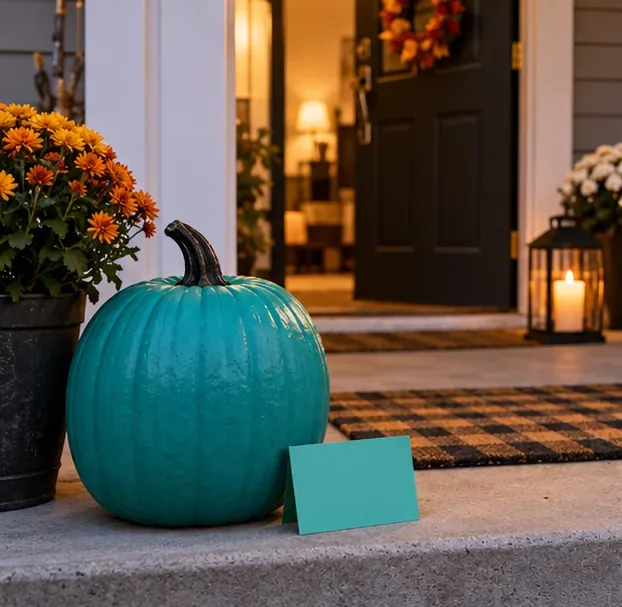
Caption: A teal-painted pumpkin and a plain teal sign sit beside a welcoming front door, signaling that non-food treats are available.
For hosts: how to participate
Choose non-food items that are easy to hand out
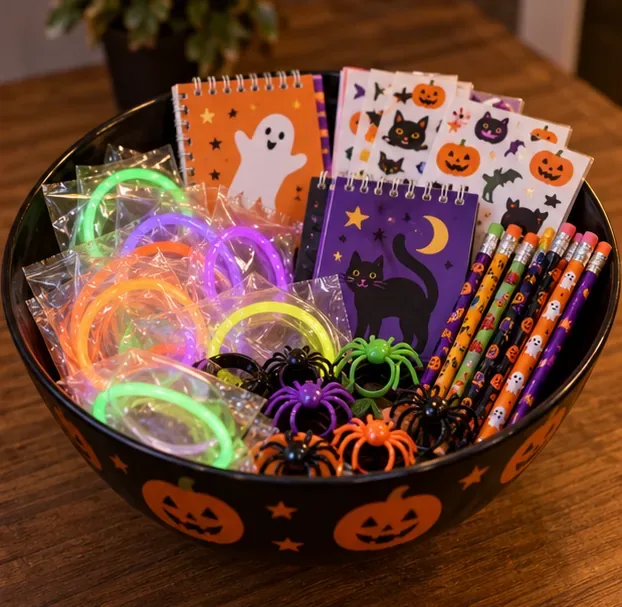
Useful options include stickers, pencils, mini notepads, bookmarks, bubbles, glow sticks, spider rings, and other small toys. FARE lists these kinds of items as non-food treat ideas, and notes that hosts who offer candy too should keep it in a separate bowl. Choose items that suit the ages likely to visit. Small parts can pose a choking risk for very young children, so check age guidance on packaging and avoid handing tiny items to children who may put them in their mouths. The U.S. Consumer Product Safety Commission advises keeping small balls and toys with small parts away from children under 3; see its toy safety guidance. FARE’s non-food treat suggestions provide a longer list.
A non-food item removes food ingredients from that particular choice, but it is not automatically right for every child. Some families may avoid specific materials or small parts for reasons beyond food allergy. Keep choices visible and let the child or accompanying adult decide. If you are unsure what an item contains or whether it is age-appropriate, offer another option without pressure.
Caption: A bowl of non-food Halloween giveaways includes glow bracelets, stickers, pencils, and small notebooks.
Keep the two choices physically separate
If you are giving out both candy and non-food items, use different bowls or containers and label them plainly, such as “Candy” and “Non-food treats.” Place them far enough apart that hands moving through one bowl are less likely to touch the other. Keep candy in its original packaging, and avoid pouring loose candy into a shared container. If you hand items out yourself, keep the non-food items in a separate container and handle them with clean hands.
Cross-contact means an allergen is unintentionally transferred from one food or surface to another. A wrapper can reduce direct contact with the candy inside, but residue on hands or a shared bowl can still make a mixed setup less clear. Separation is a practical way to reduce confusion and accidental contact; it cannot guarantee that every item or surface is safe for every person.
Caption: A teal pumpkin sits behind two distinct containers, with wrapped candy kept apart from non-food trinkets.
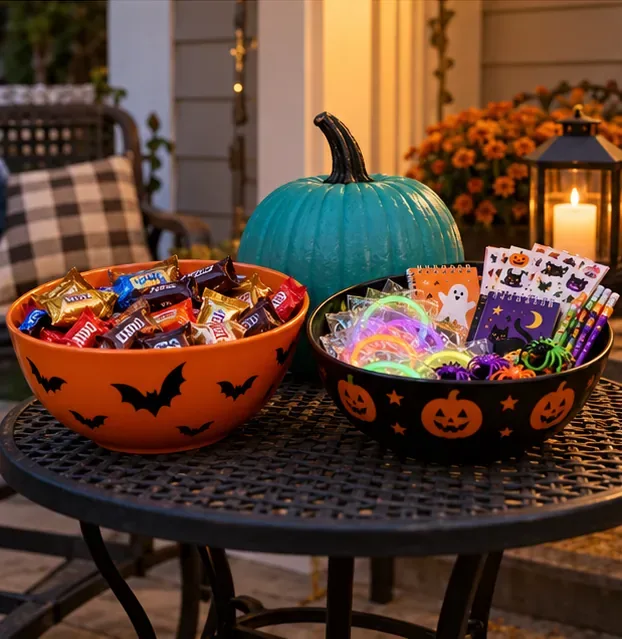
Display the signal where visitors can see it
Put a teal-painted pumpkin near the front door, or use a Teal Pumpkin Project sign in a window or by the entry. FARE offers printable project signs. Make sure the display is visible from the sidewalk and does not block the path, steps, or accessible route. If you are hosting a trunk-or-treat, school event, or neighborhood gathering, place the sign beside the non-food station rather than relying on families to infer which bowl is which.
FARE’s September 22, 2026 announcement also invites people to act as Teal Pumpkin Project Community Captains, encouraging participation by neighbors and local organizations. A simple invitation can be enough: share the project’s official information, explain what the teal pumpkin means, and ask nearby homes or event organizers to provide a non-food option.
For families: plan a route and review the haul
Use the 2026 map as one planning tool, not as a guarantee. A listing indicates that someone has said they offer non-food treats; it does not verify the household, its procedures, the current availability of items, or whether a specific toy works for your child. If details matter, contact the host or event organizer before Halloween when possible. Carry the child’s prescribed emergency medication and follow the family’s individual food-allergy care plan.
At each stop, a child can ask for the non-food option or choose from the separate bowl. It is fine to decline an item or move on. After trick-or-treating, review candy at home before it is eaten. Check each label and package, including miniature or “fun-size” versions: FARE’s 2026 announcement cautions that smaller versions can have different recipes, manufacturing arrangements, or labeling from full-size products. The U.S. Food and Drug Administration (FDA) identifies nine major food allergens in the United States—milk, eggs, fish, crustacean shellfish, tree nuts, peanuts, wheat, soybeans, and sesame—and explains how packaged foods must declare major allergen sources. Read the FDA’s current food allergy and labeling guidance for the limits and details of those rules.
Labels are one part of managing an allergy, not a substitute for an individual care plan. Advisory statements such as “may contain” are voluntary, and not every sensitivity or allergy is covered by the list of nine major allergens. When a product’s ingredients or labeling are unclear, do not guess; follow the family’s established guidance or contact the manufacturer. Do not trade candy between children unless caregivers have reviewed it.
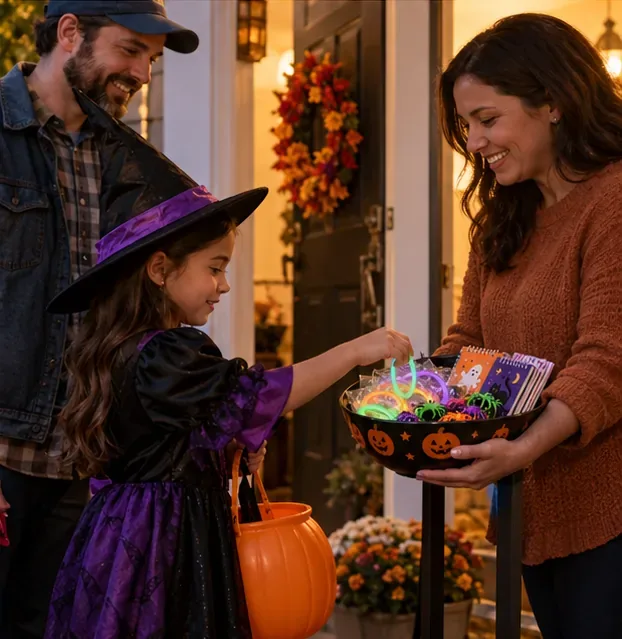
Caption: A child at a neighbor’s door selects a glow bracelet from the non-food bowl while a caregiver and host stand nearby.
Host checklist
- Buy a small selection of age-appropriate non-food items.
- Keep non-food treats apart from candy in separate, clearly identified bowls.
- Leave candy in its original wrappers; do not describe it as safe for every allergy.
- Display a teal pumpkin or official sign where visitors can see it.
- Keep the walkway clear and the treat station easy to reach.
- Check FARE’s 2026 map or add your home or event if the map is being used in your area.
Family checklist
- Review the child’s allergy plan before leaving and bring prescribed emergency medication.
- Use the map to plan, while remembering that listings are not safety certifications.
- Ask for non-food treats when preferred and decline anything uncertain.
- Review every food label at home before a child eats a treat; compare the exact package, not just the brand or product name.
- Keep the child’s plan and medication accessible, and follow it if a reaction occurs.
What to avoid
- Calling the entire home “allergy-safe.” A teal pumpkin communicates one practical option, not a guarantee about every food, surface, or material.
- Putting candy and toys in one bowl. Separate containers make the choice clear and reduce accidental mixing.
- Assuming all candy from one brand is the same. Compare the precise package and read its current label, especially for miniature products.
- Handing out tiny toys without checking the age range. Choose items appropriate for the children who may receive them.
- Pressuring a child to explain an allergy. Offer the non-food bowl as a normal choice and let families decide what works for them.
Keep the promise specific
For Halloween 2026, the most reliable message is modest and useful: “We have non-food treats.” A visible teal pumpkin, separate choices, and a quick review of the official map can help families plan while leaving medical decisions with the people who know the child’s needs. The project does not make every candy or toy universally safe, and no single display replaces label checks or an individual emergency plan.
If a severe allergic reaction is suspected, follow the person’s emergency care plan and seek emergency medical help. The CDC explains that food-allergy reactions vary and can become life-threatening; see its food allergy emergency guidance. Hosts can make a meaningful difference by offering a clear alternative without claiming more than they can verify.