Home
» Wiki
»
Quiet Quitting vs. Quiet Firing in 2026: What’s Really Changing at Work
Quiet Quitting vs. Quiet Firing in 2026: What’s Really Changing at Work
You stop volunteering for extra assignments because your workload is already full. A few weeks later, your manager stops inviting you to stretch projects and gives you less feedback. Is that “quiet quitting”? “Quiet firing”? Or simply a strained working relationship that needs a direct conversation?
The most useful answer is: do not start with the label—start with the observable behavior. “Quiet quitting” and “quiet firing” are informal workplace terms, not formal legal or HR classifications. They can describe real patterns, but they can also oversimplify situations involving burnout, unclear expectations, legitimate performance management, restructuring, poor communication, discrimination, or retaliation.
That distinction matters in 2026 because workplace disengagement remains widespread. Gallup’s State of the Global Workplace 2026 report, based on 2025 data, says 20% of employees worldwide were engaged at work. In the United States and Canada, engagement was 31%. At the same time, the U.S. Bureau of Labor Statistics reported a 1.9% quits rate in July 2026. Those numbers show ongoing strain and caution in the labor market, but they do not prove that any specific employee is quiet quitting or that any specific manager is quiet firing. See Gallup’s 2026 global workplace data, its 2026 regional data, and the BLS Job Openings and Labor Turnover Survey.
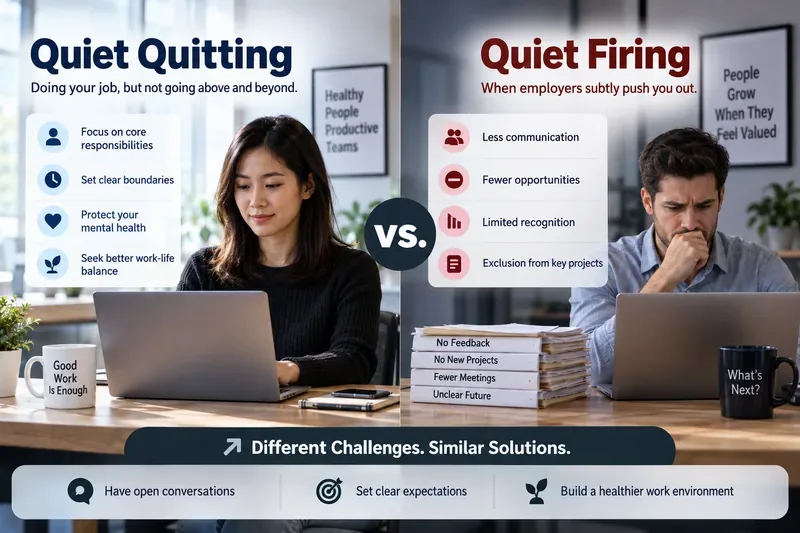
Quiet quitting usually describes employee disengagement or stricter boundaries, while quiet firing describes a pattern of reduced support or opportunity; neither label can establish motive by itself.
The short version: what is verified, what depends on context, and what is unknowable from the outside?
Claim
What we can say
Useful next action
“Quiet quitting means an employee is quitting.”
False as a definition. The employee remains employed. Gallup used the term to describe people who are psychologically detached and do the minimum required.
Compare actual job expectations with current performance before using the label.
“Quiet firing means a manager is secretly trying to make someone resign.”
Sometimes, but not always knowable. Gallup describes quiet firing as managerial neglect that can push employees out. Intent may be unclear.
Ask for clear feedback, priorities, and development expectations in writing.
“A bad review or lost project proves retaliation.”
No. Under U.S. law, retaliation requires protected activity, a materially adverse action, and a causal connection.
Document dates, decisions, comparators, and the protected activity rather than relying on the label.
“If work becomes unbearable, resigning automatically counts as forced termination.”
No. Constructive-discharge standards are fact-specific and vary by jurisdiction.
Before resigning over serious mistreatment, consider legal or union advice relevant to your location.
Misconception 1: Quiet quitting means laziness
The phrase became popular in 2022, but the underlying behavior is older. Gallup described quiet quitters as employees who are “not engaged”: they do the minimum required and are psychologically detached from the organization. Its original analysis linked lower engagement with weaker clarity of expectations, fewer development opportunities, lower feelings of care, and weaker connection to organizational purpose. See Gallup’s original quiet-quitting research.
That does not mean every employee who refuses unpaid overtime or unnecessary after-hours messages is disengaged. A person can be highly effective while maintaining firm boundaries. Another employee can work long hours and still be disengaged. The label does not tell you the quality of the work.
What to do: define the actual job. Employees should ask, “What are the three outcomes that matter most in my role?” Managers should answer with measurable priorities instead of vague expectations such as “show more commitment.” If performance meets those agreed expectations, boundary-setting should not automatically be treated as poor attitude.
Misconception 2: Quiet firing is always a secret plan to force someone out
Gallup defines quiet firing more broadly as managers failing to provide adequate coaching, support, development, and recognition, which can eventually push an employee out. That pattern can be damaging even when there is no explicit strategy to make someone resign. See Gallup’s quiet-firing analysis.
However, the same outward signs can have different explanations. Fewer projects may reflect a reorganization, a budget cut, a change in client demand, an upcoming role redesign, or legitimate concerns about performance. Less contact from a manager may be neglect—or simply an overloaded manager. From the employee’s perspective, motive is often the least certain part.
What to do: ask specific questions instead of accusing someone of quiet firing. For example: “I’ve noticed I was removed from two client projects and our one-on-ones have been canceled for six weeks. Has my role or performance expectation changed?” A concrete question gives the other side something concrete to answer.
Misconception 3: Any unfair treatment is automatically illegal
Unfair, inconsistent, or poor management can be harmful without necessarily violating employment law. In the United States, for example, the Equal Employment Opportunity Commission defines retaliation as materially adverse action taken because someone engaged in protected activity under federal EEO laws, such as filing or participating in a discrimination complaint or reasonably opposing unlawful discrimination.
The EEOC also makes an important counterpoint: protected activity does not immunize an employee from legitimate discipline. An employer may still discipline or terminate someone for non-retaliatory, non-discriminatory reasons that would otherwise justify the action. See the EEOC’s retaliation guidance and its retaliation questions and answers.
What to do: if you believe treatment may be discriminatory or retaliatory, keep a factual timeline. Record dates, changes in responsibilities, performance feedback, relevant complaints or accommodation requests, and comparable treatment of others where appropriate. Avoid rewriting events later from memory.
Misconception 4: Resigning after bad treatment always means you were effectively fired
The legal concept closest to the popular idea of being pushed out is often called constructive discharge. The U.S. Department of Labor’s WARN Advisor explains that a resignation may be treated as involuntary when an employer creates a hostile or intolerable environment or applies severe pressure or coercion that forces the worker to resign. It also notes that the exact standard is usually defined by state law and can vary. See the Department of Labor’s constructive-discharge glossary.
That is a much more demanding concept than “my manager is making work unpleasant.” Whether the standard is met depends on the facts, applicable law, and jurisdiction. This article cannot determine that for an individual situation.
What to do: if you are considering resignation because conditions feel coercive, discriminatory, retaliatory, or unsafe, get advice before making an irreversible decision. Depending on your location and workplace, that may mean HR, a union representative, an employment lawyer, or the relevant labor agency.
What quiet quitting usually looks like in practice
When the term is useful, it often describes a pattern such as:
doing assigned work but no longer volunteering for extra tasks;
stopping after-hours availability that was never formally required;
reducing emotional investment in the organization;
avoiding discretionary projects that do not affect evaluation or pay;
remaining in the job while mentally preparing to leave.
None of these behaviors alone tells you whether the employee is underperforming. The key question is whether agreed responsibilities and performance standards are still being met.
Employee action: review your job description and recent goals. If you are intentionally reducing discretionary work, make sure critical obligations are still clear and documented.
Manager action: do not measure commitment by invisible overtime. Measure outcomes, quality, reliability, teamwork, and expectations that were actually communicated.
What quiet firing usually looks like in practice
A pattern may include canceled one-on-ones, disappearing feedback, exclusion from useful projects, unexplained changes in duties, loss of development opportunities, inconsistent scrutiny, or the sense that the employee has no realistic path forward.
Yet every one of those signals is context-dependent. A single missed meeting is weak evidence. A repeated pattern combined with unexplained negative changes is more meaningful. Even then, intent remains a separate question.
Employee action: look for patterns over time, not isolated incidents. Ask for priorities, performance concerns, and career expectations directly.
Manager action: if performance is the problem, say so. Use specific examples, explain the standard, provide a realistic opportunity to improve, and apply comparable standards consistently.
Why these dynamics persist in 2026
The labels may feel recent, but the underlying problems—low engagement, weak management, burnout, poor role clarity, and distrust—are not new. Gallup’s 2026 global data shows employee engagement at 20% in 2025, down from 21% in 2024 and below the 23% recorded in 2022 and 2023. That is evidence of a broad engagement challenge, not proof of a single cause.
At the same time, workers may feel less willing to quit without another job lined up. The BLS reported a 1.9% U.S. quits rate in July 2026. A slower quitting environment can leave dissatisfied employees and dissatisfied employers in the same relationship longer, which can make silent withdrawal and poor communication more visible.
What to do: treat “I’m stuck” as a signal to improve information. Employees need clarity on expectations and career paths. Managers need clarity on workload, performance, retention risk, and whether problems are individual or structural.
If you think you are quiet quitting: a five-question self-check
Am I still meeting the role’s agreed expectations? If not, this may be a performance issue rather than simply a boundary issue.
Do I know what good performance looks like? If expectations are vague, ask for measurable goals.
Is my withdrawal caused by temporary overload, chronic burnout, conflict, or loss of trust? Different causes need different solutions.
Have I told my manager what is not working? Silent disengagement removes the chance to fix solvable problems.
Would I stay if one or two specific conditions changed? If yes, name them. If no, focus on a responsible exit plan.
If you think you are being quiet fired: a five-question self-check
What exactly changed? List assignments, meetings, evaluations, access, compensation, reporting lines, or development opportunities.
Was a reason given? Ask directly and document the response.
Is the change consistent with how comparable employees are treated? Context matters.
Did the change follow protected activity? If so, review the relevant legal protections in your jurisdiction.
Is there a formal process to challenge or clarify the decision? HR, a grievance process, a union, or management review may be available.
For managers: the safest alternative to “quiet firing” is explicit management
If an employee is struggling, the answer is not to starve them of support until they leave. Clarify the standard, give evidence-based feedback, provide coaching where appropriate, document decisions consistently, and explain what improvement would look like. If the role is changing for business reasons, say that clearly too.
This matters even more after an employee has engaged in protected activity. The EEOC advises employers to reduce retaliation risk by independently evaluating adverse actions in that context and ensuring they are supported by legitimate reasons.
Manager self-check: would you be comfortable explaining the same decision, with the same evidence, to HR, another manager, and the employee? If not, the process probably needs more clarity.
The healthier workplace dynamic is less “quiet”
Quiet quitting and quiet firing are useful conversation starters, but poor diagnostic tools. They describe how work can feel when expectations, trust, feedback, and opportunity break down. They do not tell you the cause, the intent, or the legal significance.
The practical response is surprisingly unglamorous: define the job, communicate changes, document facts, give direct feedback, protect lawful employee rights, and escalate serious concerns through appropriate channels. Employees should not have to guess whether they are succeeding. Managers should not have to guess whether someone is committed. And neither side benefits when silence is allowed to do the work of management.