Home
» Today
»
Australia Power Outages: Live Maps, Storm Risks and Safety Steps | November 11, 2026
Australia Power Outages: Live Maps, Storm Risks and Safety Steps | November 11, 2026
Information checked: November 11, 2026, at 8:10 p.m. in Sydney, Australian Eastern Daylight Time (AEDT, UTC+11:00); 7:10 p.m. in Brisbane, Australian Eastern Standard Time (AEST, UTC+10:00); 09:10 UTC. This is the time official guidance and outage resources were reviewed, not a claimed time when any particular outage began.
Checking a power outage in Australia? Go first to your local electricity distribution network's outage map, search your street or postcode, and follow its reporting instructions. Electricity interruptions are tracked by separate regional networks, so a power cut in one suburb does not establish a nationwide blackout. If there are fallen wires, electric shocks, fire or immediate danger, move away and call Australia's emergency number, 000.
The Bureau of Meteorology's November 11 forecast warned that severe thunderstorms with damaging winds, large hail and heavy rain could affect southeast Queensland and northeast New South Wales, potentially bringing down trees and powerlines. The bureau also identified a risk of further thunderstorms on Thursday, November 12. These are weather forecasts and potential impacts, not a verified count of customers without electricity. Check an address-specific outage map for actual supply interruptions and restoration estimates. See the Bureau of Meteorology storm update and Brisbane forecast.
Destaques
Check by address: Your network distributor—not necessarily the company sending your power bill—maintains the outage map and estimated restoration time.
Storm risk: Official November 11 forecasts flagged possible outage-causing damage in parts of southeast Queensland and northeast NSW; local outages must be confirmed separately.
Stay safe: Keep clear of any downed or damaged wire, use battery-powered lighting and call 000 for life-threatening emergencies.
Protect essentials: Keep refrigerator and freezer doors shut, conserve phone power and activate backup arrangements for electrically powered medical equipment.
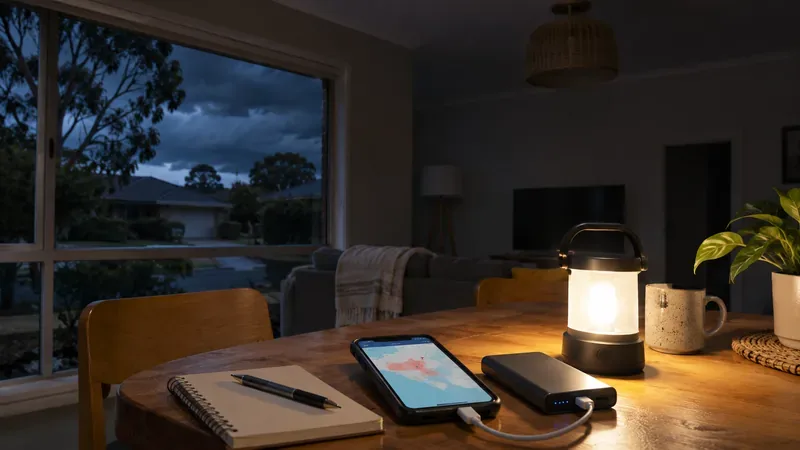
Illustration: A battery-powered lantern and charged phone can help households stay connected during an outage. This is not a photograph of a specific outage.
Is there a power outage in Australia today, November 11?
Official networks publish separate records for planned and unplanned interruptions. Ausgrid and Endeavour Energy provide address-level outage tools in New South Wales, while Energex operates an outage finder in southeast Queensland. Other regions have their own operators. A network map can show a reported fault, a planned shutdown, or a restoration estimate, but it may not immediately reflect a fresh incident or an individual household's situation.
In the storm-exposed northeast NSW and southeast Queensland areas, the November 11 Bureau of Meteorology update identifies risks rather than a confirmed nationwide power emergency. Weather can worsen after an initial forecast, and the reported position of network outages can change as crews locate faults. Treat any listed restoration time as a working estimate, not a promise.
Where can I check the live power outage map for my area?
Use the operator covering your exact address. If you do not know which network serves you, check the distributor name on your electricity bill or search your address in the relevant network's official site. The retailer that bills you may be different from the distributor that repairs lines and substations.
Tip: On the official map, look for whether the incident is planned or unplanned, the affected streets, the status of field crews, and whether an expected restoration time has been posted. Some network maps also offer SMS or email notifications. Energex says its outage finder refreshes about every 15 minutes, but during a major storm updates may be delayed. Use the page's refresh control and check again if your outage is not shown immediately.
What should I do first if the power goes out at home?
Check for immediate danger before touching anything. Stay away from fallen lines, flooded electrical equipment, sparking sockets, smoke or a burning smell. Never assume a wire is dead. Call 000 for an emergency and notify your distributor when safe.
Check whether the interruption is wider than your home. From a safe place, see whether nearby homes or streetlights appear affected. Look up your address on the distributor's official map.
If safe and conditions are dry, inspect your switchboard. A tripped safety switch or circuit breaker may indicate a property-level problem. Do not approach the switchboard during lightning, flooding, electrical arcing, or other warning signs; do not repeatedly reset a breaker that trips. Contact a licensed electrician when the fault appears to be inside the premises.
Report an unlisted outage. Use the network's online reporting form or emergency/outage telephone line, giving the address, when the supply failed and any hazards seen. Do not approach a fallen pole or cable to collect details.
Save battery power. Switch on low-power mode, charge essential devices from a safe power bank, and use a battery-operated radio if mobile service becomes unreliable.
For example, Ausgrid lists 13 13 88 for outages and hazards, while Energex lists 13 62 62 for power outages and 13 19 62 for electrical hazards. These numbers belong to those service territories, not the whole country. For electrical dangers elsewhere, consult the number on the appropriate operator's website.
How long will it take for the electricity to come back?
There is no reliable Australia-wide restoration time. A local equipment fault may be resolved sooner than damage involving fallen trees, damaged poles, flooded access roads or several separate faults. After a storm, crews may need to make the area safe and inspect the network before an accurate estimate is possible. AusNet explains that restoration estimates can change as inspections and repairs progress.
If the status reads "under investigation," "time to be confirmed" or similar, it means the network has not yet established a dependable restoration time. A blank or stale map is not proof that electricity is available. If surrounding properties have been restored but yours has not, report your particular address and, when safe, have the switchboard checked.
How do I keep food, medicine and family members safe during an outage?
Food in the refrigerator and freezer
Food Standards Australia New Zealand advises keeping refrigerator and freezer doors closed as much as possible. A closed refrigerator generally stays cold for around four hours; a closed freezer may remain frozen for around 24 hours, depending on conditions. These are guides, not guarantees that every food remains safe for the full period. Do not taste food to decide if it is safe, and do not refreeze food that has thawed. Discard perishable food if it has warmed to an unsafe temperature or if its safety is uncertain.
Life support equipment and medical needs
If anyone depends on oxygen equipment, a powered medical device or medication requiring refrigeration, follow the backup plan agreed with their healthcare provider and device supplier immediately. Contact the distributor about registered life-support needs. If the interruption creates an urgent medical emergency, call 000; do not wait for the restoration estimate. For non-emergency medical advice in Australia, healthdirect provides guidance and links to appropriate services.
Lighting, heating and generators
Choose LED lanterns or flashlights rather than candles. Never run a portable generator, barbecue or fuel-burning camping appliance indoors, in a garage, or near doors and windows: exhaust fumes can cause deadly carbon monoxide poisoning. Never connect a portable generator directly to household wiring without a professionally installed, compliant changeover arrangement. Unplug sensitive electronics where safe to do so, and leave one light switched on so you can tell when supply returns. See NSW government power-disruption guidance.
Could more outages occur on November 12?
The Bureau of Meteorology November 11 forecast indicated that another round of severe storms could affect parts of southeast Queensland and northeast NSW on Thursday, November 12, 2026. For this period, Brisbane and other southeast Queensland locations use AEST (UTC+10:00), while Sydney and most of NSW use AEDT (UTC+11:00). A storm outlook does not mean every locality will lose power. If severe weather develops, monitor official Bureau warnings and your own distributor's reports rather than relying on screenshots of an old outage map.
For extended interruptions, arrange access to drinking water, charged communications, safe lighting and alternative accommodation if a household member cannot remain safely at home. Check on neighbors who may need assistance, but do not travel through floodwater or around damaged electrical infrastructure.
Power outage in Australia: Frequently asked questions
Who should I call when the power is out?
Contact the electricity distribution network covering your address for an ordinary supply fault, using its official outage page or outage number. Call 000 if there is an immediate risk to life or a serious electrical emergency.
Why is my power out but my neighbor's is on?
Properties close to each other can be supplied through different cables or phases. A tripped safety switch or property fault is another possibility. Check the network outage map and, only if safe, your switchboard; report the address if the network has not listed it.
Can I trust the estimated power restoration time?
Use it for planning, but not as a guarantee. It can change after crews inspect storm damage, locate faults or encounter safety issues. Recheck your distributor's official map and any alerts instead of assuming an initial estimate is final.