Home
» Today
»
Canada’s NATO Military Commitments: Spending and US Defense Scrutiny — November 21, 2026
Canada’s NATO Military Commitments: Spending and US Defense Scrutiny — November 21, 2026
Information checked November 21, 2026, at 3:02 p.m. Eastern Standard Time (Toronto and Ottawa, UTC−05:00; November 21, 20:02 UTC).
Canada’s military relationship with the United States is facing renewed attention after reports of a Pentagon directive restricting some military contacts. The precise scope of the reported restrictions has not been made public in the sources reviewed. That distinction matters: administrative limits on meetings are not the same as a suspension of shared continental defense, NATO deployments, or intelligence cooperation. Reuters’ November 20 report described the reported directive without establishing its full operational effect.
At the same time, Canada has substantially changed its NATO spending position. Ottawa says it reached the alliance’s former 2% of gross domestic product defense-spending benchmark in the 2025–26 fiscal year. Under the newer NATO agreement, Canada has pledged investment equivalent to 5% of GDP by 2035, divided between core military capabilities and broader security-related spending. The remaining question is how announced allocations translate into trained personnel, deployable equipment, and lasting readiness.
Destaques
Canada says it met NATO’s 2% core defense benchmark in fiscal 2025–26; it has not yet achieved the entire 2035 pledge.
The 2035 NATO goal is 3.5% of GDP for core defense and up to 1.5% for broader defense and security-related activities.
Canada leads a multinational NATO formation in Latvia while also cooperating with the United States on continental security through NORAD.
Reports of new Pentagon contact restrictions should not be interpreted as proof that joint operations have stopped.
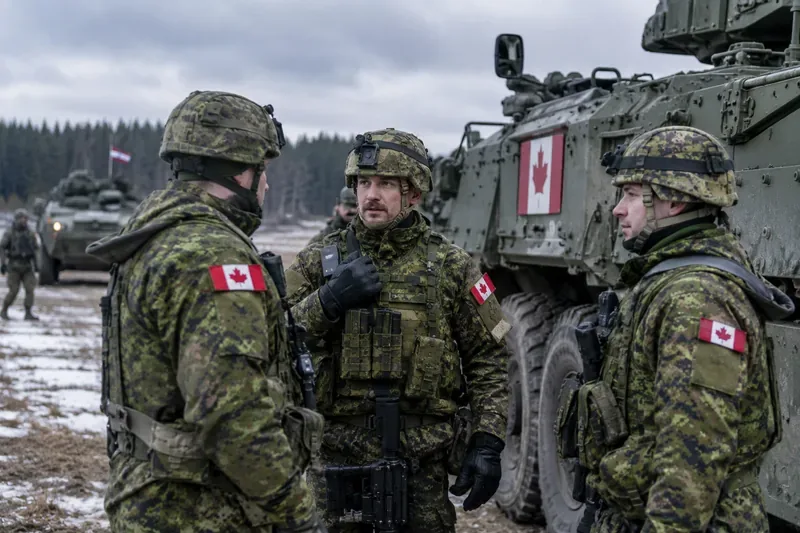
Illustrative scene of Canadian soldiers beside an armored vehicle during winter training; this is not a photograph of a specific NATO operation or Pentagon meeting.
What has changed in US–Canada military relations?
The immediate news concerns reports that U.S. Defense Secretary Pete Hegseth issued guidance narrowing certain military interactions with Canadian counterparts. Public accounts have not provided a complete text of the directive or a comprehensive list of affected activities. A subsequent account cited U.S. Senator Mike Rounds describing restrictions focused on participation in think-tank events and social engagements, with permission requirements rather than an anticipated interruption of joint missions or intelligence exchanges. Canada's defense minister also indicated he had not observed a change in day-to-day defense cooperation. These are attributed descriptions, not independently verified details of a classified document.
For Canadian readers, it helps to distinguish three layers of the relationship. Bilateral political and administrative contacts can change quickly. Operational cooperation—particularly North American aerospace warning and defense under NORAD—depends on standing commands and procedures. NATO is a separate multilateral alliance whose obligations and deployment decisions are not automatically rewritten by a U.S. departmental memo.
How much does Canada spend on defense, and what does NATO require?
In March 2026, the Canadian government announced that defense-related expenditures reached 2% of GDP for fiscal 2025–26, covering spending across the Canadian Armed Forces, the Department of National Defence, and other eligible agencies. The government's initial backgrounder described more than C$63 billion in eligible defense spending. Its subsequent budget documents use updated numbers and projections; figures can differ by accounting basis, coverage, fiscal period, and revised economic estimates. The milestone is a reported spending measure, not proof that every equipment or readiness gap has been closed. See Canada’s March 2026 defence spending backgrounder.
At NATO’s 2025 Hague summit, members adopted a substantially higher 2035 investment pledge. The structure is important: at least 3.5% of GDP is intended for core defense requirements such as armed forces and capabilities, and up to 1.5% can be counted toward qualifying defense- and security-related spending, including critical infrastructure, cyber protection, preparedness, and industrial capacity. NATO calls for annual plans and has set a review of the commitment’s trajectory in 2029. The details appear in NATO’s defence investment framework.
Canada's Canada’s 2026 budget says the government has a funded path toward approximately 4% of GDP within this decade, while the full 5% target remains a longer-term commitment. The independently published Parliamentary Budget Officer’s defence spending primer underscores that achieving such a substantial increase requires sustained fiscal spending, procurement, and implementation. A target date is not the same thing as equipment delivered or a unit ready for deployment.
What military commitments does Canada already fulfill for NATO?
Canada’s NATO mission in Latvia
Canada’s most visible overseas NATO role is Operation REASSURANCE, its largest overseas military mission. Canada acts as framework nation for the multinational brigade in Latvia, contributing command leadership and personnel alongside troops from other allied countries. The Department of National Defence lists approximately 2,000 Canadian Armed Forces personnel in Latvia. In July 2026, Ottawa announced an extension of the operation through 2031 and an expanded role in Multinational Division North. These commitments go beyond annual budget percentages: they involve maintaining equipment, supplies, training, and operational coordination on NATO’s eastern flank. Details are available from the Department of National Defence’s Operation REASSURANCE page.
North American defense through NORAD
The North American Aerospace Defense Command, or NORAD, is a binational Canadian–U.S. command focused on aerospace warning, aerospace control, and maritime warning. It is not the same organization as NATO. Canada's air and surveillance capabilities, Arctic infrastructure, and modernization of early-warning systems are therefore relevant to both national sovereignty and joint continental defense. Scrutiny of spending should consider whether investments strengthen the ability to detect, assess, and respond to threats across Canada's extensive airspace and northern approaches.
Why is a defense-spending percentage only part of the story?
A GDP ratio makes national spending easier to compare, but it cannot by itself measure combat readiness. A country might commit money before aircraft, vessels, ammunition, housing, or training capacity become available. Recruiting and retaining specialists, maintaining existing fleets, and delivering equipment on schedule all influence what the armed forces can actually do. NATO's own framework emphasizes capability targets alongside spending commitments.
There is also a budget distinction. NATO reports spending under standardized definitions, while Canada's federal budget discusses fiscal-year spending using different cash and accrual concepts. That means apparently conflicting dollar figures should not be compared without checking their dates and methods. For taxpayers, the useful questions are which projects are funded, when equipment will enter service, whether staffing is available to operate it, and how Parliament will assess results.
What happens next for Canada's NATO commitments and US defense cooperation?
The immediate issue is clarification of the reported Pentagon restrictions. If the measures are limited to public engagements and routine permissions, their operational effects may be narrow; a broader directive affecting commands or intelligence channels would have different implications. Neither outcome should be assumed without official documentation or on-the-record operational confirmation.
Separately, the Canadian government must translate its financing path into credible annual plans toward the 2035 NATO commitment. The next meaningful indicators are procurement milestones, CAF staffing and readiness data, NATO's published defense expenditure estimates, and parliamentary budget oversight. The planned NATO review in 2029 provides another checkpoint. Canada's Latvian deployment and NORAD obligations will remain practical tests of whether added spending yields usable military capacity.
Frequently asked questions
Has Canada reached NATO's defense spending target?
Canada says it reached the former 2% of GDP benchmark in fiscal 2025–26. The newer 5% pledge is due in 2035 and has not yet been fully met.
Is Canada leaving NATO or NORAD?
No withdrawal has been established by the reporting reviewed. Canada continues to describe substantial NATO operations and continental defense commitments.
What does NATO's 5% target include?
At least 3.5% of GDP for core defense requirements and up to 1.5% for eligible defense- and security-related investments, under NATO's 2035 pledge.