Home
» Today
»
Pete Hegseth’s Canada Defense Directive: What Changed, November 21, 2026
Pete Hegseth’s Canada Defense Directive: What Changed, November 21, 2026
Verified and updated: November 21, 2026, 8:01 p.m. UTC (November 22, 2026, 3:01 a.m. ICT, UTC+07:00).
U.S. Defense Secretary Pete Hegseth is facing fresh scrutiny over reported restrictions on some military engagement with Canada, but the Pentagon says the guidance does not change joint operations through NORAD, NATO cooperation or defense intelligence sharing. Canadian Defense Minister David McGuinty said Saturday, November 21, that he had not seen the reported classified memorandum and had detected no change in military-to-military cooperation. For Canadians, the immediate distinction is between a potentially significant diplomatic signal and a verified change in continental defense operations.
The controversy also brings renewed attention to Canada's military spending. Ottawa says it reached NATO's former benchmark of 2% of GDP in fiscal 2025–26 and has committed, alongside other allies, to the higher 2035 target. Neither the full text of Hegseth's reported directive nor any new spending demand specifically imposed on Canada through that directive was publicly verified in the sources checked for this article.
Destaques
A classified Hegseth directive was reported November 20; its complete wording and operational scope are not public.
Pentagon spokesperson Sean Parnell says NORAD, NATO and intelligence cooperation are not affected by the guidance.
Canada's David McGuinty says defense cooperation continues and senior military officials have observed no change.
Canada reports achieving the 2% NATO spending benchmark and is pursuing the alliance's 5%-of-GDP commitment for 2035.
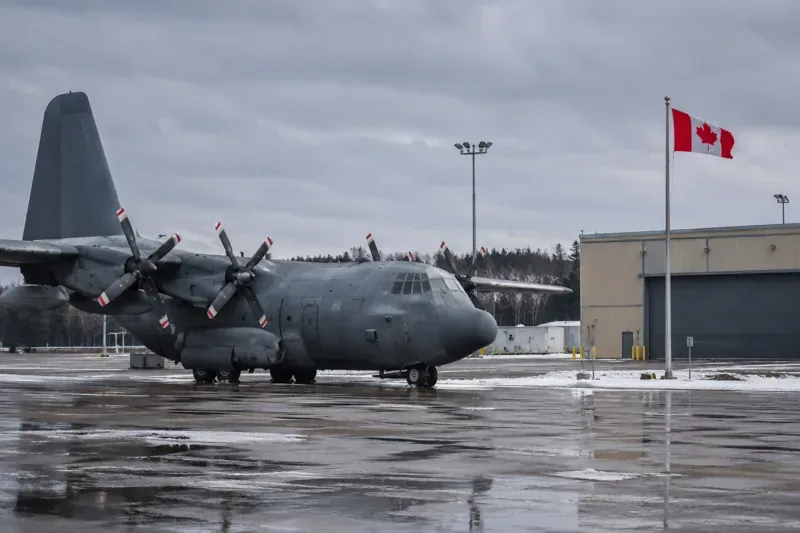
Illustrative AI-generated image of a military transport aircraft on a Canadian airfield; not a photograph of the reported directive or the November 2026 security meetings.
What did Pete Hegseth's reported Canada directive change?
Reporting published November 20 described a classified Pentagon memorandum attributed to Hegseth that would limit certain interactions between U.S. and Canadian military personnel. Its text has not been released for public scrutiny, so claims about a comprehensive suspension of joint exercises, intelligence, air defense or military deployments would go beyond what is established.
Pentagon chief spokesperson Sean Parnell said the department was directing engagement with Canada toward concrete U.S. defense priorities and Canada's NATO responsibilities. Crucially, Parnell said that the guidance does not affect bilateral intelligence work, the binational North American Aerospace Defense Command, or NATO collaboration. That response establishes an important publicly stated boundary, although it does not specify every type of informal or institutional contact that might require new approval.
Senator Mike Rounds, citing information from a Pentagon liaison, characterized the constraints as mainly concerning think-tank events and social engagements, with advance permission required in some cases. That is a lawmaker's account rather than the published directive itself. The precise administrative rules, effective dates and exemptions should be treated as unconfirmed until an authoritative document or detailed Pentagon explanation is available.
How did Canada respond at the Halifax International Security Forum?
Speaking to reporters on November 21 during the Halifax International Security Forum in Halifax, Nova Scotia, McGuinty said he had not reviewed the alleged memo and had checked with senior Canadian military officials, who had seen no practical shift. His response was measured: Canada continues to work with the United States on defense, security and intelligence, while monitoring whether anything changes.
The Canadian government had already announced that McGuinty would co-host the November 20–22 Halifax forum. Because the minister's remarks were reported from the forum but an independently verified exact speaking time was not available, no precise clock time is assigned to those remarks here. Halifax was on Atlantic Standard Time (AST, UTC−04:00) during the forum.
U.S. reactions have not been uniform. Some lawmakers criticized the symbolism and diplomatic tone of the reported move, while Rounds suggested the practical restrictions were narrower than the initial headlines implied. Both interpretations should be distinguished from documented changes in NORAD command procedures or actual military missions, for which no disruption was confirmed in the reporting reviewed.
Is Canada's military spending still below NATO's target?
Not the former 2% benchmark, according to Canada's official fiscal reporting. The Department of National Defence says Canada achieved defense expenditures equivalent to 2% of GDP for fiscal 2025–26. Canada's 2026 budget also describes a funded plan to reach 4% of GDP before the end of this decade. These are government-reported achievements and plans, not independent confirmation that every future expenditure has already occurred.
The new NATO undertaking agreed at The Hague summit in June 2025 is 5% of GDP annually by 2035, divided into at least 3.5% for core defense requirements and up to 1.5% for wider defense- and security-related investments such as infrastructure, resilience and cybersecurity. The commitment therefore should not be described as an immediate requirement for Canada to spend 5% on traditional military equipment this year. NATO expects credible annual national plans, with a review of the trajectory in 2029.
For Canadian readers, the key question is increasingly about what new appropriations translate into: deployable personnel, Arctic surveillance, equipment readiness, domestic industry capacity, resilient communications and reliable cross-border systems. A headline GDP share alone does not establish that military capability shortfalls have been resolved.
Why do NORAD and Arctic defense matter in this dispute?
Canada and the United States are closely integrated in monitoring and defending North American approaches. NORAD's function, including aerospace warning and control, means a genuine interruption would have implications far beyond conferences or ceremonial military exchanges. That is why the Pentagon's express exclusion of NORAD from the reported guidance matters.
Arctic sovereignty is another central policy question for Ottawa. Canada has identified northern defense, infrastructure and military modernization as areas requiring investment. Greater Canadian capacity can support common continental security while allowing Ottawa to make decisions consistent with its own sovereignty and procurement priorities. It would be premature, however, to claim the reported directive has produced specific changes to aircraft purchases or Arctic deployments without documentary evidence.
What happens next for U.S.–Canada defense relations?
The most consequential next development would be an official clarification of the memorandum's scope: which meetings or exchanges need permission, when the policy started, and whether it changes established training or professional-development programs. A Canadian or U.S. announcement identifying a concrete cancelled activity would also provide a firmer measure of impact than speculation about the memo's intent.
Separately, Canada will be judged on how it implements spending plans and whether investments improve real capabilities. NATO's 2035 pledge, the expected annual plans and the 2029 review provide measurable milestones. None of these future outcomes is guaranteed merely by the current Pentagon controversy. As of this verification, the confirmed picture is diplomatic friction over a reported directive, official reassurances concerning the most critical cooperative structures, and an already announced Canadian defense-investment trajectory.
Did Pete Hegseth halt U.S.–Canada military cooperation?
No such broad halt has been verified. The Pentagon says the reported guidance does not affect NORAD, NATO cooperation or defense intelligence sharing.
Has Canada met NATO's 2% defense spending benchmark?
Yes, according to Canadian government reporting for fiscal 2025–26. The separate 5% NATO commitment has a 2035 deadline and includes nontraditional security-related investments.
Has the Pentagon released the full classified memo?
No publicly available full text was verified during this update. Its exact restrictions remain partly unknown.