Home
» Today
»
CBA CEO Matt Comyn’s Parliamentary Hearing: Fee Scrutiny and Key Takeaways, Nov. 16, 2026
CBA CEO Matt Comyn’s Parliamentary Hearing: Fee Scrutiny and Key Takeaways, Nov. 16, 2026
Information checked: November 16, 2026, 4:14 p.m. AEDT (UTC+11:00; 5:14 a.m. UTC). Commonwealth Bank of Australia (CBA) CEO Matt Comyn faced Australian lawmakers on Friday, November 13, just after the corporate regulator launched a new lawsuit alleging that the bank overcharged business customers. His appearance before the House Standing Committee on Economics brought customer fees and accountability into sharp focus, alongside questions about home lending, competition, artificial intelligence and the bank’s broader operations.
The immediate development was not a change to mortgage rates or a new bank policy. It was a public examination of how CBA identifies incorrect charges, responds to complaints and compensates customers. The Australian Securities and Investments Commission (ASIC) separately disclosed that its CommBiz proceedings concern alleged overcharging of approximately 42,000 customers by about A$8.5 million between November 2020 and May 31, 2025. Those are regulator allegations, not a court finding.
Destaques
Comyn appeared before the House Standing Committee on Economics in Canberra on November 13, 2026.
ASIC has filed civil penalty proceedings over allegedly undisclosed CommBiz transaction fees affecting approximately 42,000 business customers in the specified penalty period.
ASIC says CBA’s broader CommBiz remediation program has paid more than A$26.4 million to approximately 93,000 customers.
Questions about charges to low-income customers, mortgages, emerging technologies and governance remain important areas of parliamentary scrutiny; a hearing alone does not establish a legal breach.
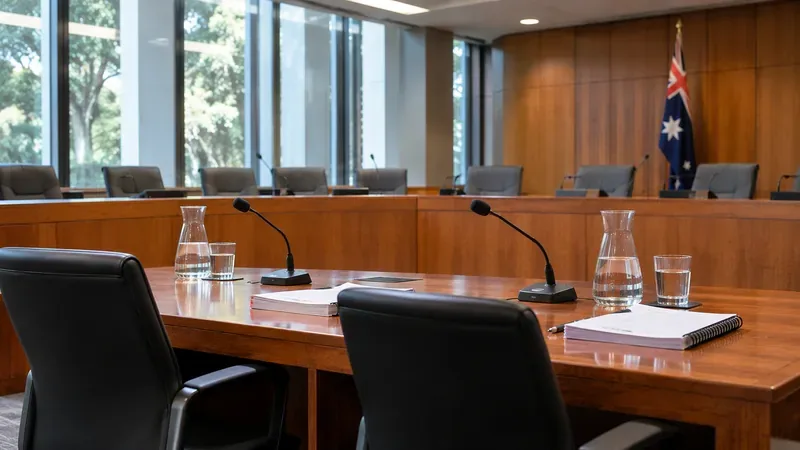
Illustrative image of a parliamentary hearing room; not a photograph of Matt Comyn’s November 13 appearance.
What happened when Matt Comyn appeared before Parliament?
The committee’s annual review of the four major banks held public hearings in Canberra on November 12 and 13, 2026. The official listing places the November 13 hearing at Parliament House in Canberra, Australian Eastern Daylight Time (AEDT, UTC+11:00). The scheduled hearing day ran from 9:15 a.m. to 5:00 p.m. AEDT, corresponding to 10:15 p.m. UTC on November 12 through 6:00 a.m. UTC on November 13. These times refer to the day’s hearing program, not an individually verified start time for Comyn’s testimony.
The committee is chaired by Ed Husic and reviews the major banks’ practices in public. CBA’s appearance followed the regulator’s announcement of civil proceedings concerning its CommBiz platform. The timing meant lawmakers could question the bank about known fee problems and its response while regulatory litigation was pending. The hearing’s scope also includes lending and deposit rates, borrower finances, the availability of credit and how banks handle customer complaints.
The official sources for the inquiry are the Parliament of Australia inquiry page, public-hearing records and committee terms of reference. At the time of this check, a finalized official transcript containing every word of Comyn’s November 13 testimony could not be confirmed from the accessible parliamentary pages. Accordingly, the article does not attribute unverified exact quotations to him.
Why was CBA questioned about CommBiz transaction fees?
ASIC says the bank’s published CommBiz terms did not adequately disclose an additional fee associated with the movement of money into or out of the customer’s own account when processing certain Direct Credit or Direct Debit payments. For example, ASIC describes transactions where a business could incur a fee for the payment and an additional fee related to its linked CommBiz account.
According to ASIC’s November 2026 media release on the CommBiz proceedings, the alleged conduct in the identified penalty period affected approximately 42,000 customers and totaled about A$8.5 million. ASIC has brought civil penalty proceedings in the Federal Court of Australia. Its legal claims must be distinguished from proven contraventions: the commencement of a proceeding does not establish liability.
ASIC also states that CBA temporarily stopped charging the relevant fees in June 2025, amended its terms in August 2025, and has waived the relevant “contra leg” fees since February 2026. The regulator reports that CBA completed a broader remediation program extending back to December 2006, with more than A$26.4 million paid to approximately 93,000 past and present CommBiz customers, including about 40,000 small businesses. The broader remediation total and the A$8.5 million allegation cover different scopes and must not be added together as if they were independent losses.
What did Comyn say about customers and bank accountability?
Contemporaneous accounts of the hearing say Comyn apologized for business customers being overcharged and maintained that CBA had contacted or repaid affected customers. That account is consistent with the completed remediation program described by ASIC, although it does not resolve the regulator’s legal allegations. An apology or repayment is not the same as a court ruling.
Lawmakers also pressed the bank about high-fee accounts used by people on low incomes. This is a separate issue from the CommBiz business-account case. In its 2024 review of low-income banking customers, ASIC found that several major banks had left low-income customers in costly accounts. ASIC’s 2026 enforcement update says A$68 million in refunds announced by CBA in December formed part of sector-wide action to address this issue. Reporting from the November 13 hearing described disagreement over whether CBA’s voluntary payments should be characterized as goodwill or remediation. The article does not equate that dispute with a judicial determination that every fee was unlawful.
Were mortgage rates and lending standards changed at the hearing?
No mortgage-rate change, deposit-rate increase or lending-rule amendment is established by the verified hearing material. The committee’s remit explicitly includes interest rates on loan and deposit products, the financial position of borrowers, bank margins, funding costs and credit available to households and businesses. Those topics can produce important testimony without changing customer contracts on the day of the hearing.
For borrowers, the distinction matters. A bank executive’s answers to lawmakers do not constitute a Reserve Bank of Australia cash-rate decision, a revised CBA rate sheet, or an approved change to a mortgage contract. Customers should rely on their bank’s direct notices and published product terms for any actual change. Similarly, comments about housing supply, construction lending and inflation should be read as assessments or policy arguments unless supported by published bank data.
What other issues were on the committee’s agenda?
The parliamentary terms of reference cover artificial intelligence in credit assessment and customer service, cyber risk, fraud and scam prevention, dispute resolution, banking access outside major cities, payment services, climate-related risks and the implementation of recommendations from the banking royal commission. These topics help explain the breadth of questions facing CBA but should not be confused with newly announced CBA commitments.
The distinction between prevention, detection and response is especially relevant in fee and scam cases. A bank can have policies and internal controls and still face scrutiny when a recurring issue is not discovered or fixed quickly enough. For consumers, transparent notice, accessible complaints channels and timely redress are practical measures to watch. Specific improvements, implementation dates or enforcement outcomes should be reported only when the bank, regulator or committee publishes them.
What happens next for CBA and the parliamentary inquiry?
The next concrete milestones are further documents from the committee, any answers the bank provides to questions taken on notice, and progress in ASIC’s Federal Court case. If a judgment, settlement, regulatory direction or additional verified repayment figure is published, it could materially change the story. None of those outcomes should be assumed from the hearing itself.
CommBiz users who believe they paid the fees described by ASIC should review their statements and correspondence and contact CBA if they have not received a response. ASIC expressly advises potentially affected customers who have not been remediated to contact the bank. Customers dissatisfied with how a banking complaint is resolved can also examine their eligibility for external dispute resolution. The relevant facts will depend on the account type, transactions and applicable period.
For now, the major takeaway from Comyn’s parliamentary appearance is a clearer picture of the issues under examination, not a definitive verdict. ASIC’s published allegation and remediation figures are documented; the legal outcome and any new customer-facing commitments remain separate questions. Readers following the matter can consult the parliamentary inquiry and ASIC releases directly rather than relying on claims circulated without documents.
FAQ: Matt Comyn’s parliamentary appearance
When did Matt Comyn appear before the parliamentary committee?
On Friday, November 13, 2026, in Canberra, Australia. The scheduled hearing day was 9:15 a.m.–5:00 p.m. AEDT (UTC+11:00); Comyn’s precise testimony start time is not established by that schedule alone.
How much did ASIC allege CBA overcharged CommBiz customers?
ASIC alleges approximately A$8.5 million in overcharges affecting about 42,000 customers between November 2020 and May 31, 2025. The claim is before the courts and is not a judicial finding.
Did the hearing change CBA mortgage rates or prove wrongdoing?
No verified evidence establishes a mortgage-rate change resulting from the hearing. Parliamentary questioning also does not itself determine civil liability in ASIC’s ongoing proceedings.