Home
» Chinese Astrology
»
Chinese Zodiac 2027 Guide: Year of the Fire Goat Meaning, Luck, and Forecast
Chinese Zodiac 2027 Guide: Year of the Fire Goat Meaning, Luck, and Forecast
If you are searching for a “lucky” date, trying to identify your zodiac animal, or wondering what the 2027 forecast means for work and relationships, start with the calendar. The Chinese zodiac year does not begin on January 1. The Hong Kong Observatory’s 2027 Gregorian-lunar conversion table labels the year Ding-wei, Year of the Goat, and marks February 6 as the first day of the first lunar month. The Smithsonian’s National Postal Museum calls it the Year of the Fire Goat, also rendered Ram. The main guide below explains what those labels mean and how to use a horoscope as a reflection tool rather than a guaranteed prediction.
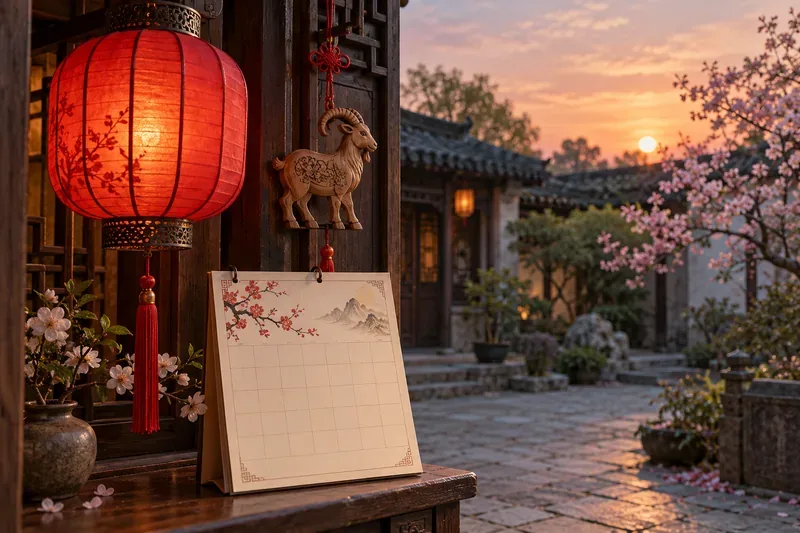
A red lantern, goat ornament, and calendar page evoke the 2027 lunar-year transition.
Step 1: Know what “Chinese zodiac” means
The Chinese zodiac is a repeating sequence of twelve animal signs associated with years: Rat, Ox, Tiger, Rabbit, Dragon, Snake, Horse, Goat, Monkey, Rooster, Dog, and Pig. The Hong Kong Observatory lists the cycle and describes the calendar system. A person’s year sign is commonly identified from the lunar year in which they were born, so birth dates near Lunar New Year require care.
A horoscope is an interpretation that uses a zodiac sign to discuss themes such as personality, relationships, career, or fortune. It is not the same as the calendar fact that a particular lunar year is associated with an animal and stem-branch name. Calendar tables can establish when a year begins; horoscope interpretations do not establish what will happen to an individual.
Step 2: Understand the 2027 name and date boundary
2027 is commonly called the Fire Goat year. The Observatory’s official table uses the designation Ding-wei and identifies the animal as Goat. The National Postal Museum describes 2027 as the Year of the Fire Goat or Ram and notes that the zodiac combines a twelve-animal sequence with five elements: Wood, Fire, Earth, Metal, and Water. “Ding-wei” is the traditional stem-branch designation; “Fire Goat” is a familiar English rendering.
For the popular lunar-year convention, the Goat year begins on February 6, 2027. January 1 through February 5 is still before that lunar New Year. Some specialized Chinese metaphysical systems use a solar-term boundary for particular chart calculations instead. If you are checking a birth chart, find out which convention it uses rather than assuming every system changes signs on the same date.
The Goat is also called Sheep or Ram in English-language descriptions. This naming difference reflects translation and regional usage; it does not mean there are three consecutive zodiac animals. The Smithsonian notes that regional traditions can differ, so identify the cultural calendar being used when comparing an online chart with a family or community tradition.
Step 3: Find your animal sign accurately
Write down your full birth date, then check the Lunar New Year date for that birth year. If you were born well after the transition, the year animal is usually straightforward under the lunar-year convention. If your birthday falls in January or early February, check the calendar table before assigning your sign. A Gregorian birth year alone can mislabel people born before Lunar New Year.
Do not confuse the Chinese zodiac with Western astrology. Western sun signs use a different calendar framework based on the Sun’s apparent position through the year. They answer a different question and should not be substituted for one another. A detailed Chinese astrological chart may also consider more than the year animal, including birth month, day, and hour, depending on the tradition. A general “2027 zodiac guide” is therefore broad, not a complete personal chart.
Step 4: Read “luck” as a theme, not a promise
Annual forecasts often discuss luck in categories such as career, money, love, health, or family. Those categories can help you think through priorities, but they cannot reliably predict a promotion, investment return, new relationship, or medical outcome. Treat statements about favorable energy or difficult periods as cultural symbolism, not as evidence that an event will occur.
A practical way to use a forecast is to translate each theme into a question you can answer with real information:
Career: What skill or result would make you more prepared for a role you want?
Money: Does a choice fit your budget, time horizon, and tolerance for loss?
Relationships: Are communication, respect, and follow-through present in daily behavior?
Well-being: What routine or professional support would help, regardless of the horoscope?
This keeps the reflective value while avoiding a common mistake: treating a lucky color, number, date, or sign match as a substitute for checking terms, behavior, or finances. Do not postpone needed medical care, make an investment, end a relationship, or take on debt because a horoscope says a period is favorable or unfavorable.
Step 5: Prepare for the Fire Goat year in a grounded way
Before Lunar New Year, choose one or two goals that matter to you. Make each goal observable. Instead of “have better career luck,” set a target such as completing a course, asking for feedback, or applying for a defined number of suitable roles. Instead of “improve relationships,” schedule a conversation about a specific issue or make room for regular time together. For money, set a savings target or review recurring expenses.
Then choose a small first action and a date to review it. If you are considering a major change, compare at least two options, including the cost of waiting. Gather the relevant information: written job terms, monthly expenses, fees, a realistic timeline, or a direct conversation. The zodiac theme can serve as a prompt to reflect, but your choice should rest on evidence about your circumstances.
Common mistakes to avoid
Using January 1 as the zodiac boundary: the lunar year begins on a different date. Check the calendar for the specific year.
Assuming every source uses the same boundary: lunar-year readings and some solar-term chart methods may differ. Confirm the method.
Confusing “Goat,” “Sheep,” and “Ram” as separate signs: these are alternate English labels for the same zodiac animal in many references.
Expecting a year sign to describe a whole person: a broad annual sign is only one layer in a varied cultural tradition.
Taking forecasts literally: treat predictions as unverified interpretation and check decisions against observable facts.
Self-check: is the guide helping?
Before acting on a 2027 horoscope, ask: Do I know which calendar boundary is being used? Have I separated confirmed date information from symbolic interpretation? Can I explain the choice using practical criteria? Have I checked the likely downside and considered a smaller, reversible step? If you can answer yes, the horoscope has helped you organize your thinking without taking control of the decision.
The core calendar fact is clear: the Hong Kong Observatory calls 2027 Ding-wei, Year of the Goat, with the first lunar month beginning February 6. The Fire Goat meaning and forecasts belong to the interpretive side of the tradition. Use the distinction to explore the year’s symbolism, plan goals, and make decisions with the information that actually applies to your life.