Picking up a supermarket basket should be one of the least complicated parts of a grocery run. But when a basket is wide, heavily loaded, difficult to balance, or uncomfortable to grip, even a short shop can become tiring. That is why online interest in “Coles’ new ergonomic shopping baskets” deserves a careful fact check rather than a quick assumption.
As of September 23, 2026, Coles has not published an official announcement that we could verify confirming a nationwide rollout of a new ergonomic shopping-basket design. Coles does publish information about accessibility, safer equipment, sustainability, and in-store shopping improvements, but its current official material does not clearly document a new basket launch matching the recent “ergonomic basket” wording. Shoppers should therefore treat claims about a newly launched Coles ergonomic basket as unconfirmed unless Coles publishes store, rollout, or product details.
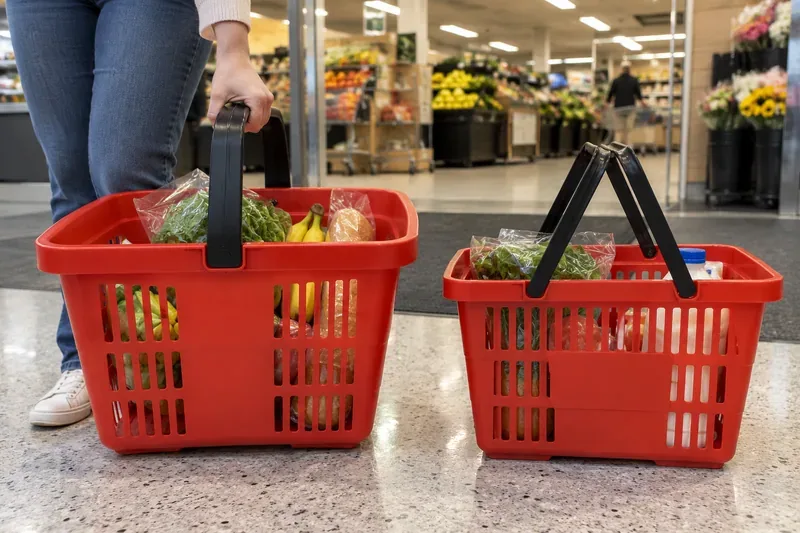
Two red grocery baskets with different handle arrangements show how basket shape and carrying position can affect the shopping experience.
What is actually confirmed about Coles shopping equipment?
Coles has a documented history of changing store equipment for sustainability and accessibility reasons. In 2021, the company said its Moonee Ponds innovation store used trolley baskets made from 90% recycled milk bottles and 10% recycled plastic collected through REDcycle. That information appears in an official Coles Group media release about sustainability initiatives.
Coles also describes accessibility as a continuing part of its store strategy. Its current Quiet Hour information explains how most supermarkets reduce sound during designated periods to make stores easier to use for customers who find high-sensory environments challenging. Separately, Coles Group’s health, safety and wellbeing page says the company uses fit-for-purpose equipment and consults team members on design input for new concepts and changes.
Those statements show that Coles considers equipment design, safety, sustainability, and accessibility. They do not, however, confirm that a new ergonomic hand basket has been launched in 2026. That distinction matters because shoppers may otherwise mistake social-media discussion, a store-level trial, or a rival supermarket’s redesign for a confirmed Coles rollout.
Why can a shopping basket feel uncomfortable even if it looks simple?
A basket becomes a manual load as soon as groceries are placed inside it. The practical problem is not just total weight. Shape, balance, grip size, handle orientation, and how far the basket sits from the body all affect how it feels to carry.
WorkSafe Victoria’s official guidance on hazardous manual handling identifies several factors that increase physical demand, including awkward posture, high force, loads that are unstable or unbalanced, and objects that are hard to hold. Its manual-handling safety guidance is written for workplaces, not supermarket customers, but the basic ergonomic principles help explain why two baskets with the same groceries can feel very different in the hand.
For a shopper, the most noticeable issues are usually simple: the basket tilts as items shift, the handle forces the wrist into an uncomfortable angle, the basket sits too far from the leg, or the load becomes too heavy for one hand. A design described as “ergonomic” should ideally reduce those problems for a broad range of users, but no single handle shape will suit every person, body size, grip strength, or mobility need.
What should you do if a Coles basket feels awkward?
Start with the easiest fix: reduce the load. A basket that feels comfortable with a few light items can become unpleasant once it contains bottles, cans, milk, or other dense groceries. Moving one or two heavier products to another basket, or switching to a trolley, can make a bigger difference than trying to change your grip repeatedly.
1. Keep heavier items low and near the center
Uneven loading makes a basket swing and rotate. Put heavier items near the bottom and as close as practical to the center of the basket. Lighter items such as bread, leafy vegetables, and paper goods can sit on top. The goal is not perfect engineering; it is simply to stop one side from becoming noticeably heavier than the other.
2. Avoid carrying a heavy basket at arm’s length
If the basket design allows it, keep the load reasonably close to your body. A wide or bulky basket carried away from the body can increase the effort needed to control it. If the handle shape forces an uncomfortable wrist, elbow, or shoulder position, do not assume you need to “get used to it.” Choose another carrying option instead.
3. Switch to a trolley earlier
A common mistake is waiting until the basket is already heavy before changing plans. If you are buying large drink bottles, multiple cans, pet food, laundry products, or several kilograms of produce, a trolley may be more practical from the start. This is especially relevant for people with reduced grip strength, joint pain, recent injuries, pregnancy-related discomfort, or other mobility considerations.
4. Ask staff about alternatives in that store
Store equipment can vary by location. If the baskets available at your local Coles are uncomfortable, ask a team member whether another basket type, smaller trolley, or accessibility trolley is available. Coles has previously documented specialised trolley designs for wheelchair users and families with children with disabilities in its accessibility materials, although availability can vary by store.
How can you tell whether a “new” basket is really part of a Coles rollout?
Use three checks before treating a sighting as evidence of a national change.
- Look for an official Coles announcement. Coles Group publishes major store and sustainability changes through its newsroom and corporate channels.
- Check whether the design appears in multiple stores. A basket in one location may be a local replacement, trial, or temporary supply choice rather than a chain-wide rollout.
- Separate visible features from marketing claims. Two handles, a thicker grip, or a different basket shape may affect comfort, but the word “ergonomic” should not be assumed unless the retailer or manufacturer actually uses that description.
This is particularly important when search interest rises quickly. A popular phrase can spread faster than the underlying facts, and supermarket equipment is easy to misidentify when several major retailers use similar red, green, or recycled-plastic basket designs.
Does a twin-handle basket automatically mean better ergonomics?
No. A twin-handle layout can give a shopper more carrying options and may make it easier to distribute the load between two handles, but comfort still depends on handle thickness, spacing, basket width, total weight, and the user’s reach and grip. Conversely, a single central handle may suit some shoppers because it can be picked up quickly with one hand.
The useful question is not whether one design is universally “better,” but whether the basket lets you carry a realistic load without sustained wrist deviation, excessive grip force, repeated rebalancing, or the basket striking your leg as you walk. That is a more practical test than judging the basket by appearance alone.
What should accessibility-conscious shoppers watch for?
For some customers, a small change in basket design can have a disproportionate effect. People with arthritis, hand weakness, limited shoulder movement, balance issues, or mobility aids may rely on a particular carrying position. A larger handle is not automatically easier to use, and a wider basket can be harder to manoeuvre through narrow aisles or beside a mobility device.
Coles’ broader accessibility work shows that the company already recognises that store environments need to serve customers with different requirements. Its official accessibility information describes low-sensory shopping measures, while earlier accessibility plans documented specialised trolley options. If a basket design creates a genuine barrier, reporting that experience to store staff or through Coles customer feedback gives the retailer a specific usability issue to assess rather than a general complaint.
How to check whether the basket works for you
Before walking deep into the store, place two or three typical items in the basket and carry it for a short distance. Pay attention to four things: whether the basket stays balanced, whether your wrist can remain reasonably neutral, whether the basket clears your leg while walking, and whether you can set it down safely without twisting. If any of those feel awkward while the basket is still lightly loaded, switch to a trolley or another basket before adding more weight.
After a few minutes, reassess. A good result is not that you can tolerate the basket; it is that you can carry your intended shopping without repeatedly changing hands, tightening your grip, lifting your shoulder, or compensating with an awkward posture. If discomfort builds, change the method rather than pushing through it.
Bottom line
The current search trend around “Coles’ new ergonomic shopping baskets” is ahead of what can be verified from Coles’ official information. As of September 23, 2026, there is no clearly documented Coles announcement confirming a new nationwide ergonomic hand-basket rollout. What is confirmed is that Coles has previously introduced recycled-content shopping equipment and continues to publish accessibility and safer-equipment initiatives.
For shoppers, the practical takeaway is straightforward: judge the basket by how it behaves with your actual groceries. Keep the load balanced, switch to a trolley before the basket becomes heavy, and use another option if the handle or shape forces an uncomfortable grip or posture. If Coles later publishes a formal redesign, the most useful details to look for will be handle configuration, basket dimensions, rollout locations, accessibility testing, and whether older basket types remain available.