Home
» Today
»
Ebola Explained: Symptoms, Spread, and UK Risk — Updated November 6, 2026
Ebola Explained: Symptoms, Spread, and UK Risk — Updated November 6, 2026
Information checked: November 6, 2026, 5:08 p.m. London GMT (UTC+00:00); 17:08 UTC. This is the time of the editorial source check, not the date of the patient transfer or the outbreak data cutoff.
A British doctor diagnosed with Ebola while assisting the outbreak response in the Democratic Republic of the Congo (DRC) was brought to London for specialist care on November 5, 2026. The patient is being treated in a high-level isolation unit at the Royal Free Hospital. UK health officials say the risk to the general public remains low and that the transfer does not require extra precautions for people in the UK, according to the UK Department of Health and Social Care and UK Health Security Agency (UKHSA).
Ebola is a serious viral illness, but it does not spread through the air like influenza or COVID-19. People typically become infected through direct contact with body fluids from someone who is ill or has died from Ebola. Symptoms can begin 2 to 21 days after exposure, often starting with fever, severe tiredness, headache, or muscle pain. Understanding those distinctions helps people evaluate risk without mistaking an imported patient for local community transmission.
Destaques
A British patient is receiving specialist isolation care in London following an infection linked to outbreak-response work in the DRC; UKHSA says public risk is low.
Ebola spreads through infected body fluids or contaminated materials, not ordinary airborne exposure or simply being near someone.
Symptoms may begin 2–21 days after exposure. Early signs are nonspecific; bleeding is not inevitable and often occurs only in severe cases.
In the UK, anyone with compatible symptoms after recent exposure or travel to an affected area should stay home, call NHS 111, and disclose their travel or contact history.
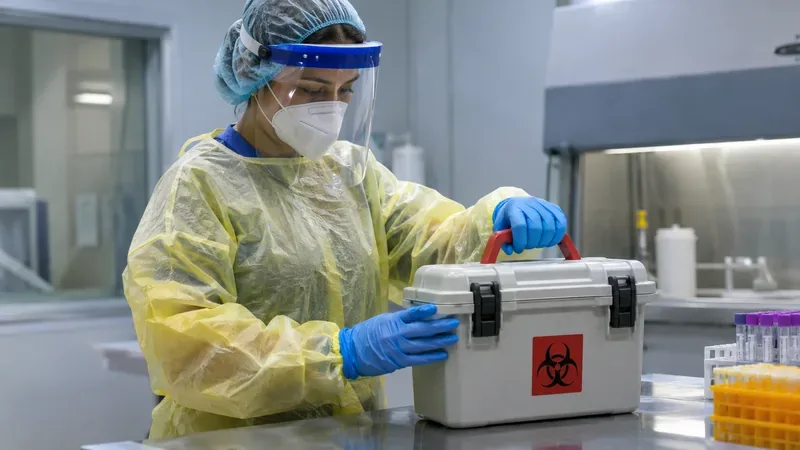
Illustrative laboratory scene showing protective equipment and a sealed specimen case. This does not depict the London patient or an actual Ebola outbreak site.
What happened with the Ebola patient in London?
On November 5, the UK government confirmed that a medical doctor who had worked on the Ebola response in the DRC had tested positive and returned to the UK on a specialist medical evacuation flight. Staff followed established infection-control procedures during transport and admission. The Royal Free Hospital is equipped to isolate and treat patients with high-consequence infectious diseases. Officials have not characterized this as person-to-person spread within Britain, and the NHS says Ebola has not spread from person to person in the UK. The latest official statements reviewed for this article do not establish the patient’s clinical outcome.
The wider outbreak is caused by Bundibugyo virus, one member of the group of viruses that cause Ebola disease. In a WHO outbreak report published October 23, 2026, WHO recorded 9,704 confirmed cases and 4,687 deaths in the DRC as of October 20, 2026. Those numbers are a dated snapshot, not a real-time November 6 count. WHO also described imported cases in Kenya and Nigeria. Imported cases and ongoing transmission require public-health monitoring, but they do not mean Ebola spreads casually in the UK.
How does Ebola spread from person to person?
According to the World Health Organization (WHO) and CDC guidance on Ebola transmission, the main route is direct contact, through broken skin or the eyes, nose, or mouth, with infectious blood or other body fluids. These can include vomit, diarrhea, urine, saliva, sweat, and semen. A person may also become infected by touching needles, clothing, bedding, or other items contaminated with those fluids and then exposing susceptible skin or mucous membranes.
Contact with the body of someone who died from Ebola can transmit the virus, making trained, safe, and respectful burial procedures important. People can also acquire an Ebola-causing virus through contact with infected wildlife, including certain bats and nonhuman primates. Some survivors can carry virus in semen after they feel well, so healthcare teams give specific guidance on sexual health and follow-up testing.
Is Ebola airborne or contagious before symptoms appear?
No. Ebola is not an airborne infection in the way measles or COVID-19 can be. Walking past an infected person or sharing a public room without exposure to their body fluids is not the usual route of transmission. People infected with Ebola are not considered contagious before symptoms begin. However, once illness starts, close contact with bodily fluids poses a risk, especially without protective equipment.
What are the first symptoms of Ebola?
Symptoms generally begin 2–21 days after infection, with an average onset of about 8–10 days, according to UKHSA. The early illness can resemble influenza, malaria, or other common infections. Early signs include:
Sudden fever, chills, and profound fatigue
Severe headache or muscle and joint aches
Sore throat, weakness, or loss of appetite
As the illness develops, patients may have nausea, vomiting, diarrhea, abdominal pain, a rash, or impaired liver and kidney function. Some develop confusion or internal or external bleeding. Bleeding is less common than many people assume and is not required for an Ebola diagnosis. Symptoms alone cannot confirm an infection; clinicians use appropriate laboratory tests and evaluate travel, exposure, and alternative diagnoses.
What should you do if you think you have been exposed to Ebola?
For readers in the United Kingdom, the NHS Ebola guidance and UKHSA advise that anyone who becomes unwell within 21 days after visiting an affected area, or after a possible relevant exposure, should stay at home and call NHS 111. Tell the adviser exactly where you traveled, when you returned, whether you cared for someone ill, and whether you had contact with body fluids. Do not arrive unannounced at a GP surgery or hospital. In a medical emergency, call 999 and disclose the possible Ebola exposure.
While awaiting instructions, avoid close physical contact, sharing bedding or towels, and contact with your body fluids. If health authorities identify you as a close contact, follow their monitoring instructions for the 21-day incubation window, even if you feel well. Someone with fever but no travel to an affected area or relevant exposure is far more likely to have another illness; the appropriate medical assessment still matters.
Can Ebola be treated or prevented with a vaccine?
Early hospital care can improve survival. Treatment may include intravenous fluids, correction of electrolyte imbalances, oxygen and organ support, management of complications, and testing for other treatable infections. The exact treatment depends on which Ebola-causing virus is involved.
WHO recommends specific monoclonal antibody treatments for disease caused by Ebola virus (also known as Zaire ebolavirus), and vaccines such as Ervebo target that species. Those approvals should not be assumed to cover Bundibugyo virus. UKHSA reported on November 5 that no licensed vaccine or virus-specific therapeutic was available for the Bundibugyo virus driving the current outbreak; research and clinical trials are underway. Supportive care and rigorous infection prevention remain central.
What happens next, and what does it mean for the UK?
UKHSA’s current assessment is that the general UK public does not need extra precautions because the transferred patient is isolated and the NHS has dedicated facilities and trained teams. That assessment could change if authorities identify any additional exposure or transmission; no such development is established by the official statements checked here.
In affected countries, the priorities remain rapid diagnosis, safe patient care, contact tracing, protective equipment for health workers, and safe burials. Travelers should review up-to-date country advice and discuss essential travel or deployment to outbreak areas with a travel-health professional. New outbreak figures and case locations should be checked against official WHO and UKHSA updates rather than assumed from older reports.
FAQ
Can you catch Ebola by breathing the same air as a patient?
No. Ebola is not spread by ordinary airborne transmission. Infection requires relevant contact with infected body fluids, contaminated materials, or infected animals.
How long after Ebola exposure do symptoms appear?
Symptoms can start anywhere from 2 to 21 days after exposure, often around 8 to 10 days. A person does not transmit Ebola before symptoms develop.
Does everyone with Ebola experience bleeding?
No. Fever, fatigue, headache, muscle pain, vomiting, and diarrhea are more typical. Bleeding can occur in some patients, particularly with severe disease, but its absence does not rule out infection.