Home
» Today
»
Eurovision Asia 2026: All 11 Nations, Voting Format and First Winner — November 15 Update
Eurovision Asia 2026: All 11 Nations, Voting Format and First Winner — November 15 Update
Information checked: November 15, 2026, 12:18 a.m., Bangkok, ICT (UTC+07:00); November 14, 2026, 5:18 p.m. UTC.
Eurovision Song Contest Asia made its debut at One Bangkok Forum in Thailand on Saturday, November 14, 2026, with 11 competing nations and a single live grand final. The contest is no longer an upcoming event: the Philippines' CARMELLE won the inaugural edition with “Sobra-Sobra,” according to a November 15 Associated Press report. Thailand's MANG x DAOU finished second and Vietnam's Tóc Tiên third. For viewers who searched for what to expect, the key story is how the Asian spin-off actually worked, from its national selection shows and multinational lineup to its combination of jury and global audience votes.
The broadcast began at 8:30 p.m. Saturday in Bangkok, Indochina Time (ICT, UTC+07:00), equivalent to 1:30 p.m. UTC and 2:30 p.m. Central European Time (CET, UTC+01:00). In Australia, that was 12:30 a.m. Sunday, November 15 in Sydney and Melbourne, Australian Eastern Daylight Time (AEDT, UTC+11:00), and 11:30 p.m. Saturday in Brisbane, Australian Eastern Standard Time (AEST, UTC+10:00). These times refer to the broadcast, not to the article's update timestamp.
Destaques
The inaugural Eurovision Asia grand final took place November 14 in Bangkok with 11 songs representing 11 countries.
The Philippines won, with Thailand second and Vietnam third, according to post-event reporting.
The final result combined 50% national-jury votes and 50% audience votes, including a Rest of the World voting allocation.
Australian viewers could watch the official worldwide YouTube stream; SBS was also listed among international broadcasters.
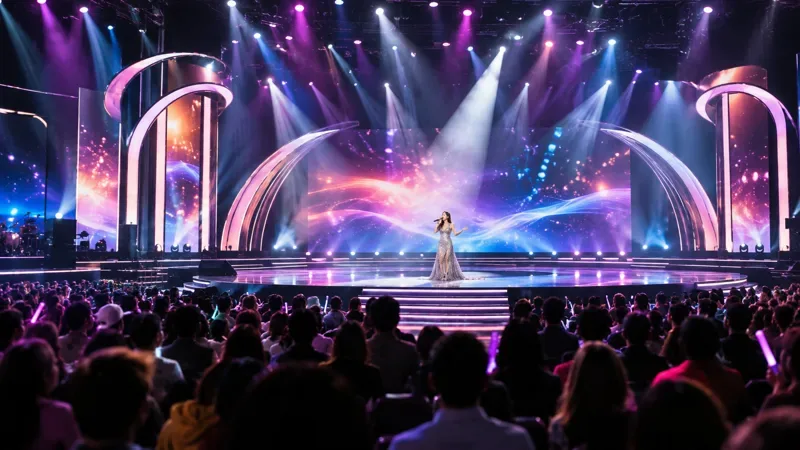
Illustrative image of a televised international song contest stage; not a photograph from Eurovision Asia 2026.
Which countries participated in Eurovision Asia 2026?
The final roster comprised Bangladesh, Bhutan, Cambodia, Laos, Malaysia, Mongolia, Nepal, the Philippines, South Korea, Thailand and Vietnam. The European Broadcasting Union initially announced 10 countries in March; Mongolia appeared in the subsequently confirmed 11-country lineup. This distinction matters because older preview articles and early promotional material may not reflect the final participants. The official running order was published October 29, and all 11 songs had been revealed by October 19.
Order
Country
Performer
Song
1
Vietnam
Tóc Tiên
EM TIÊN
2
Cambodia
Monetrey
I Let You Go
3
Laos
Thinla
BAE
4
Mongolia
Beck
Chamguigeer (Without You)
5
Bhutan
Nyendra
Lhayi Semo
6
Philippines
CARMELLE
Sobra-Sobra
7
Bangladesh
Beatmosphere
Tumi Ele
8
Thailand
MANG x DAOU
Aroma
9
South Korea
JUNHEE
DEEP DIVE
10
Nepal
Pratik Himal Rai
Ananta Maya
11
Malaysia
Aina Abdul
Bluest Sky
Vietnam opened the broadcast, while Malaysia performed last. This was a pan-Asian contest rather than an invitation-only event for countries that participate in the European competition. The lineup brought together music markets with very different sizes, broadcast networks and performance traditions. Artists performed songs in regional languages and English, illustrating the event's aim of presenting varied musical identities on the same stage. See the official running order for the confirmed sequence.
How did the Eurovision Asia 2026 format work?
National selection shows came before the grand final
Each participating country selected its representative through a national selection process rather than simply entering a song chosen by the central organizer. Those shows ran from August through October. Some selected an artist, others selected a song for an established performer, and the voting arrangements could differ by national selection. For example, Vietnam's national selection awarded 40% of its score to a professional jury, 40% to viewers in Vietnam and 20% to viewers elsewhere. That national-selection formula should not be confused with the separate voting rules used in the Bangkok final.
How were the winner and points decided?
The grand final featured 11 competitive performances in a single broadcast. The official Eurovision Asia voting rules assigned 50% of the overall result to the 11 national juries and 50% to the audience. Public voting included a Rest of the World allocation, equivalent to another country's set of audience points. Each voter was offered eight free votes, to be spread across at least three songs; additional paid votes were subject to a limit. People in participating countries could not vote for their own national entry.
Scores followed the familiar Eurovision-style distribution: 1 through 7 points, followed by 8, 10 and 12 points for the highest-ranked songs. This structure made the show accessible to Eurovision fans while allowing countries outside Europe and international viewers to influence the result. The distinction between 11 sets of jury points and 12 audience allocations is central to understanding how a song could appeal differently to experts and the public.
Where was Eurovision Asia held, and how could Australians watch?
The show was held at One Bangkok Forum in Bangkok, Thailand, and was presented by Woody Milintachinda and Cindy Bishop. Thailand's Channel 3 served as host broadcaster in collaboration with Voxovation and production partners. The EBU described the show as roughly two and a half hours long, with special guest performances from Eurovision 2026 champion DARA and Thai performer Jeff Satur.
Fans across the world were able to watch the free official Eurovision Song Contest YouTube stream. Local television coverage was available through participating broadcasters, including Thailand's Channel 3, Vietnam's VTV3, Malaysia's TV3 and South Korea's ENA. The event's official viewing guide also identified SBS Australia among international broadcast partners. Australian viewers looking for a replay should check the official Eurovision channels and SBS programming listings for current access rather than assuming that the original live broadcast remains available indefinitely.
What did the inaugural result show, and what happens next?
The Philippines' victory provides the first concrete indication of how the contest's hybrid jury-public system can reward a song that crosses language and national boundaries. However, a single edition cannot establish which genres or markets will consistently dominate. Thailand's runner-up finish and Vietnam's third place are outcomes, not reliable forecasts for any subsequent contest. The event's international free stream and region-spanning voting also created a possible avenue for artists to find audiences outside their home markets.
For the organizers, the more important longer-term tests are whether participating broadcasters renew their commitments, whether audience demand supports another edition and whether the contest can maintain transparent voting and credible production standards. As of this information check, no independently verified date, host city or finalized list of countries for a subsequent edition has been established in the sources used here. Any forecast about a 2027 event is therefore conditional, not a confirmed announcement.
The first year's confirmed operational milestones include a host city, published artist roster, national selections, a clear points framework and an internationally accessible final. That makes Eurovision Asia 2026 a useful case study in how the established Eurovision model can be adapted to a larger, linguistically diverse region without simply duplicating the European contest.
FAQ: Eurovision Asia 2026
Who won Eurovision Asia 2026?
CARMELLE of the Philippines won the inaugural contest with “Sobra-Sobra.” The result was reported after the November 14 grand final by the Associated Press.
How many countries competed?
Eleven countries competed: Bangladesh, Bhutan, Cambodia, Laos, Malaysia, Mongolia, Nepal, the Philippines, South Korea, Thailand and Vietnam.
Could viewers outside Asia watch and vote?
Yes. The contest offered a worldwide YouTube livestream and an international online audience vote. Public voting formed half of the result, with rules including eight free votes per user distributed across at least three songs.