Home
» Today
»
FAA Nationwide Ground Stop Lifted: U.S. Flight Disruptions Continue — November 14, 2026
FAA Nationwide Ground Stop Lifted: U.S. Flight Disruptions Continue — November 14, 2026
Checked: November 14, 2026, 04:03 AM UTC (UTC+00:00). The Federal Aviation Administration (FAA) has lifted the nationwide ground stop it imposed across the United States on Friday, November 13, 2026, after a widespread air traffic control telecommunications disruption. The U.S. airspace shutdown ended at approximately 8:15 p.m. Eastern Standard Time (EST, UTC−05:00) on November 13, or 1:15 a.m. UTC on November 14. However, the resumption of departures does not mean airline schedules have returned to normal.
The extraordinary halt prevented departures from U.S. airports for hours and disrupted aircraft, crews, and passengers across North America. Officials described unstable communications involving air traffic control facilities and aging network equipment; the technical cause remains subject to investigation. For passengers in Canada, the main question now is whether individual U.S.-bound flights, connections, or returning aircraft are operating as scheduled—not whether the original national order remains in force.
Destaques
The nationwide FAA ground stop began on November 13 and was lifted at about 8:15 p.m. EST (UTC−05:00), equivalent to 1:15 a.m. UTC on November 14.
Officials attributed the immediate safety response to instability in air traffic control telecommunications. A final technical investigation has not been published.
U.S. airline cancellations and delays may continue while planes and crews are repositioned; the lifting of the FAA order is not an individual flight confirmation.
Canada–U.S. passengers should check their airline directly and review rebooking or refund options before heading to the airport.
Is the FAA nationwide ground stop still in effect?
No. The FAA lifted the nationwide order on the evening of November 13. U.S. Transportation Secretary Sean Duffy said air traffic control facilities were able to resume operations after testing and restoration efforts. The agency's action reopened the ability to depart, subject to traffic management and airline readiness. Individual airport restrictions or new delays can still occur independently of the cancelled nationwide order.
The FAA's original order told departing traffic to remain on the ground and said incoming international operations would be handled case by case. Aircraft already airborne were managed under established air traffic control procedures rather than being automatically ordered to land immediately. The national safety measure followed communication problems at facilities responsible for aircraft travelling between airports, not a reported weather system affecting every U.S. region simultaneously.
For a current airport-by-airport picture, use the FAA National Airspace System Status page. It is a source for federal traffic-management conditions, not a substitute for the airline's confirmed flight status or boarding instructions.
What caused the November 13 FAA ground stop?
The immediate trigger was a telecommunications problem involving U.S. air traffic control facilities. During the November 13 briefing, federal officials described older communications hardware and networking devices that became overloaded and began producing inconsistent data. They said the nationwide shutdown was a precaution taken while controllers and technicians worked to ensure safe flight operations. Those statements are an account of the operational failure, not a completed independent root-cause report.
Homeland Security officials said there was no indication of a malicious cyberattack at the time of their briefing. That statement should not be presented as proof that every technical or investigative question has been resolved. Officials have also discussed the need to modernize older components of the national air traffic control network. The verified fact remains that communications instability prompted a safety response on November 13; precise responsibility and prevention measures require follow-up documentation.
How many flights were cancelled or delayed?
Flight-tracking data cited in reporting on the November 13 disruption showed thousands of U.S. cancellations, with additional flights delayed or diverted. Different counts can reflect different reporting cutoffs and whether a source measures cancellations, diversions, or delays. For that reason, a snapshot from Friday should not be treated as a live Saturday total. The FAA's decision to allow departures again did not instantly place airline crews, aircraft, and available departure slots back in their planned positions.
Airlines must rebuild flight rotations after an extensive pause. A plane delayed at one airport can miss later departures at several others, while crews may approach duty-time limits or be unable to reach their next assignment. Some flights may operate later than scheduled, some may be consolidated or cancelled, and the timetable for recovery will vary by carrier and airport. A complete nationwide recovery estimate had not been independently verified at this check.
What does the ground stop mean for Canadian flights and U.S. connections?
Canada–U.S. services were directly exposed because many aircraft cross the border and then continue onward to U.S. domestic destinations. Air Canada was reported to have cancelled remaining Canada–U.S. flights on Friday during the disruption. That historical cancellation decision does not establish the status of its Saturday schedule, or the status of any particular Air Canada, WestJet, United, Delta, American, or other carrier flight.
Passengers whose journeys begin in Canada should confirm both the first flight and any onward U.S. connection. A flight displayed as operating may still have a changed departure time, gate, aircraft, or connection arrangement. Travellers with separate tickets should be especially careful because a missed second booking may not be protected in the same way as a single through-ticket.
What should passengers do after the FAA ground stop is lifted?
Check the operating carrier's app or website: verify the exact flight number and travel date, including any connecting flights, before leaving for the airport.
Review the carrier's disruption notice: airlines may publish special change-fee waivers, rebooking windows, and eligibility rules. Keep a copy of the offer relevant to your ticket.
Ask for a confirmed itinerary: if rebooked, verify all legs and check-in requirements rather than assuming a waitlist means a seat is secured.
Preserve records: retain cancellation messages, receipts, and the reason the airline gives for the disruption in case a refund or complaint is necessary.
Are refunds or compensation available for cancelled flights?
Rights depend on the itinerary, applicable jurisdiction, airline, and cause of the disruption. The Canadian Transportation Agency's rules cover flights to, from, and within Canada, including connecting itineraries. Under the rules for disruptions outside an airline's control, carriers must generally seek a confirmed booking on their own or a partner airline within 48 hours of the original departure; if they cannot provide one within that period, passengers must be offered a choice of refund or rebooking under the applicable provisions. Not every disruption creates an entitlement to cash compensation for inconvenience.
For flights subject to U.S. Department of Transportation refund rules, passengers whose flights are cancelled or significantly changed and who decline alternatives may qualify for a refund regardless of the reason for cancellation. Consult the U.S. DOT refund guidance and the operating carrier's written notice. A mandatory refund is distinct from discretionary meal, hotel, or inconvenience payments.
What happens next for U.S. air travel?
The immediate priority is clearing the backlog safely. Travelers should expect the possibility of rolling changes as airlines assess aircraft positioning, crew availability, and airport capacity. Further official findings may clarify which equipment failed, how the network was restored, and whether additional safeguards are required. Until those findings are released, theories attributing the shutdown to a cyberattack, a specific new software system, or a single undisclosed actor should not be treated as established facts.
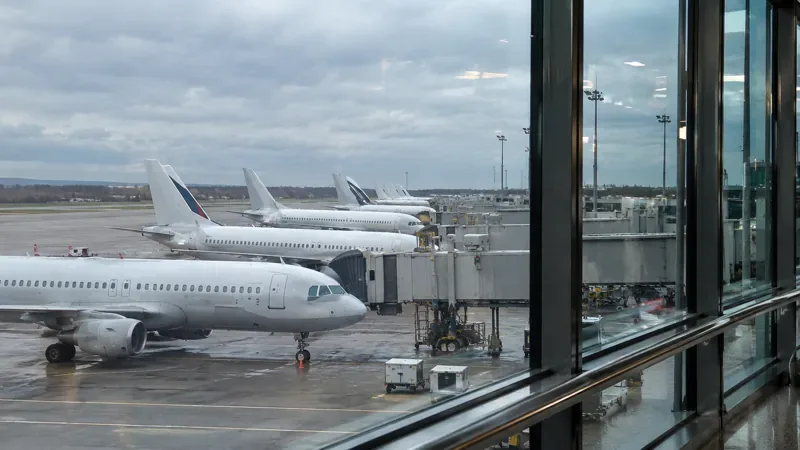
Illustrative, AI-generated airport scene showing parked commercial aircraft. This is not a photograph of the November 13, 2026 FAA disruption.
FAQ
Did the FAA ground all U.S. flights on November 13, 2026?
The FAA ordered a nationwide halt to departures as a safety precaution. Aircraft already in flight continued under air traffic control guidance, and inbound international flights were handled case by case.
What time was the nationwide ground stop lifted?
Approximately 8:15 p.m. on November 13 in U.S. Eastern Standard Time (UTC−05:00), or 1:15 a.m. UTC on November 14, 2026.
Are flights back to normal now?
The nationwide order is over, but airline-level cancellations, delays, and rebooking can continue. Check your specific flight directly with its operating airline.