Make Realistic Fake Blood Without a Cleanup Surprise

Mix a glossy prop-only fake blood batch, choose safer products for skin and costumes, and test cleanup before Halloween night.
A mouse helps you use your computer efficiently. But when something goes wrong, it can be a source of frustration and annoyance.
The scroll wheel has been a feature of mice since the mid-1990s. It's an important feature for interacting with operating systems, applications, and games. But when your mouse wheel malfunctions and starts scrolling incorrectly, what can you do to fix it?
Table of Contents
Surprisingly, the majority of mouse scrolling problems are caused by dust.
Dust collects in the area around the scroll wheel, interfering with the sensor and preventing accurate scrolling. But the good news is that you can easily clean the dust out of your mouse. Simply pick up the mouse and blow hard into it to get the dust out. In most cases, this will be enough to push the dust out, resulting in smooth scrolling again.
Note : You can use a can of compressed air to do this job.
If the above doesn't work, then the problem may be the power supply rather than the dust. This is especially likely if you're using a wireless mouse instead of a wired USB mouse.
To make sure the battery has enough charge to function properly, open the mouse, remove the battery, and try it on another device. Also, test it with the charger if available. Batteries with a charge above 30% should still work fine, although you should consider replacing the battery as soon as possible.
Once you have a fully charged or fresh battery, try your mouse again. Hopefully any scrolling errors you were experiencing should now be gone.
Sometimes, inconsistent scrolling — such as skipping too many lines at once or not scrolling as many lines as expected — can be caused by incorrect settings in Windows. These settings control how the mouse wheel works and can be easily adjusted to suit your preferences. Here's how to access them:
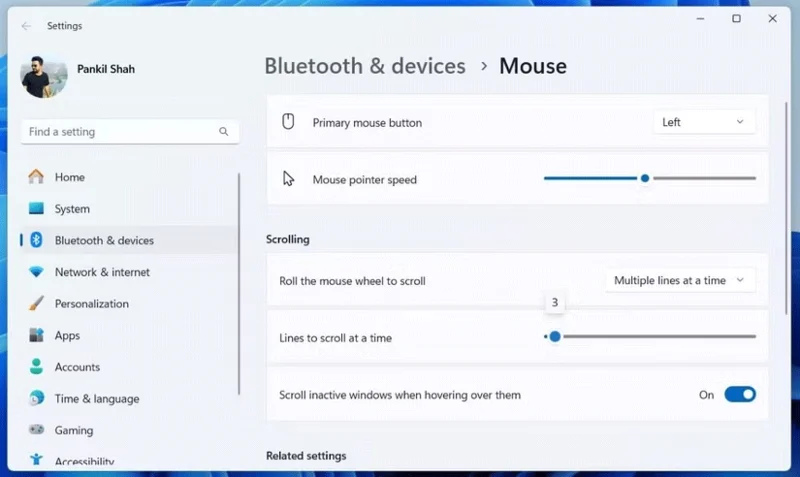
After adjusting your scroll settings, go back to the browser, word processor, or application where you experienced jerky scrolling and test it. If scrolling still feels choppy, you may need to tweak the sliders further to get the right results.
See also: How to change mouse settings in Windows if needed.
Whether you're using a wireless USB mouse or a wired device, swapping USB ports on your PC or laptop can make all the difference for scrolling issues.
Most computers have both USB 2.0 and USB 3.0 ports . Swapping from one type of port to the other can help a lot here. Also, if you're using a USB hub , remove it from the equation if possible and connect your mouse or its receiver directly to your computer.
Try your mouse wheel again - hopefully it will work again.
Device drivers can become corrupted or conflict with other drivers. These issues are often resolved by updating the driver . If you're using Windows 10, this is easy to do:
If this was the cause of the error, your mouse wheel should now work properly.
You may find that your mouse wheel only misbehaves in specific applications, such as a browser or word processor, or even in a video game.
Regardless of the application, if you've updated your mouse driver and the issue hasn't improved, consider updating the application in question.
Updating apps will vary by software. You'll usually find a link to the update page in the About menu , which will help you update the software if there's no download link. For video games, use a digital distribution service (e.g. Steam) to update your software.
Windows 10 users may find that Tablet Mode interferes with mouse operation, which can affect scrolling speed.
In many cases, you may not even realize that Tablet Mode is running (it's not a feature on desktops or laptops). To turn off Tablet Mode on a Windows 10 tablet or desktop PC:
Smooth mouse wheel scrolling should now work again.
Good luck in fixing the error!
Mix a glossy prop-only fake blood batch, choose safer products for skin and costumes, and test cleanup before Halloween night.
Create a gentle Halloween look with pastel colors, friendly ghosts, easy no-carve accents, and practical safety tips for your home.
Create a spooky office cubicle with Halloween desk decor ideas that keep your workspace usable, tidy, and mindful of workplace safety.
Plan a recognizable Halloween 2026 look with pop culture costumes inspired by Spider-Man, Supergirl, Toy Story 5, Moana, Mario, and Wednesday.
Sort leftover Halloween candy safely, share or repurpose sealed treats, and choose food use or compost for pumpkins based on their condition.
Compare workplace Halloween costume choices by respect, dress code, mobility, and safety—and learn when a subtle accessory or a policy check is the better option.
Find a couples costume that fits your style, budget, and comfort level, from Addams Family classics to original inside-joke duos.
Need a last-minute high school Halloween costume? Compare 10 easy closet-based ideas by prep time, comfort, school-day practicality, and simple safety checks.
Use a simple 2026 Halloween decorating timeline for indoor décor, outdoor displays, and fresh pumpkins, with practical adjustments for weather and events.
Mix five vivid, approachable Halloween cocktails with measured recipes, simple prep tips, and an alcohol-free option for your party guests.